Octane Files
Explore CarsCizeta V16T

Cizeta V16T

Overview

The story usually told about the Cizeta is that it is the Lamborghini that got away. That is close enough to be misleading. What actually happened is that Marcello Gandini drew a Diablo for Lamborghini, Chrysler took ownership and had Tom Gale's studio smooth it into the car that reached production, and Gandini took his rejected shape elsewhere. Elsewhere was Claudio Zampolli, a former Lamborghini test and development engineer who had moved to Los Angeles and built a business servicing other people's exotics.

Zampolli wanted an engine nobody else had. He got a 6.0-litre V16: one aluminium block, four cylinder heads, eight camshafts, 64 valves, mounted across the car with gearing in the middle of the block feeding a single output to a five-speed ZF transaxle. The T in the name is for transversale.

His partner was Giorgio Moroder, the composer, who put in half the money and had a Countach serviced at Zampolli's shop. The car was unveiled in Los Angeles on 5 December 1988, hosted by Jay Leno, with a Moroder composition written for the evening. Moroder was gone before production started.

Distinctions

The defining attributes and collector status that make this car garage-worthy.

Octane Files Select
Renowned for its history, engineering, or cultural weight.

Collectibility scorecard

Rated 1 to 10 on the traits that matter for owning, driving, and holding on to a car like this.

Desirability
8/10
Rarity
10/10
Driving thrill
7/10
Investment trajectory
7/10
Usability
2/10
Ease of restoration
1/10
Cultural impact
6/10
Electronic dependence
Fully analogHeavily electronic

The V16 is fuel-injected and runs electronic ignition, but in a distinctly 1980s way: early cars used Bosch K-Jetronic, and later cars a bespoke management system built in Bologna by engineers who had come out of Weber-Marelli. The engine carries two injection systems and four distributors because it is effectively two eights sharing a block. Beyond that there is very little. No ABS, no traction control, no stability system, no electronic damping. The steering is a power-assisted ZF rack, the gearbox a five-speed manual transaxle, and the driver has no software between the pedal and the crankshaft.

Market data

Demand tier, price trend, and typical values by condition. Our own assessment, not a quoted valuation.

Demand tier
EntrySolidHighBlue-chip

Strong, sustained collector demand. Good examples never wait long for a buyer.

Value trajectory
AppreciatingStableCooling

Values are holding steady. What you pay today is what it's worth tomorrow.

Price by condition
Driver
Excellent
Concours

No price band is published here, because eleven cars cannot generate one. The verified public record consists of a small number of appearances by the same handful of cars. Chassis 001, the 1988 Cizeta-Moroder prototype, sold at RM Sotheby's in Phoenix in January 2022 for USD 1,363,500 against an estimate of USD 900,000 to 1,200,000, notable as the first collector car offered with an accompanying NFT package. The same car returned to RM Sotheby's at Monterey in August 2026 at USD 1,450,000 and did not find a buyer. A 1993 coupe, one of the three Brunei cars, sold at RM Sotheby's Monterey in August 2024. Original list was around USD 300,000 in 1991, quoted at USD 650,000 for a coupe and USD 850,000 for the Spyder by 2006. Transactions are sporadic by definition: with this many cars, a year with two public sales is a busy year.

Buyer's guide

What anyone seriously considering this car should know first.

Why it's worth it
The transverse V16 that nobody else has attempted
Callout
A 6.0-litre V16 mounted sideways, with the drive taken out of the middle of the block
What to watch for
Buy the history first, because there is no mechanical safety net. The V16 is unique to this car: two fuel-injection systems, four distributors, sixteen spark plugs, eight camshafts and gearing between the two halves of the block. Nothing about it can be diagnosed by analogy with something else, and Claudio Zampolli, who designed the company, sold the cars and knew them individually, died in July 2021. That makes the paperwork trail more valuable than usual. With so few cars, each one is known: where it was built, whether it came out of Modena or Fountain Valley, and who has looked after it. Three went to the Brunei royal family through Hong Seh Motors in Singapore and sat in Asia for decades, so a low-mileage car with a long static period is a real possibility and a real risk. Ask when the engine last ran properly, and what was done to make it run. Ask who did the work, since the list of people who have been inside one is short. A cheap Cizeta does not exist, but an expensive one that has not turned a wheel in fifteen years certainly does.

The Story

Driving character

Everything follows from the engine being sideways. The V16T is over two metres wide, and the driving position sits well inboard with a huge shoulder of car on either side, which makes placing it on a road an act of faith and makes it feel enormous even by supercar standards. The engine itself is the reason to be there. It makes 540hp at 8,000rpm and 540Nm at 6,000, so unlike the big-torque Americans of the era it wants to be revved, and sixteen small cylinders through four camshaft drives produce a noise no V8 or V12 makes. It is a higher, busier, more metallic sound than a Lamborghini V12, and it climbs. The gearbox is a five-speed ZF transaxle taking drive from the centre of the block rather than from either end, an arrangement that exists nowhere else. The claimed top speed is 328km/h and the claimed 0 to 100km/h is four seconds. Both are claims from a company that built eleven cars, and the engine, not the stopwatch, is the point.

Design

The front is Gandini's, and it is the same nose he had drawn for the Diablo before Chrysler intervened. Four pop-up headlamps in two pairs, a low sharp prow, and the hard-edged wedge geometry he had been refining since the Countach. Zampolli reworked the rear himself, so the car is not a pure Gandini object, and the join between the two sensibilities is visible if you look for the point where the sharp lines soften. The proportions come from the packaging. A transverse V16 with the gearbox in line behind it dictates a car more than 2 metres wide and around 4.5 metres long, which in 1988 was extreme and today still reads as excessive. Bodies for the Modena cars were built by Giancarlo Guerra, whose earlier work included coach-building the Ferrari 250 GTO. That detail says more about how the V16T was made than any spec sheet: hand-formed panels, on an Italian scale, for a company financed by an exotic-car mechanic and a disco producer.

Motorsport pedigree

The V16T never raced, and it was never going to. Homologation for any GT category of the era needed a production run the company could not remotely supply, and Cizeta's total output over twelve years would not have filled half a grid. The firm had no competition department, no budget and no engine spare to develop. The people behind it did have racing form, which makes the absence more pointed. Zampolli had been a test and development engineer at Lamborghini. Oliviero Pedrazzi, who designed the V16, had come from the same place, as had Achille Bevini and Ianose Bronzatti on suspension and chassis. Their collective experience was in making road cars work, at a firm that had famously refused to go racing under Ferruccio Lamborghini, and the Cizeta inherited that outlook wholesale. So the V16 was built as a showpiece rather than a competition unit: an 8,000rpm road engine designed to be unrepeatable rather than to be developed over seasons. What Cizeta was chasing was not a trophy, it was the fact of the engine, and no race result would have made that argument any better.

In culture

The Cizeta's cultural life is inseparable from Giorgio Moroder, which is unusual for a car nobody has driven. The producer behind Donna Summer, Midnight Express, Scarface and Top Gun put up half the money, lent the car half its name and wrote a piece of music called A Car is Born for the Los Angeles unveiling on 5 December 1988, an evening hosted by Jay Leno. For a brief moment the V16T was a Hollywood object rather than an Italian one. Then it vanished. Eleven cars cannot sustain a public profile, and the car's reputation since has been built almost entirely by writers rediscovering it, usually under some variation of the Lamborghini that got away. The one enduring cultural fact is the Brunei connection. Three V16Ts were ordered by the Brunei royal family through Hong Seh Motors in Singapore, which places the Cizeta in the most famous private collection of the 1990s, alongside the other cars that only made sense to people for whom money was not a constraint.

Rivals

Cars from other manufacturers that competed for the same buyers when new.
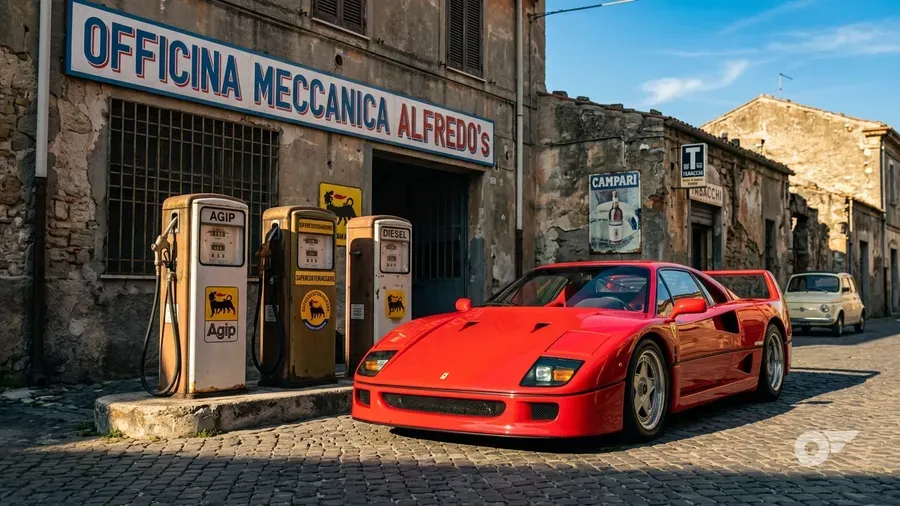
Ferrari F40

Ferrari F40

Italy·Exotic·1987–1992

Owning One

Why collectors want it

Eleven cars, on Wikipedia's count, over twelve years and two continents. That alone would make the V16T rare. What makes it collectible is that it is the only place the engine exists. Nobody before or since has put a transverse V16 in a road car, and nobody is going to, so a Cizeta is not a rarer version of something else the way most low-volume supercars are.

The Gandini provenance is the second pillar. The nose is his rejected Diablo, built the way he meant it, and the Diablo that reached showrooms is the compromised version. Collectors who care about that argument know exactly which car settles it.

The hierarchy inside the run is unusually clear. Chassis 001, the 1988 prototype and the only car ever badged Cizeta-Moroder, is the halo: Moroder kept it for over three decades and it made USD 1,363,500 at RM Sotheby's in Phoenix in January 2022. Below it sit the Modena-built coupes from 1991 to 1995, then the handful finished in California, and the single Spyder of 2003 stands apart as a one-off within a one-off.

Which one to look for

Three groups, and they are not equally desirable. Chassis 001 is the 1988 prototype, the only car wearing the Cizeta-Moroder badge, kept by Moroder himself until 2022. It is the reference car and it is priced accordingly. Then the Modena cars, built between 1991 and 1995 with bodies from Giancarlo Guerra, who had coach-built the Ferrari 250 GTO. Wikipedia records eight cars including the prototype from this period, which is the largest single group and the one most buyers will encounter. Last, the California cars. After the Modena operation closed, Zampolli moved to Fountain Valley and finished three more between 1999 and 2003: two coupes and one Spyder. The Spyder is the connoisseur's pick and the rarest single body style in the marque, and it was listed at USD 850,000 in 2006 against USD 650,000 for a coupe. Treat every count with care. Wikipedia says eleven cars in total including the prototype and the Spyder, RM Sotheby's says nine production cars plus the prototype, and other sources say twelve. The car you are looking at matters more than the total.

Cizeta-Moroder V16T · 1988

Chassis 001, the prototype and the only car ever badged Cizeta-Moroder. Unveiled in Los Angeles on 5 December 1988 with Jay Leno hosting and a Moroder composition written for the evening. Giorgio Moroder kept it for over three decades. It is the reference car for the whole marque and the one that fixes what Gandini's rejected Diablo nose actually looked like.

V16T Coupe · 1991–2003

The production car. Bodies for the Modena-built cars were made by Giancarlo Guerra, who had coach-built the Ferrari 250 GTO. After the Modena operation closed in 1995 Zampolli moved to Fountain Valley, California, and finished two more coupes there in 1999 and 2003. Same 6.0-litre transverse V16 and ZF five-speed transaxle throughout.

V16T Spyder · 2003

One open car, built in California and the last Cizeta completed. Mechanically as the coupe. Listed at USD 850,000 in 2006 against USD 650,000 for a closed car, which is the clearest published statement of what the marque thought the body style was worth.

What owning one is like

There is no such thing as routine maintenance on a Cizeta, only planned work. The V16 is the whole ownership experience: sixteen plugs, four distributors, eight camshafts and two injection systems mean that a full service is a project rather than an afternoon, and the number of people who have done one is small enough to name. The good news is that the engine is not fragile in principle. It is an aluminium block with four heads built by ex-Lamborghini engine men, and the cars that have been used report no structural weakness peculiar to the layout. What hurts is disuse. Most of the eleven have spent long periods static, and static is what kills fuel systems, seals and rubber. Width is the daily reality. At over two metres, the car does not fit ordinary parking and needs judgement on a British or Italian road. And every owner is, whether they like it or not, part of the support network, because with a car this rare, the shared knowledge between the known owners is the only technical resource that exists.

Upkeep & parts

Plan on fabrication rather than supply. There is no parts catalogue for a V16T, no reproduction trim, and nothing that can be ordered from a shelf beyond the ZF transaxle internals and the general Italian supercar consumables of the era. Anything specific to the car, from the injection hardware to the pop-up lamp mechanisms and the panels, will be made or repaired rather than replaced.

Cizeta Automobili still exists in name, and the American operation maintains a public presence, which matters because it is the only continuity back to the people who built the cars. Claudio Zampolli's death in 2021 removed the single most important source of knowledge, so anything documented while he was alive is worth having.

There is no owners club and no registry. The most substantial reference work is the pictorial history of the marque published as a book, which is where the chassis-by-chassis story of these cars has been assembled. Budget for specialist labour at Italian supercar rates and for long waits, and treat any car with a recent, documented engine service as worth a real premium.

Country of origin
Italy
Class
Exotic
Production years
1991–2003
Units built
~11
Model
V16T
Nickname
No nickname ("Cizeta-Moroder" names the 1988 prototype specifically, not the generation)
Body
Coupe, Spider
Layout
Mid-engine, RWD
Engine
6.0L 64-valve V16 (540hp)
Transmission
5-speed ZF S5-42 manual transaxle
Designer
Marcello Gandini