Octane Files
Explore CarsSaab Sonett I

Saab Sonett I

Overview

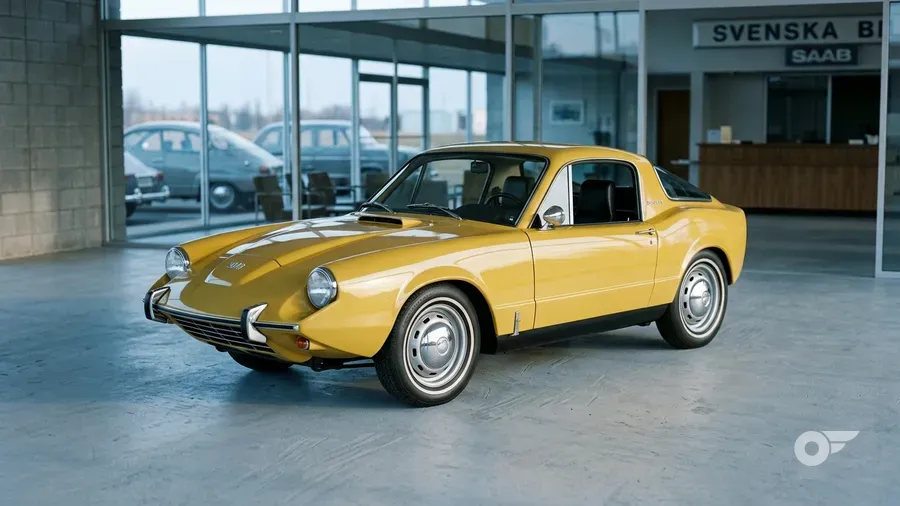
Saab's first sports car was never a company product. It was four engineers, a rented barn in Åsaka outside Trollhättan, and a board with no appetite for a two-seater. Rolf Mellde started sketching in 1954, was given permission to build one in his own time rather than money to do it, and had the car finished in the autumn of 1955. What emerged was strange even by Saab standards. The chassis was a riveted stressed-skin aluminium box weighing under 70 kg, put together the way Saab put together aircraft fuselages, and over it went a hand-laid glassfibre body. The 93's longitudinal three-cylinder two-stroke and its gearbox were turned through 180 degrees, so the engine sat behind the front axle line and still drove the front wheels. Tuned to 57.5 hp against a dry weight of 500 kg, it was pointed squarely at international small-capacity sports car racing. Saab showed it at the Stockholm Bilsalong on 16 March 1956 as the Sonett Super Sport, talked about building 2,000 a year, then watched the rulemakers open those classes to tuned production saloons. Six cars were built. All six still exist.

Distinctions

The defining attributes and collector status that make this car garage-worthy.

Octane Files Select
Renowned for its history, engineering, or cultural weight.

Collectibility scorecard

Rated 1 to 10 on the traits that matter for owning, driving, and holding on to a car like this.

Desirability
8/10
Rarity
10/10
Driving thrill
6/10
Investment trajectory
5/10
Usability
1/10
Ease of restoration
2/10
Cultural impact
4/10
Electronic dependence
Fully analogHeavily electronic

Nothing on this car is electronic in any modern sense. Fuelling is by a special twin-choke carburettor built for the project, ignition is coil and points, and lubrication is oil mixed into the petrol rather than metered by anything. There is no fuel injection, no engine management, no servo assistance and no driver aid of any kind. The freewheel, the only piece of automatic behaviour in the drivetrain, is a purely mechanical device that disengages on a closed throttle. The electrical system is there to make sparks and run the lights, and that is the whole of it.

Market data

Demand tier, price trend, and typical values by condition. Our own assessment, not a quoted valuation.

Demand tier
EntrySolidHighBlue-chip

The proven elite. Values are established, liquid, and defended at every auction.

Value trajectory
AppreciatingStableCooling

Values are holding steady. What you pay today is what it's worth tomorrow.

Price by condition
Driver
$250k
Excellent
$400k
Concours
$600k

No Sonett I has ever traded publicly. All six are accounted for, two in the Saab Car Museum at Trollhättan and the rest in private and corporate collections, and there is no auction record, no dealer sale and no published valuation for the model anywhere. The band below is therefore an editorial estimate rather than a figure drawn from comparable sales, and it should be read that way. It is anchored on the nearest thing to a comparable that does trade, the Volvo P1900, the other Swedish glassfibre sports car of 1956-57, built in 68 examples and offered in recent years around the equivalent of 120,000 dollars. A six-car works prototype with a Stockholm show history and a national speed record sits well above that, but how far above is untested. The tier is Blue-chip on rarity and significance rather than on money changing hands, and the trajectory is stable because nothing trades to make it anything else.

Values as of August 2026.

Buyer's guide

What anyone seriously considering this car should know first.

Why it's worth it
Saab's first sports car, and the origin of the Sonett name
Callout
Built in a rented barn, in the team's own time, without the board's blessing
What to watch for
Buying one is a matter of waiting for a collection to break up, not of shopping. None of this is a normal inspection, so the work starts and largely ends with provenance. There are six cars, numbered one to six, and any candidate has to place itself in that list with paperwork the club and the SaabSonett.org registry can corroborate. The structural question comes next, and it is the one real distinction between cars: prototype number one carries the riveted aluminium tub, while the five built in spring 1957 use sheet steel, so the repair history you are reading means different things depending on which car you are standing in front of. The glassfibre was laid by hand off the prototype and every panel is effectively unique, which makes how a previous repair was done far more important than whether one exists. Mechanically the news is better than the rest of it suggests. The two-stroke triple, the gearbox and most of the running gear come from the Saab 93, a supported car with a live parts trade. What cannot be bought at any price is the tub, the body or the special carburation, and a car missing any of those is a fabrication project wearing a price tag.

The Story

Driving character

Nothing in the numbers prepares you for the proportions. The car is 3,485 mm long and 825 mm tall, weighs 500 kg dry, and makes 57.5 hp from 748cc, which is over 100 hp per tonne in 1956. The factory quoted 0 to 100 km/h in about 12 seconds, which reads slowly now and read quickly then for something with three cylinders and no fourth stroke. The engine is the whole character. A Saab two-stroke triple runs on petrol with oil mixed into it, fires three times per revolution, and makes the hard flat ringing note that Swedish rally crowds spent the next decade learning to recognise. There is a freewheel, which every Saab two-stroke of the period needed to keep oil reaching the pistons on a closed throttle, so the car coasts when you lift instead of slowing. Drive goes to the front wheels with the engine sitting behind the axle line, which takes weight off the nose that no later front-drive Saab managed to lose. Saab projected 190 km/h and its own press material claimed 200 with a closed body. Neither was ever proved, and the only measured figure on record is Carlsson's 159.4.

Design

Sixten Sason gave the car its shape and its name. The name came close to first: Sonett is drawn from the Swedish så nätt den är, roughly how neat it is, which Saab management rejected before accepting it in October 1955. The shape is what a designer does with a structure he cannot hide. At 825 mm overall the car stands about waist high, with a rounded nose, cut-down sides and none of the chrome and scallops that American and British sports cars were piling on in 1956. The most interesting design decision is not visible at all. Mellde's tub is a riveted stressed-skin aluminium box built to aircraft practice, under 70 kg, with the engine and suspension hung directly off it, and every line of the body sits where that structure allows rather than where a stylist would prefer. Sason worked with it rather than around it. All six cars were right-hand drive, which Saab's own saloons were not. Put the Sonett I beside a Saab 93 and the family resemblance is faint. Put it beside something Saab built to fly and it makes considerably more sense.

Motorsport pedigree

This car exists because of racing and it barely got to race. Mellde built it for the international small-capacity sports car classes, where 500 kg and 57.5 hp would have counted for something, and Saab planned 2,000 cars a year to satisfy the numbers. Then the rules for 1958 opened those classes to tuned production cars, which meant a manufacturer could go racing with a modified saloon instead of a purpose-built two-seater. The Sonett's entire reason for existing evaporated in a rulebook. Competition appearances were limited mostly to Swedish events during 1957, and there is no international result to point at. What happened instead matters more to Saab's history: the effort went into the 93 and the GT750, and from there into rallying, where Erik Carlsson turned a two-stroke saloon into one of the great competition reputations of the 1960s. The Sonett did get its moment, four decades late. In September 1996 Carlsson took the restored prototype out and set a Swedish record in the class for cars up to 750cc at 159.4 km/h, doing on a measured run what the car had been built to do in 1956.

In culture

The Sonett's cultural footprint is small, Swedish and durable. There are no film credits and no chart appearances. What there is instead is a founding story Saab people have retold for seventy years: engineers building a racing car in a rented barn in Åsaka, off the books, because the company would not pay for one. That story has done more for Saab's self-image as an engineering culture than any advertisement the company ever ran. The name outlived the car by a long way. Sonett came from a Swedish phrase about how neat the thing was, and when Saab revived it for a production coupe in 1966 this car was retroactively relabelled the Sonett I, which is how it has been known ever since. Club Sonett Sweden, founded in 1981, still treats it as the start of the line. Two of the six sit in the Saab Car Museum at Trollhättan and one is in the American heritage collection, so owners of far more numerous Sonett IIIs do occasionally get to stand next to the original.

Rivals

Cars from other manufacturers that competed for the same buyers when new.
Owning One

Why collectors want it

Collectibility here is not really a market question, because there is no market. Six cars were built and all six are accounted for, two of them in the Saab Car Museum at Trollhättan. What makes them matter is what they are: the first Saab designed to be fast rather than sensible, and the clearest surviving evidence of what happened when Saab's aircraft engineers were let loose on a car with no product plan to answer to. The riveted alloy tub, the reversed drivetrain and the glassfibre shell were not styling exercises. They were an aeroplane company solving a car problem its own way, years before Saab had any competition reputation at all. Every Sonett that followed, and by extension the whole idea that Saab built driver's cars, traces back to this one. The hierarchy inside the six is short and obvious. Prototype number one is the car the team actually built in the barn, the only one with the aluminium chassis, and the one Erik Carlsson drove to a Swedish class record forty years later. The five cars finished in spring 1957 are its copies. If one ever came loose from a collection it would set the Saab record on the first bid.

Which one to look for

There are no trims, no options and no model years. There are six cars, and the only dividing line runs between the first one and the other five. Prototype number one is the car built in the barn: aluminium chassis, hand-formed glassfibre body that served as the pattern for everything after it, the car Saab put on the Stockholm show stand in March 1956, and the one Erik Carlsson drove to a Swedish under-750cc record of 159.4 km/h in September 1996. It is the reference example in every sense of the phrase. Cars two to six were completed in the spring of 1957 for exhibition and competition, and switched from aluminium to sheet steel for the tub, which makes them heavier in principle and a good deal easier to repair in practice. Two of the six live at the Saab Car Museum in Trollhättan. The rest are privately held, one of them in the American Saab heritage collection. Nobody picks between them the way a buyer picks a specification, but if the question is which car carries the story, it is number one, and it is not close.

What owning one is like

Owning one is custodianship rather than motoring, and most of the practical reality is about the two-stroke. Saab's three-cylinder of this era is lubricated by oil mixed into the petrol, so the fuel has to be mixed correctly every single time, and getting it wrong is not a slow-developing fault. It turns up as a seized piston. The freewheel is not a quirk to be engineered out either. It is there because a closed throttle starves a two-stroke of oil, so anyone tempted to lock it out for engine braking is asking for the same failure by a different route. Plugs foul, the exhaust carbons up, and a decoke counts as maintenance rather than repair. Around that engine sits a hand-built car with no spares behind it. The tub, whether the prototype's aluminium or the later cars' steel, was made once, by people who are no longer available to make another. The glassfibre panels were laid by hand off the prototype and no two repeat exactly. None of the work is mysterious. All of it is bespoke, and that is the entire difference.

Upkeep & parts

The split here is unusually clean: the mechanical side is a solved problem and everything else is fabrication. Because the engine, gearbox and running gear come from the Saab 93, an owner draws on the same parts trade that keeps two-stroke 93s, 95s and 96s running, and that trade is a real one. Specialist Scandinavian and German suppliers still list freewheel components, gaskets and engine parts for the family. Club Sonett Sweden, founded in 1981 and running to around 390 members, stocks spares, commissions reproduction parts and publishes a quarterly journal, and the SaabSonett.org registry covers the whole 1956 to 1974 run with documentation, drawings and chassis records. Neither exists for a six-car prototype specifically, but between them they cover most of what sits under the skin. What they cannot supply is structure or body. Any repair to the tub or the glassfibre is a one-off job for someone able to read the original construction, and that is where a budget goes. The two museum cars set the standard for how these are presented, which is a useful benchmark and an expensive one.

Country of origin
Sweden
Class
Sports
Production years
1955–1957
Units built
6
Marque
Model
Sonett
Nickname
No nickname ("Super Sport" was the car's own launch name and "Saab 94" its factory project number, neither a community nickname)
Body
Roadster
Layout
Front-mid-engine, FWD
Engine
748cc three-cylinder two-stroke (57.5hp, developed from the Saab 93 unit)
Transmission
3-speed manual, 4-speed manual
Designer
Sixten Sason (body styling and the Sonett name), Rolf Mellde (project lead, chassis and engineering)