Octane Files
Explore CarsPorsche 911 996

Porsche 911 996

Overview

Porsche did not go water-cooled for the fun of it. New exhaust regulations required a four-valve cylinder head, and by the company's own account a four-valve head could not be cooled reliably in every operating condition by air alone. That is the whole argument, and it ended thirty-four years of air-cooled flat sixes in a single model change. The rest of the 996 came from the same place. Porsche was still rebuilding itself after a collapse that had cut sales from more than 50,000 cars in 1986 to fewer than 15,000 by 1993, so the new 911 was engineered in parallel with the Boxster on a shared platform, sharing its front structure and its headlamps. It worked. Porsche built 175,262 of them, more than the 964 and 993 combined, and the money underwrote everything the company did next. What the car got in return was twenty years of abuse about its face, its cooling and its engine, some of it earned and most of it repeated by people who had never driven one. The 996 is the 911 that paid for Porsche's survival and then spent two decades being the cheap one.

Distinctions

The defining attributes and collector status that make this car garage-worthy.

Legend
A car that transcended the hobby, known far beyond the people who drive them.
Octane Files Select
Renowned for its history, engineering, or cultural weight.

Collectibility scorecard

Rated 1 to 10 on the traits that matter for owning, driving, and holding on to a car like this.

Desirability
7/10
Rarity
3/10
Driving thrill
8/10
Investment trajectory
7/10
Usability
9/10
Ease of restoration
6/10
Cultural impact
6/10
Electronic dependence
Fully analogHeavily electronic

Bosch Motronic engine management and a drive-by-wire throttle run the engine, and Porsche Stability Management arrives here, standard on the 1998 Carrera 4 and optional on the rear-drive cars, making this the first 911 with electronic stability control. The rear spoiler raises itself on a speed signal, the Turbo's four-wheel drive is electronically governed, and the Tiptronic S shifts on buttons set into the wheel. Against that, the steering is hydraulic and unusually communicative, the dampers are passive, there is no adaptive suspension anywhere in the range, and the GT3 deliberately deletes most of the assistance. It sits one clear step above the 993 and a step below everything that follows.

Market data

Demand tier, price trend, and typical values by condition. Our own assessment, not a quoted valuation.

Demand tier
EntrySolidHighBlue-chip

A dependable market. Well-kept cars hold their value and find ready buyers.

Value trajectory
AppreciatingStableCooling

Values are climbing. The market wants more of these than exist.

Price by condition
Driver
$22k
Excellent
$34k
Concours
$55k

Tracked sale averages sit near $27,000 for a 1998-2001 Carrera and $31,000 for a 2002-2004 car, while Hagerty puts the whole generation's condition-3 average at $43,700, up 40 per cent since 2020. The rise is from a low base and this is still the cheapest way into a 911, which is exactly what is driving it. The band below describes a manual Carrera coupe with a documented inspection. Turbo, GT2 and GT3 cars trade in their own market well above it, with a GT3 near $100,000. Cabriolets and Tiptronic cars sit under the band.

Values as of August 2026.

Buyer's guide

What anyone seriously considering this car should know first.

Why it's worth it
The first water-cooled 911, and the car that paid for Porsche's survival
Callout
Porsche built more 996s than 964s and 993s combined
What to watch for
Buy the inspection before you buy the car. Two engine faults set the price of every 996 Carrera and both are diagnosable. The intermediate shaft bearing is the famous one and it is narrower than its reputation: 1997 to 1999 cars use a dual-row bearing, 2000 and 2001 can be either, and 2002 to 2005 cars use the single row that carries the risk. The figures entered in the Eisen class action were roughly one per cent failure for the dual row and up to eight per cent for the single row, both measured during the warranty period, with no dataset at all for the decades since. That is why a replaced bearing with paperwork is worth real money and forum arithmetic is not. On a serviceable car the job is done at clutch time, usually quoted at six years or 75,000 miles. The GT3, GT2 and Turbo use the Mezger engine and are not part of this conversation. The second fault is bore scoring: the open-deck M96 runs its right-hand bank hotter, cylinder six worst, and the tells are a tick when cold, oil consumption and soot in the left tailpipe. A borescope is the best money you will spend on this car.

The Story

Driving character

What gets forgotten in the arguing is that the 996 is quick in a way no air-cooled 911 is. Three hundred PS in a car under 1,400 kilos was serious in 1998 and is still plenty now, and the 3.6 from 2002 pulls harder again. The engine is the part people criticise and the part that changed the car: it spins cleanly to the limiter, makes real torque from 2,500rpm, and sounds flatter and more mechanical than a 993 rather than worse, with induction noise doing the work the cooling fan used to do. Past that, the chassis is the story. This is the first 911 with a properly stiff shell, and the multi-link rear end inherited from the 993 means it turns in hard and stays neutral instead of asking permission first. The hydraulic steering is among the last genuinely talkative racks Porsche fitted and is better than anything that came after. The six-speed shift has a longer throw than a 993's and a slightly rubbery feel, which is the one honest ergonomic complaint. A GT3 is a different car again, harder and far more precise, and it is the one that kept the faithful in the room.

Design

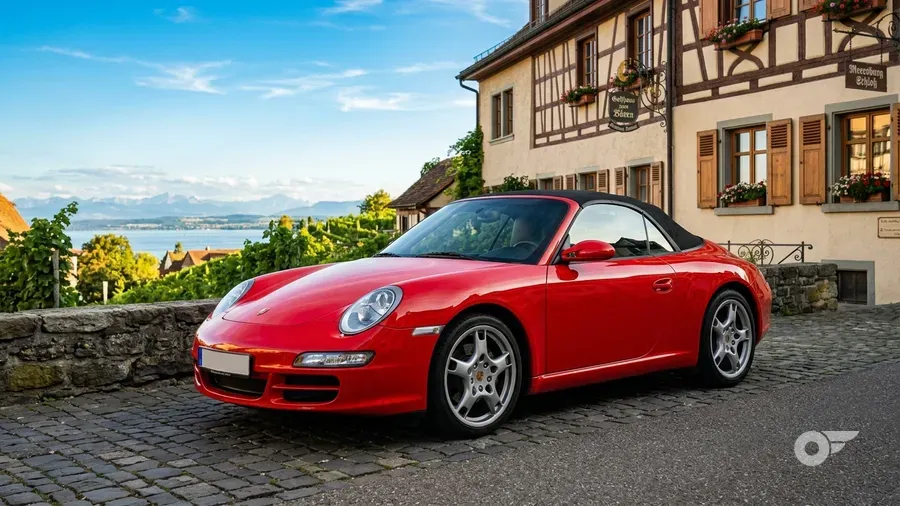
Pinky Lai drew the 996 under Harm Lagaay, and the brief was harder than it looks: replace a shape everyone loved, share the front end with a cheaper car, and lose nothing. He got two of the three. The proportions are right and the profile is unmistakably 911, longer and lower and cleaner than the 993, slipperier than any 911 before it. But the headlamps came from the Boxster, carrying the indicator inside the lamp unit in a way that reads, to a great many people, as a fried egg. Porsche's own press material says what happened next in plain terms: the 2002 update gave the regular 996 the Turbo's rounded lamps specifically to differentiate it more clearly from the Boxster. The same update widened the Carrera 4S onto Turbo bodywork and gave the Targa a sliding glass roof with an opening rear hatch. Inside, this is the first 911 cabin built around a modern dashboard rather than five round dials and a shelf, which is the change that dated fastest and the one owners still argue about at length.

Motorsport pedigree

Two results carry the 996 and one of them is out of all proportion. On 2 February 2003 The Racer's Group entered a 996 GT3-RS in the Rolex 24 at Daytona and won outright, beating the prototypes, with Kevin Buckler, Michael Schrom, Timo Bernhard and Jörg Bergmeister sharing the driving. No GT car has taken that race overall since, and Porsche thought enough of it to build Bergmeister a tribute car twenty-one years later. The other is the class record at Le Mans. The 911 GT3 R won the GT class in 1999 and 2000, Alex Job Racing won it in 2003 with Emmanuel Collard, Lucas Luhr and Sascha Maassen, and the GT3 RSR took GT2 in 2004 and 2005. The 2000 result carries an asterisk worth stating: a Dick Barbour Racing GT3-R finished first in class and was disqualified afterwards over an oversize fuel cell, though the same team took the ALMS GT championship that year with nine wins from twelve races. Under all of it sits the 911 GT3 Cup, which turned Carrera Cup and Supercup into the busiest one-make racing anywhere.

In culture

The 996's cultural position is a running joke that has slowly stopped being funny. It is the 911 the internet made a punchline of, the one with the fried-egg lamps and the borrowed face, and for twenty years it was the cheap answer in every argument about which sports car to buy, offered half as a dare. That is a real cultural role even if it is not a flattering one, and it produced something genuine: a generation of people who could not afford a 911 bought one anyway, then wrote up what they found. The reappraisal, when it came, arrived through video and the auction sites rather than through film or music. Values are up 40 per cent since 2020. Jalopnik has published a defence of the fried-egg headlamp. Owners post their own borescope footage, so the car's faults are better documented than most classics' virtues. The 996 also spent its commercial life confined to Need for Speed, because Electronic Arts held an exclusive Porsche licence from 2000, so a whole generation met the water-cooled 911 in one game and nowhere else.

Rivals

Cars from other manufacturers that competed for the same buyers when new.
Owning One

Why collectors want it

The case for the 996 has changed in five years and it is worth being precise about why, because it is not nostalgia. The cheapest way into a 911 turned out to be a genuinely fast, genuinely modern one, and the market noticed. Hagerty puts the generation's average condition-3 value at $43,700, up 40 per cent since 2020, which is close to the rise the 993 posted over the same period from four times the money. The hierarchy inside the range is steep and unusually well understood. The GT3, GT2 and Turbo all use the Mezger engine, which has no part in either of the two faults the ordinary cars get judged on, and they trade in a separate market: a 996 GT3 sits near six figures, the 1999 car was never officially sold in America, and the GT2 is a fewer-than-1,300-car proposition. Below that, the 2002-on cars with the 3.6 and the Turbo-derived headlamps carry a premium over the 3.4, the wide-bodied Carrera 4S carries another, and a documented, inspected, honest 3.4 coupe is still the cheapest real 911 anybody sells.

Which one to look for

Start with the year, because 2002 changes four things at once: 3.6 litres instead of 3.4, 320 PS instead of 300, the Turbo's headlamps instead of the Boxster's, and a reworked cabin. That is why the later cars carry a premium and why this split matters more here than on any other 911. Among the Carreras, the wide-bodied Carrera 4S from 2002 wears the Turbo's body and brakes without the turbochargers and is the connoisseur's ordinary 996. The Targa, 5,152 cars, brought a glass roof that slides under the rear screen and the first opening rear hatch fitted to a 911. The 40 Jahre of late 2003, 1,963 numbered cars in GT Silver with the X51 power kit and a limited-slip differential, is the collectable narrow body. Above them sit the Mezger cars, in their own market: the Turbo at 420 PS or 450 with the X50 pack, the GT2 at 462 then 483 PS with fewer than 1,300 built, and the GT3, which is the one to chase. The 1999 GT3 never officially reached America. The 2003 car did, at 381 PS, alongside 682 GT3 RS built for homologation.

40 Jahre 911 · 2003–2004

Numbered anniversary car in GT Silver with the X51 power kit at 345 PS, a limited-slip differential, M030 suspension and polished lightweight wheels. Narrow body, rear-wheel drive.

Carrera · 1998–2004

The volume car. 3.4-litre flat six at 300 PS to 2001, then 3.6 litres and 320 PS with the facelift. Rear-wheel drive, six-speed manual or five-speed Tiptronic S, Coupe or Cabriolet.

Carrera 4 · 1998–2004

Four-wheel-drive Carrera, same engines and bodies as the rear-drive car. The 1998 Carrera 4 was the first 911 with Porsche Stability Management fitted as standard.

Carrera 4S · 2002–2004

The wide one. Turbo bodywork, Turbo brakes and suspension over the naturally aspirated 3.6. The connoisseur's ordinary 996 and the best-looking of them.

GT2 · 2001–2005

Rear-wheel drive, no stability control, ceramic brakes and the Turbo engine turned up: 462 PS from 2001 and 483 PS from 2004. The hardest road 911 of its era.

GT3 · 1999–2004

Mezger flat six at 360 PS to 2001, then 381 PS for the 2003 facelift car, with a fixed rear wing and reworked aerodynamics. Rear drive, manual only, no rear seats.

GT3 RS · 2003–2004

Homologation special. White paint with red or blue graphics, polycarbonate rear screen, carbon bonnet and wing, lightened shell, the same 381 PS engine.

Targa · 2002–2005

Glass roof panel sliding back under the rear screen, plus the first opening rear hatch fitted to any 911. Narrow body, 3.6 litres.

Turbo · 2000–2005

Twin-turbocharged 3.6-litre Mezger engine at 420 PS, four-wheel drive, six-speed manual or Tiptronic S. The X50 power kit lifted it to 450 PS, and the 2005 Turbo S made 450 PS as standard.

What owning one is like

Living with a 996 is cheaper than living with any other 911 and more nerve-racking than it needs to be, mostly because of what people say about it rather than what it does. The engine questions are real and they are finite. On the cars with the serviceable bearing, the intermediate shaft is a scheduled item rather than a lottery, and thousands have now been done with an upgraded bearing and a receipt to prove it. Bore scoring is the one that ends engines, and it announces itself: a tick when cold, oil disappearing, soot on the left side. Everything else is ordinary ageing. The rear main seal weeps and gets replaced with the clutch. The plastic coolant pipe inside the crankcase and the plastic expansion tank both go brittle, and both have known fixes. Coil packs, the air-oil separator and convertible roof motors are the usual small bills. The body is galvanised and holds up well, the interior plastics scuff, door handles break. Owners who use their cars hard report the fewest problems, which is the opposite of the folklore and entirely consistent with how these engines behave.

Upkeep & parts

Parts and knowledge are the 996's quiet advantage. It shares a great deal with the Boxster, so the aftermarket supporting both is the deepest in modern Porsche, and Pelican, Design911 and the specialist trade will sell you anything on the car at prices that would embarrass a 993 owner. Routine servicing is genuinely cheap by 911 standards, with long intervals and no valve adjustment to do. The costs to plan for are the engine-out jobs, and they arrive in a predictable order. A clutch means dropping the engine and gearbox, so the intermediate shaft bearing and the rear main seal get done at the same time and the combined bill is a fraction of doing them separately. A borescope inspection before purchase pays for itself. A rebuild after bore scoring runs well into five figures and is the reason a cheap 996 can turn into an expensive one. Independent specialists exist in every market, LN Engineering publishes the definitive technical material on the intermediate shaft, and Rennlist's 996 forum holds twenty years of documented fixes. Very little on this car needs a dealer.

Country of origin
Germany
Class
Sports
Production years
1998–2004
Units built
175,262
Model
911
Nickname
Fried Egg
Body
Convertible, Coupe, Targa
Layout
Rear-engine, AWD / RWD
Engine
3.4L water-cooled flat-six (300 PS, 1998-2001), 3.6L water-cooled flat-six (320 PS, 2002-2004), 3.6L Mezger flat-six (GT3, 360 PS then 381 PS), 3.6L twin-turbocharged flat-six (Turbo 420 PS, X50 pack and Turbo S 450 PS), 3.6L twin-turbocharged flat-six (GT2, 462 PS then 483 PS)
Transmission
6-speed manual, 5-speed Tiptronic S automatic
Designer
Pinky Lai (styling, under design director Harm Lagaay)