Octane Files
Browse CarsNissan Skyline GT-R R34

Nissan Skyline GT-R R34

Overview

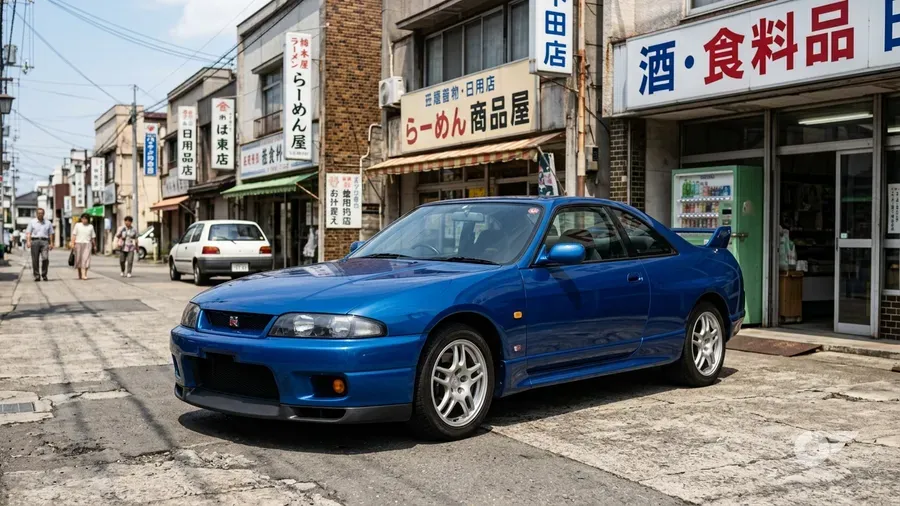
The R34 is the last Skyline GT-R and the one everybody wants, and those two things are true for reasons that have very little to do with each other. Nissan shortened the car from the R33, taking 55mm out of the wheelbase and 75mm out of the length, stiffened the shell again, and fitted the family's only six-speed gearbox, a Getrag 233. The RB26DETT was unchanged in everything that gets published: still 2,568cc, still twin-turbocharged, still rated at 280 PS, because the Japanese industry's advertising ceiling stood until 2004. What was new sat in the middle of the dashboard, a 5.8-inch multifunction display reading boost, oil pressure, injector duty cycle, four separate temperatures, a lap timer and a g-meter, in a road car in 1999. Production ran from January 1999 to November 2002 and stopped at 11,578, the smallest run of the three modern GT-Rs, and then the badge left the Skyline for good. Its afterlife has been considerably louder than its life, because between 2003 and 2009 a blue R34 became the most recognisable Japanese car on earth.

Distinctions

The defining attributes and collector status that make this car garage-worthy.

Legend
A car that transcended the hobby, known far beyond the people who drive them.
Poster Car
The car on the bedroom wall, the one people dreamed about before they could drive.
Octane Files Select
Renowned for its history, engineering, or cultural weight.

Collectibility scorecard

Rated 1 to 10 on the traits that matter for owning, driving, and holding on to a car like this.

Desirability
10/10
Rarity
6/10
Driving thrill
9/10
Investment trajectory
8/10
Usability
6/10
Ease of restoration
6/10
Cultural impact
10/10
Electronic dependence
Fully analogHeavily electronic

The most computerised Skyline GT-R, and still not a drive-by-wire car, which is why it sits where it does. Engine management is an ECU on six individual throttle bodies. ATTESA E-TS Pro splits torque front to rear and, through an active rear limited-slip differential, side to side across the rear axle. Super HICAS steers the rear wheels. The 5.8-inch multifunction display in the centre stack reads boost, oil pressure, injector duty cycle, oil, water, exhaust and intercooler temperatures, with a lap timer and a g-meter, plus a television tuner on Japanese cars that worked below 5 km/h. What keeps it at four rather than five: the throttle is a cable, the steering hydraulic, the six-speed Getrag a plain manual, and there is no stability control at all. The R35 that replaced it went to drive-by-wire and a dual-clutch gearbox. This one did not.

Market data

Demand tier, price trend, and typical values by condition, based on recent sales data.

Demand tier
EntrySolidHighBlue-chip

The proven elite. Values are established, liquid, and defended at every auction.

Value trajectory
AppreciatingStableCooling

Values are holding steady. What you pay today is what it's worth tomorrow.

Price by condition
Driver
$140k
Excellent
$240k
Concours
$350k

Blue-chip, and the only GT-R here whose trajectory is stable rather than rising. Values moved from roughly $30,000 to $40,000 in 2015 into six figures now, and the January 2024 opening of US import eligibility took speculation out of the market rather than adding to it. Anchors: clean standard 1999 cars from about $150,000; a 2001 V-spec II sold in the UK for £109,500 in January 2026; a recent five-car auction group averaged $300,000 and came in below seller expectations. The band below describes standard and V-spec cars, which is what most buyers will actually meet. The 1,003 Nür cars and the 19 Z-tunes sit far outside it and change hands through specialist brokers rather than in the open. One structural point worth knowing: eligibility phases in by build date month by month through 2027, so US supply is still increasing, which is a real argument for the flat trajectory.

Values as of August 2026.

Buyer's guide

What anyone seriously considering this car should know first.

Why it's worth it
The last Skyline GT-R, and the badge's first global star
Callout
1,003 run-out Nür cars carry the N1 racing engine block
What to watch for
An R34 is bought and sold on documentation more than on condition, because the money involved has made provenance the asset. Start with the chassis number and the build record, since gtr-registry.com will confirm colour, options and date, and a claimed V-spec II Nür with the wrong build date is a serious problem. Then the engine, which is the RB26 with its two familiar items: the oil pump drive collar that cracks at the gear interface under sustained high rpm, and turbochargers that will not tolerate raised boost on the factory ceramic wheels, though the Nür cars left with the tougher N1 unit. Ask what boost the car has run and for how long. Beyond that, check the ATTESA hydraulic pump for leaks, feel for the front axle taking drive, and accept Super HICAS as eventual expenditure. Rust is less of an issue than on the R33 but sills and rear arches still deserve a torch. The R34-specific trap is the import calendar: cars clear the US 25-year rule month by month by build date, and one that has not yet cleared cannot be legally imported whatever the seller says.

The Story

Driving character

This is the RB26 at its most resolved, and the car around it argues with you less than either of the others. The engine is familiar: very little happening below 3,500 rpm, then both turbochargers together and a long, hard, flat pull that keeps building past where you expect it to stop, over the same hiss of six throttle bodies. The six-speed Getrag is the real difference. The R32 and R33 had five ratios and gaps you drove around; the R34 has closer ones and a shorter, more precise shift, and it changes the car's rhythm on a road completely. The shell is stiffer again and the wheelbase shorter than the R33's, so it turns in with more urgency and none of the R32's nervousness. It is also the heaviest of the three at 1,560 kg, which you feel under braking rather than in corners. ATTESA E-TS Pro is by now genuinely clever and nearly invisible, and the car simply declines to run out of grip where physics suggests it should. The live readout in front of you does the rest.

Design

The R34 is the hard-edged one, and Nissan clearly understood what it had lost with the R33. The nose is blunter and more upright, the arches are squarer and blistered rather than blended, the bonnet carries a functional vent, and the rear wing is a proper adjustable aerofoil on twin uprights rather than a lip. The whole shape is shorter and denser than the R33's, which is precisely the impression it wanted. Signatures: four round tail lamps, unbroken from the Hakosuka; the carbon bonnet with its NACA duct on the V-spec II; the carbon rear diffuser on V-spec cars; and a five-spoke wheel that became one of the most copied designs in the aftermarket. Inside, the 5.8-inch multifunction display is the R34's real statement, and the usual claim about it needs correcting: Gran Turismo's developer Polyphony Digital did not build it. Nissan did. Polyphony was commissioned for the R35's display eight years later. Bayside Blue, launched with the car, is now the colour the R34 means.

Motorsport pedigree

The R34 won a championship in its first season, which is a good line and needs immediate qualification. In 1999 the Pennzoil Nismo car of Erik Comas and Satoshi Motoyama took the All Japan Grand Touring Car Championship GT500 title in the R34's debut campaign, following the R33's 1998 title with the same team and the same lead driver. But GT500 was a silhouette formula by then. The racing Skyline shared a name, a rough outline and very little else with the road car, and no part of the R34 road car was built to homologate anything. That is the honest difference between this generation and the R32, whose entire specification was a Group A rulebook rendered in metal. The R34's competition presence is real and also indirect: the RB26DETT kept winning in privateer hands in Japanese endurance racing and time attack for another two decades, and the N1 block the Nür cars carry exists precisely because of that racing. The other number attached to the car is a Nürburgring lap, an unofficial 7:52 set by Kazuo Shimizu in 1999, quicker again than the R33's.

In culture

No Japanese car has a larger cultural footprint, and almost all of it comes from one franchise, so it is worth stating exactly what is documented and then stopping. In 2 Fast 2 Furious in 2003, Brian O'Conner drives a silver and blue R34. In Fast & Furious in 2009 he drives a Bayside Blue one, built by Kaizo to a specification Paul Walker requested himself: Turbonetics front-mounted intercooler, Nismo springs, NE-1 exhaust, roll cage, ARC titanium strut brace, 19-inch Volk RE30 wheels, Rotora brakes. Only one genuine GT-R was used in that film, the stunt cars being lesser GT-T Skylines dressed as GT-Rs, and that car later sold at Bonhams for $1.36 million. Everything past this gets vague quickly, and this page stops here. Underneath the films sits Gran Turismo, which put the R34 in front of millions of players from launch, and Bayside Blue became one of very few paint colours a whole generation can name on sight. The result is a car famous well outside the hobby, which almost nothing Japanese manages.

Owning One

Why collectors want it

The R34 is the blue-chip GT-R, and it got there in an unusual order: famous before it was collectible, and expensive before it was legal in its largest market. 11,578 built over four years, the smallest run of the three modern cars, closing a nameplate that runs back to 1969. It carries the family's only six-speed gearbox, the stiffest shell of the three and the most focused version of the RB26DETT. On top of that sits the Fast & Furious effect, which is measurable rather than fan mythology, and the 25-year import clock, which opened for the earliest cars in January 2024 and is still opening month by month through 2027. The result is a market that ran from roughly $30,000 to $40,000 in 2015 into six figures now. The hierarchy is unusually steep: standard cars, then V-spec, then V-spec II, then the softer M-spec, and above all of them the 1,003 Nür cars of February 2002 with the N1 racing engine block. Beyond even those sit 19 Nismo Z-tunes, built on used chassis, which trade in seven figures when they trade at all.

Which one to look for

The ladder here is steeper than on any other GT-R and worth learning before you spend. The standard car, 3,977 across two series, is the plain one and the most often exported. The V-spec, 4,193 built, adds ATTESA E-TS Pro with the active rear differential, a carbon rear diffuser and firmer suspension. The V-spec II of October 2000, 1,855 cars, adds a carbon bonnet with a NACA duct and stiffer settings again. The M-spec, 366 cars from May 2001, goes the other way with Ripple Control dampers, a more supple and more accurate ride, and leather. Then the two that set the market. In February 2002 Nissan built 718 V-spec II Nür and 285 M-spec Nür as run-out cars, 1,003 in total, each carrying the N1 racing engine block: rebalanced crank, revised oil and water galleries, steel-wheel turbochargers, a better oil pump and a higher rev limit. Above everything, 19 Nismo Z-tunes, built between 2003 and 2007 on used low-mileage R34s with a 2.8-litre RB28DETT rated at 500 PS.

GT-R (Series 1 and 2) · 1999–2002

The standard car. RB26DETT, ATTESA E-TS, Super HICAS, and the family's only six-speed gearbox, a Getrag 233. Carries the 5.8-inch multifunction display that defines the R34's cabin. The plainest R34 and the most commonly exported.

M-spec · 2001–2002

From May 2001, and the R34 that goes the other way. Ripple Control dampers, a stiffer rear anti-roll bar, a more supple and more accurate ride and a leather interior. The connoisseur's road-biased choice and much scarcer than the V-spec.

M-spec Nür · 2002

The other run-out car: the N1 engine block of the V-spec II Nür in the softer, more road-focused M-spec chassis with Ripple Control dampers. The rarest of the two Nür variants and the most usable fast R34.

N1 · 1999–2002

The stripped endurance-racing basis, with the tougher N1 block and the usual deletions. Built in tiny numbers and almost all of them raced.

Nismo Z-tune · 2003–2007

Not a production R34 at all. Nismo bought back used R34s with under 30,000km and rebuilt them by hand around a 2,771cc RB28DETT rated at 500 PS and 540Nm, with Sachs suspension, Brembo brakes and extensive carbon-fibre bodywork. 0 to 100km/h in 3.8 seconds.

V-spec · 1999–2000

ATTESA E-TS Pro with an active rear limited-slip differential, a carbon-fibre rear diffuser and firmer suspension. The volume enthusiast specification and the most numerous single R34 variant.

V-spec II · 2000–2002

From October 2000. As V-spec with a carbon-fibre bonnet carrying a NACA duct, stiffer suspension settings again and revised trim. The most track-focused non-Nür R34.

V-spec II Nür · 2002

The run-out car and the one the market chases. Carries the N1 racing engine block with a rebalanced crankshaft, revised oil and water galleries, steel-wheel turbochargers, an improved oil pump and a higher rev limit, on the V-spec II chassis. Named for the Nürburgring, where the car was developed.
What owning one is like

The R34 is the youngest, best-built and most usable of the three, and most of its problems are the ones money creates. Mechanically it is the RB26 list: the oil pump drive collar cracking at the gear interface under sustained high rpm, and turbochargers with ceramic wheels that will not tolerate raised boost, although the 1,003 Nür cars left the factory with the tougher N1 unit and a better pump. The ATTESA hydraulic pump leaks with age, Super HICAS eventually wants money or removing, and the six-speed Getrag is stronger than the earlier five-speeds without being immune to synchro wear. Rust is less of an issue than on the R33, though sills and rear arches still deserve inspection. The particular reality of R34 ownership is that the car is now an asset, and that changes everything: cars get stored rather than driven, mileage carries a premium that discourages use, and parts get stolen. Insurance is a genuine line item. Owners who actually drive theirs describe a completely tractable car with a light clutch, a good ride and air conditioning that works.

Upkeep & parts

Parts for an R34 are the easiest of the three to find and the most expensive to buy, which is roughly what you would expect. Nismo's Heritage Parts programme covers the R34 alongside the R32 and R33 and has reissued a long list of discontinued items since 2017, and the RB26 aftermarket is deep enough that a full engine build uses off-the-shelf components. The pinch points are R34-specific body panels, the carbon bonnet and diffuser, interior trim and the multifunction display unit, all scarce and all priced against the car's value rather than its age. Budget accordingly. The other real cost is specialist labour: a car worth this much does not go to a general workshop, and the shops that properly know ATTESA, HICAS and the six-speed are not numerous outside Japan, the UK and Australia. On the community side, GTROC is the Nissan-recognised owners club, GTR Register carries decades of accumulated knowledge, and gtr-registry.com will verify a chassis number's build date, colour and specification, which with this much money at stake is not optional.

Country of origin
Japan
Class
Sports
Production years
1999–2002
Units built
11,578
Model
Skyline GT-R
Nickname
Godzilla
Body
Coupe
Layout
Front-engine, AWD
Engine
2,568cc RB26DETT twin-turbo DOHC 24-valve inline-six (280 PS), 2,771cc RB28DETT twin-turbo inline-six (500 PS, Nismo Z-tune)
Transmission
6-speed Getrag manual
Designer
Kozo Watanabe (chief engineer)