Octane Files
Browse CarsNissan Skyline GT-R R33

Nissan Skyline GT-R R33

Overview

The R33 is the GT-R that gets dismissed in a sentence, usually the wrong one. It arrived in January 1995 on a wheelbase 105mm longer than the R32's and weighing about 100 kg more, and that weight is the entire case against it. What the weight bought is the case for it: the bodyshell is far stiffer, and Nissan spent the R32's stock of goodwill on making the car do reliably what the R32 could only do in the hands of somebody good. Kozo Watanabe, who had worked on the Hakosuka's suspension and on Nissan's late-sixties prototypes, was chief engineer, and he took the R33 round the Nürburgring twenty-one seconds faster than an R32 had gone. The RB26DETT underneath is unchanged and still publishes 280 PS, because Japan's advertising ceiling had not moved. Everything around it did: Brembo brakes, an all-wheel-drive system that now controlled torque side to side across the rear axle as well as front to rear, and a body that stopped flexing beneath it. It is the least loved GT-R and, on any measurable basis, the most capable one of its own moment.

Distinctions

The defining attributes and collector status that make this car garage-worthy.

Octane Files Select
Renowned for its history, engineering, or cultural weight.

Collectibility scorecard

Rated 1 to 10 on the traits that matter for owning, driving, and holding on to a car like this.

Desirability
6/10
Rarity
5/10
Driving thrill
8/10
Investment trajectory
7/10
Usability
7/10
Ease of restoration
6/10
Cultural impact
6/10
Electronic dependence
Fully analogHeavily electronic

The same architecture as the R32, developed a step further. Engine management is an ECU running sequential injection across six individual throttle bodies. ATTESA E-TS is still an electronically controlled clutch pack splitting torque front to rear, but the E-TS Pro version on the V-spec adds an active rear limited-slip differential, so a computer now decides how much torque each rear wheel gets as well, with independent rear brake modulation working alongside it. Super HICAS steers the rear wheels electrically rather than hydraulically, and anti-lock braking is four-channel. What holds the score where it is: the throttle is still a cable, the steering hydraulic, the clutch unassisted and the gearbox a plain five-speed manual. There is no stability control and no aid you can feel intervening.

Market data

Demand tier, price trend, and typical values by condition, based on recent sales data.

Demand tier
EntrySolidHighBlue-chip

A dependable market. Well-kept cars hold their value and find ready buyers.

Value trajectory
AppreciatingStableCooling

Values are climbing. The market wants more of these than exist.

Price by condition
Driver
$40k
Excellent
$65k
Concours
$100k

Solid rather than High, and that is a market judgment rather than an engineering one. 16,668 built, fewer than the R32 and more than the R34, and yet it trades below both: standard cars under $60,000 through 2026 and clean V-specs between $60,000 and $75,000, against roughly $150,000 as an entry point for a standard R34. The gap is reputational. The car arrived in the middle of Japan's post-bubble recession, ran only four years, got no film and no video-game halo, and has carried the unloved-middle-child label ever since. Trajectory is appreciating because that gap has begun to close as R32 and R34 money moved out of reach. The 400R, the LM Limited and the four-door Autech Version all sit well outside the band below, and so does any car with genuinely original paint and no arch repairs, which is now the rarest thing about an R33.

Values as of August 2026.

Buyer's guide

What anyone seriously considering this car should know first.

Why it's worth it
The GT-R that was engineered rather than homologated
Callout
Twenty-one seconds a lap quicker round the Nürburgring than the R32
What to watch for
The R33 shares the RB26DETT's two known weak points with the R32, so start there: the oil pump drive collar, which cracks at the gear interface under sustained high rpm, and the ceramic turbine wheels, which shatter if boost has been raised or debris has been through the compressor. Both have known fixes and both should be evidenced rather than assumed. Then the R33's own item, which is rust. These cars corrode at the rear wheel arches from stone chips and trapped moisture, and the four-door Autech cars are the worst for it; a serious one is a cut-and-weld job rather than a filler job. Check the ATTESA hydraulic pump for weeping, confirm on a wet roundabout that the front axle actually takes drive, and treat Super HICAS as a system that will eventually want money or deleting. Second and third gear synchros wear. The R33's advantage over the R32 is that it is younger, so interiors and electrics are in better order; its disadvantage is that low prices for a long time have meant harder lives. Buy the history file rather than the wheels.

The Story

Driving character

Everything the R32 does, with the chassis turned up and the drama turned down. The RB26DETT is identical and behaves identically: quiet and undramatic to about 3,500 rpm, then both turbos together and a hard, flat, unrelenting shove to the limiter with six throttle bodies hissing behind the bulkhead. Where the two cars separate is the body. The R33's shell is much stiffer, so the suspension works against something solid instead of against flex, and the result is a car that stays composed exactly where the R32 gets busy. It is more accurate and less nervous and it will carry more speed for less effort. It also feels bigger, because it is: 105mm more wheelbase and 100 kg more mass, both of which you notice at turn-in and in tight corners. The Brembo brakes are a real step and the V-spec's active rear differential lets you lean on the throttle mid-corner in a way the R32 will not. Enthusiasts who dislike the R33 usually mean they miss the R32's edginess. That is a fair preference rather than a criticism of the engineering.

Design

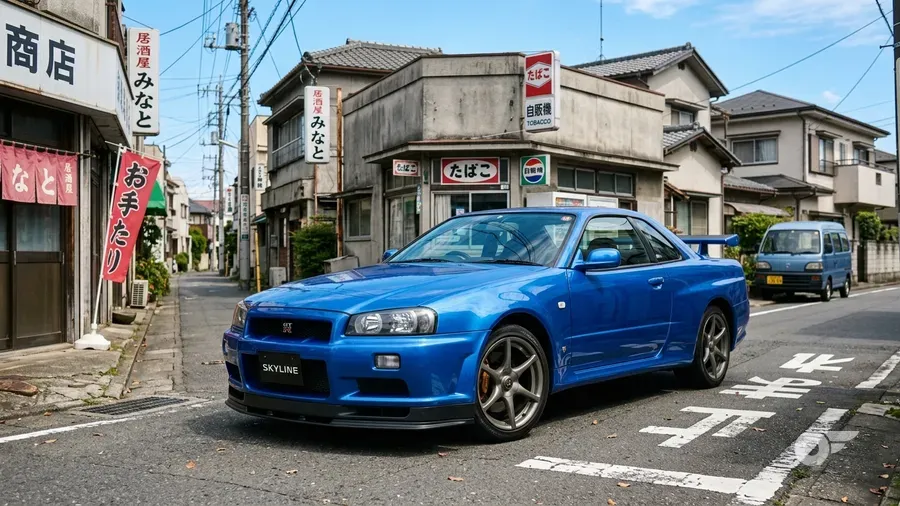
The R33 is the softest-looking GT-R and the one where the shape does least for the car. The R32's hard creases give way to rounded surfaces, a higher waist and a longer nose, and the arches are integrated rather than blistered on, which reads as less aggressive even though the track is wider. The signatures survive: four round tail lamps, a boot spoiler with an adjustable blade, a vented bonnet on the later cars and a deep front bumper. Inside is a clear step up from the R32, with a proper centre console, better seats and a more considered dashboard, and this is where the R33 quietly wins as somewhere to spend time. It is also the only GT-R generation ever offered with four doors, in the 1998 Autech Version 40th Anniversary, and the saloon roofline suits it better than it has any right to. Champion Blue, the LM Limited colour, is the shade the R33 looks best in, and it is the one most photographs of the car use for a reason.

Motorsport pedigree

The R33's competition story is Le Mans and the JGTC, because the Group A class the R32 destroyed no longer existed. Nismo took two JGTC-specification R33s to the 24 Hours of Le Mans in 1995 and, to satisfy GT1 homologation, built exactly one road-legal Skyline GT-R LM. That car was never offered for sale, went into storage the day it was finished, and lives in Nissan's heritage collection as the rarest thing ever to wear the badge. The racers came tenth overall and fifth in GT1, beaten only by far better developed McLaren F1 GTRs. At home the R33 took the 1998 JGTC GT500 title, the number 23 Pennzoil Nismo car of Erik Comas and Masami Kageyama winning both drivers' and teams' championships. Then there is the Nürburgring. In 1995 Dirk Schoysman lapped a pre-launch R33 in 7:59.887, twenty-one seconds inside the R32's 8:22.38, and Nissan marketed it as the first mass-produced car under eight minutes. The twenty-one seconds is real and is the car's genuine engineering headline. The word first is contested: the car was never verified standard, photographs show a roll cage and a non-standard exhaust, and a Jaguar XJ220 had been credited with 7:46 in 1991. This page does not adjudicate it.

In culture

The R33's cultural problem is simple: nothing famous happened in one. It never got a film role, it was never a video game's hero car, and it arrived into a Japan deep in the recession that followed the bubble, for a four-year run that ended before it had built an identity of its own. Gran Turismo carried it from the beginning, but as one Skyline among several rather than the one people remembered. Where it does appear is in the enthusiast record, and there it fares far better than the general reputation suggests: the Nismo 400R has become a serious collector's object, and the Champion Blue LM Limited is one of the better-looking Japanese cars of the decade. The clearest sign of a shift is the market itself. Buyers who cannot reach an R34 and will not pay R32 money have found the R33, and the phrase that stuck to it for a decade, that it is the unloved middle child, has started to sound more like a sales pitch than a verdict. Having been overlooked for thirty years is now the most interesting thing about it.

Owning One

Why collectors want it

For most of thirty years the R33 was the one you bought if you could not afford the other two, and that is roughly still where it sits, which makes it the most interesting value case in the family. 16,668 were built, fewer than half the R32's run and more than the R34's, and yet it trades below both. Standard cars sold under $60,000 through 2026 and clean V-specs between $60,000 and $75,000, at a point when a comparable R34 started nearer $150,000. The argument for buying one is that the reasons it is cheap are reputational rather than mechanical: no film, overshadowed on both sides, and a four-year run that opened into Japan's worst post-war recession. The hierarchy runs from standard cars up through the V-spec, then the 188 LM Limited cars of 1996, the 416-car Autech Version 40th Anniversary four-door, and at the top the 44 Nismo 400R cars with the 2.8-litre RBX-GT2. Above all of them sits a single road-legal GT-R LM, built to homologate the Le Mans car and never offered for sale.

Which one to look for

The standard GT-R is a better car than its reputation and by far the most common, at 9,299 across three series. The V-spec is the one to have, 6,567 built, adding Brembo brakes at 324mm front and 300mm rear, a lower and stiffer setup, four-channel ABS and ATTESA E-TS Pro with the active rear limited-slip differential. After that the specials get interesting. The LM Limited of May 1996, 188 cars in Champion Blue only, marks the Le Mans programme and carries a vented bonnet and a taller rear wing. The Autech Version 40th Anniversary of 1998 is the oddity worth knowing: 416 cars, and the only four-door GT-R Nissan ever sold. The N1 cars, 87 built, are the stripped endurance basis with the tougher N1 block. The grail is the Nismo 400R, 44 cars, with the bored and stroked 2.8-litre RBX-GT2 making 405 PS. Above every one of them sits the single road-legal GT-R LM built in 1995 to homologate the Le Mans racer, never sold, and now in Nissan's own collection.

Autech Version 40th Anniversary · 1998

The only four-door GT-R Nissan ever sold, built by Autech to mark the Skyline's fortieth anniversary. Full GT-R running gear in a saloon body, and the oddity of the whole family. Watch the rear arches, which rust worse on these than on the coupes.

GT-R (Series 1, 2 and 3) · 1995–1998

The standard car. RB26DETT, ATTESA E-TS, Super HICAS, five-speed manual, on a shell substantially stiffer than the R32's. Better built and more comfortable than its reputation allows, and by some distance the most common R33 you will be offered.

LM Limited · 1996

Commemorates the 1995 Le Mans programme. Champion Blue only, with a vented bonnet and a taller rear wing. Not a mechanical upgrade, but the most visually distinctive standard-engine R33 and the one that photographs best.

N1 · 1995–1998

The stripped endurance-racing basis, with the tougher N1 engine block and the usual deletions. Built in far smaller numbers than the R32 equivalent and, like all N1 cars, mostly used for the purpose it was built for.

Nismo 400R · 1996

The R33 grail. A bored and stroked 2,771cc RBX-GT2 in place of the RB26DETT, rated at 405 PS and 470Nm, with bespoke bodywork, wheels and suspension. Hot Rod recorded 0 to 60mph in 4.0 seconds and a 12.2-second quarter mile.

V-spec · 1995–1998

The one to have. Brembo brakes at 324mm front and 300mm rear, lower and stiffer suspension, four-channel ABS, and ATTESA E-TS Pro with an active rear limited-slip differential that lets the computer move torque across the rear axle as well as front to rear.
What owning one is like

The R33 is the easiest GT-R of the three to live with, and it has one clear weak point the others do not share as badly. Rust at the rear wheel arches is the R33 problem: stone chips break the paint, moisture sits in the lip, and it works outward from the inside. The four-door Autech cars are worst. A serious case wants cutting and welding rather than filler, and prices have been low enough for long enough that plenty of cars have had the cheap version done. Mechanically it is the familiar RB26 list, an oil pump drive collar that cracks under sustained high rpm and factory ceramic turbine wheels that will not tolerate raised boost. Both are solved problems with known parts. The ATTESA hydraulic pump leaks with age, Super HICAS eventually fails and is often deleted, and second and third gear synchros wear. Against all that, this is the best-built and most comfortable of the three: the interior holds together, the seats are good, and it is quiet enough to drive across a country. Owners who use their GT-Rs rather than store them very often end up here.

Upkeep & parts

Everything that supports the R32 supports the R33, which is a great deal. Nismo's Heritage Parts programme covers R33 items alongside R32 and R34, the RB26 aftermarket is deep enough that internals and turbochargers are commodity purchases, and the shared ATTESA, HICAS and gearbox hardware means a specialist who knows one generation knows all three. What is genuinely R33-specific is body panels and trim, scarcer than the R32's simply because fewer were built and fewer have been restored, and rear quarter repair sections are the item people hunt for. Budget for that if the arches are bubbling. The cost picture is slightly counterintuitive: parts cost roughly what an R34's cost while the car cost half as much, so any given repair is a far larger share of the value, which is exactly why so many R33s have been patched rather than properly fixed. Buying a good one and keeping it good is much cheaper than rescuing a cheap one. GTROC, GTR Register and gtr-registry.com all serve this generation, and the registry will confirm build date, colour and specification from the chassis number.

Country of origin
Japan
Class
Sports
Production years
1995–1998
Units built
16,668
Model
Skyline GT-R
Nickname
Godzilla
Body
Coupe, Sedan
Layout
Front-engine, AWD
Engine
2,568cc RB26DETT twin-turbo DOHC 24-valve inline-six (280 PS), 2,771cc RBX-GT2 twin-turbo inline-six (405 PS, Nismo 400R)
Transmission
5-speed manual
Designer
Kozo Watanabe (chief engineer)