Octane Files
Browse CarsHolden Monaro 1st Gen

Holden Monaro 1st Gen

Overview

Holden was General Motors in Australia, not a badge on an import. It designed and built its own full-size sedans, and from 1948 those sedans were what most Australian families drove. What it had never built was a coupe. Ford Australia had already sold one, so when Holden finally answered in July 1968 it did the job properly: a pillarless two-door hardtop on the HK sedan's floorpan, with an imported Chevrolet 327 available in the top model and a name lifted off a council sign near Cooma.

Ten weeks later three Monaros finished first, second and third in the Hardie-Ferodo 500 at Mount Panorama, the 500-mile race on a public mountain road that Australians treat as the only one that counts. Holden had a performance identity by Monday morning.

The generation ran three series in under four years. The HK (1968-69) used Chevrolet V8s. The HT (1969-70) brought Holden's own 253 and 308, put a 350 in the GTS and won Bathurst again. The HG (1970-71) closed the shape out with a three-speed automatic and softer springs, by which time the factory racing effort had already moved to the Torana.

Distinctions

The defining attributes and collector status that make this car garage-worthy.

Legend
A car that transcended the hobby, known far beyond the people who drive them.
Poster Car
The car on the bedroom wall, the one people dreamed about before they could drive.
Octane Files Select
Renowned for its history, engineering, or cultural weight.

Collectibility scorecard

Rated 1 to 10 on the traits that matter for owning, driving, and holding on to a car like this.

Desirability
8/10
Rarity
7/10
Driving thrill
7/10
Investment trajectory
8/10
Usability
5/10
Ease of restoration
6/10
Cultural impact
9/10
Electronic dependence
Fully analogHeavily electronic

Nothing on this car is electronic. Points-and-condenser distributor, mechanical fuel pump, one carburettor on every engine offered, a cable throttle, hydraulic brakes with no anti-lock, and a charging system whose only job is charging. The GTS 327's console tachometer is the most complicated instrument fitted. Power steering and power front discs were options and both are hydraulic. The only electrics that matter are the ones that age: the loom, the ignition switch, the sealed-beam headlights. An electronic ignition conversion is the usual modern upgrade, and it is reversible in an afternoon.

Market data

Demand tier, price trend, and typical values by condition, based on recent sales data.

Demand tier
EntrySolidHighBlue-chip

Strong, sustained collector demand. Good examples never wait long for a buyer.

Value trajectory
AppreciatingStableCooling

Values are climbing. The market wants more of these than exist.

Price by condition
Driver
$55k
Excellent
$100k
Concours
$145k

Values sit on Bathurst. The 1968 and 1969 wins put the first-generation Monaro at the top of the Australian collector market and keep it there, with 163 verified sales through Australian Muscle Car Sales since 2003 ranging from A$88,000 to A$350,000. The band below describes the volume car, a GTS with a Holden 253 or 308. Genuine GTS 327 and GTS 350 cars trade well above it, and a documented Bathurst-pack survivor made A$330,000 at Lloyds in 2022. The ceiling is geography: almost all the demand is domestic, so a Monaro does not reach the money an American car of comparable local fame would.

Values as of August 2026.

Buyer's guide

What anyone seriously considering this car should know first.

Why it's worth it
Holden's first coupe, and the car that beat Ford at Bathurst two years running
Callout
Ten weeks after it went on sale, Monaros finished 1-2-3 at Bathurst
What to watch for
Authenticate before you inspect. A genuine HK GTS 327 coupe carries the build number prefix 81837K on its body plate, which is the one thing a clone cannot legally wear, and Holden Historical Services will sell you a Vehicle Production Report drawn from Holden's own build records: body number, build date, which plant, and whether the car was a customer order or dealer stock. It is the nearest thing this marque has to a Marti Report. Then the shell. Rust lives in the rear quarter panels, the turret edges around the roof, the sills, the floor pans, the boot floor and the rear spring hangers. Bubbling and bulges tell you where; doors that need lifting to shut tell you the shell has already moved. Filler at the quarter-to-roof join is common and expensive to put right. Options confuse buyers. Power steering and front disc brakes were extras on lesser Monaros, so a car on drums is not necessarily wrong, and a period-correct 327 in a car that left the factory with something else is not fatal either. Buy it as what it is and pay accordingly.

The Story

Driving character

The 327 makes 250bhp at 4,800rpm and 325lb-ft at 3,200 in a car of about 1,495kg, and the torque is the whole point. Bruce McPhee won Bathurst in one without taking it past 4,000rpm, which is the most useful thing anybody has said about how this engine wants to be driven. It pulls from idle, it sounds like a small-block Chevrolet because that is exactly what it is, and the close-ratio Saginaw four-speed exists to keep it in the fat part of the curve rather than to chase revs. Everything around the engine is 1968. The steering is recirculating-ball and unassisted unless somebody ticked the box, so it is heavy at parking speed and vague on centre. Power front discs came with the 327 and drums do the work behind. The body is a pillarless hardtop, so with all four windows down there is nothing at all between you and the noise. Claimed 0-100km/h is 7.6 seconds. The six-cylinder cars are slower and softer and completely charming, which is easy to forget while a 327 is in the room.

Design

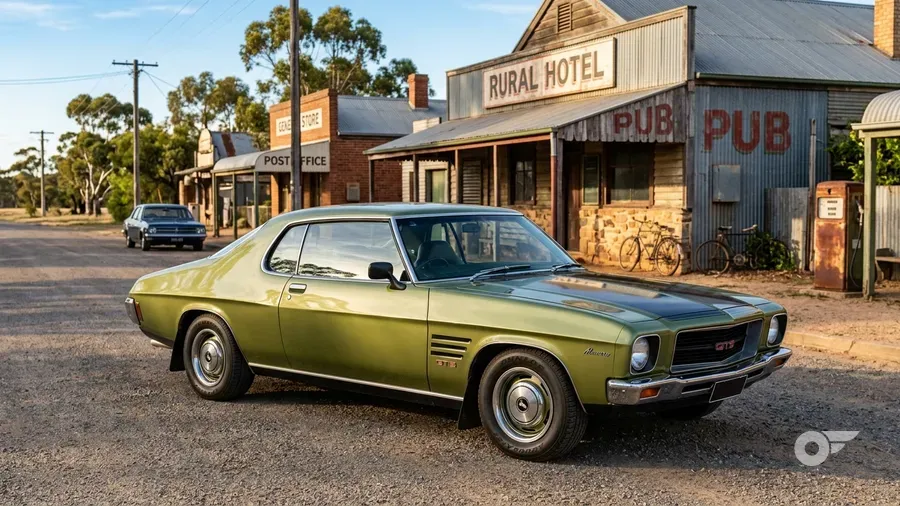
The shape was drawn in Holden's own studio under design director Joe Schemansky, with John Schinella running the coupe and Ted Schroeder finalising the roof and the daylight opening. Schinella had come from the studios that produced the Mako Shark II and the first Camaro, and the influence shows in the proportions, but the roof is the giveaway: it flows into the rear fenders in one uninterrupted line, closer to a 1966 Oldsmobile Toronado than to anything Chevrolet was building. Rear visibility suffered, and Schroeder expected to be told no. It is not a rebadged Camaro, and Australians get asked this constantly. The Monaro shares its floorpan, front sheetmetal and hard points with the HK Holden sedan. What came from Chevrolet was the engine. The clay models wore Kingswood, Premier, GTS and even Torana badges before the name was settled. GTS cars got offset stripes, bucket seats and a console tachometer. The HT added a plastic grille, larger tail lights and bonnet scoops; the HG swapped the bold stripes for thinner sidewinder graphics and softened the springs.

Motorsport pedigree

Australian touring car racing decided what Holden had to build. The Bathurst 500 ran to Series Production rules, meaning showroom-standard cars, and from 1967 a model qualified only if 5,000 were built internationally or 500 built or sold in Australia. That threshold is why Holden imported Chevrolet V8s and sold 1,192 GTS 327s to the public. It worked immediately. On 29 September 1968 Bruce McPhee took pole at 2:56.7, set the fastest lap and won the Hardie-Ferodo 500 outright, handing the car to Barry Mulholland for exactly one lap. Monaros finished first, second and third. McPhee ran a buffed road tyre rather than a race tyre, stopped twice for fuel where Ford stopped three times, and changed neither tyres nor brake pads. In 1969 the newly formed Holden Dealer Team won again, Colin Bond and Tony Roberts sharing an HT GTS 350, with Peter Brock third on his Bathurst debut. Holden had hired Harry Firth away from Ford to run it, and it wore a dealer badge because General Motors banned factory racing worldwide. Norm Beechey then took the 1970 Australian Touring Car Championship in an HT, the first title won by a Holden and by any Australian-built car. By then the team itself had moved to the lighter Torana, and no Monaro won Bathurst again.

In culture

Holden against Ford was never a marketing rivalry in Australia. It was an inherited allegiance, argued in pubs and settled in public once a year at Bathurst, and the Monaro gave the Holden half something to point at. That is why a yellow GTS 327 is still instantly readable to Australians who have never owned a car of any kind. It stayed in circulation. Wheels made the HK range its Car of the Year for 1968. First-generation Monaros turn up in Running on Empty, the 1982 street-racing film released overseas as Fast Lane Fever, although sources disagree on which series the crashing car actually was. The name came back in 2001 on a Commodore-based coupe that was exported to the United States as the Pontiac GTO, which is how most Americans have met a Monaro without knowing it. General Motors retired Holden itself in 2020, and the effect on cars like this was immediate: a nameplate with no maker behind it stops being merely old and starts being heritage. One thing outsiders get wrong is the pronunciation. It is mon-AIR-oh.

Rivals

Cars from other manufacturers that competed for the same buyers when new.
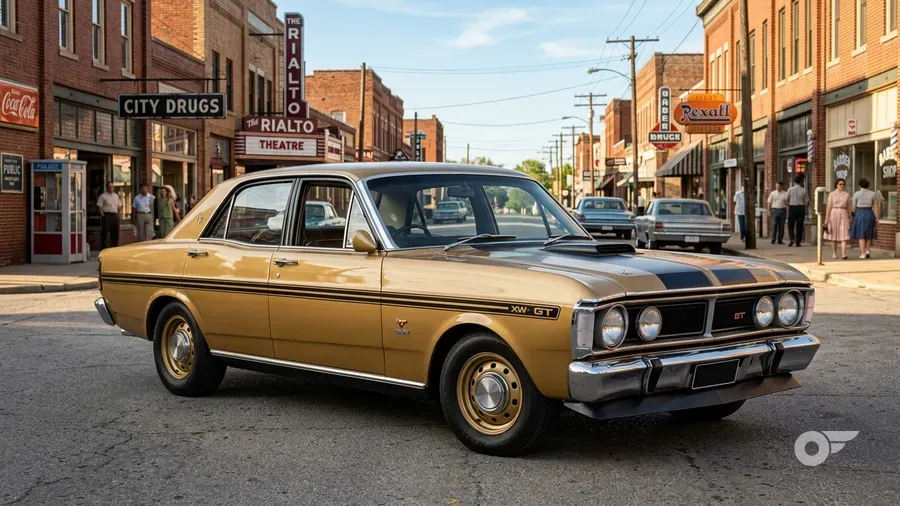
Ford Falcon GT XW

Ford Falcon GT XW

USA·Muscle·1969–1970

Chrysler Valiant Charger VH

We haven’t profiled this car yet. Request to add
Ford Falcon GT XY

Ford Falcon GT XY

USA·Muscle·1970–1972

Owning One

Why collectors want it

The Monaro is the car that gave Holden a performance reputation, and in a market split down the middle between Holden and Ford that reputation is worth more than any spec sheet. The hierarchy is steep and everybody in Australia knows it. At the top sit the HK GTS 327s built with the Bathurst option pack, 1,192 cars in all, one of which made A$330,000 at Lloyds in 2022 as an unrestored survivor with its original engine. Below them come the HT and HG GTS 350s, then the GTS cars with Holden's own 253 or 308, then the six-cylinder coupes most people forget were ever sold.

What limits supply is rust rather than production. These were cheap cars for two decades and were repaired accordingly, so a straight, honest shell is the scarce thing now, not a badge. Australian Muscle Car Sales has verified 163 first-generation Monaro sales since 2003, from A$88,000 to A$350,000, averaging A$185,699. That is real money, and it is Australian money: the buyer pool abroad is thin, which is the ceiling over every car in this story.

Which one to look for

The GTS 327 is the one the market chases, and the reason is the option list rather than the badge. Holden built 1,192, and the Bathurst pack that made it a race car added a 25-gallon long-range tank, stiffer springs and shocks, bigger anti-roll bars and four-leaf rear springs with radius rods. It came one way: close-ratio Saginaw four-speed, Positraction limited-slip differential, 3.36 gears. The HT GTS 350 is the connoisseur's alternative and the car that actually won Bathurst outright for the Holden Dealer Team in 1969, with 300bhp from an imported Chevrolet 350. The HG version is the same thing with a softer ride, sidewinder stripes and the option of the new Tri-Matic automatic, and it is usually the cheapest way into a 350. The underrated one is the GTS with the 186S six or a Holden 253. Those cars are what the Monaro mostly was: a mainstream coupe, not a homologation exercise. They cost a fraction of a 327, they drive better than the numbers suggest, and nobody has to argue about whether they are real.

Monaro · 1968–1971

The plain two-door, sold alongside the GTS from launch with a 161ci or 186ci six and a three-speed manual, later with the 253 V8. No stripes, no bucket seats, no tachometer. It is the version that shows the Monaro was a mainstream Holden coupe first and a race car second.

Monaro GTS · 1968–1971

Holden's performance pack rather than a separate model: offset stripes, bucket seats, console tachometer, firmer suspension and, in the HK, the 186S six or the Chevrolet 307 V8. From the HT it took Holden's own 253 and 308. The everyday collector car of this generation.

Monaro GTS 327 · 1968–1969

The Bathurst car. Chevrolet 327ci V8 rated 250bhp at 4,800rpm and 325lb-ft at 3,200, close-ratio Saginaw four-speed only, Positraction limited-slip differential with 3.36 gears, power front discs. The Bathurst option pack added a 25-gallon long-range tank, stiffer springs and shocks, bigger anti-roll bars and four-leaf rear springs with radius rods.

Monaro GTS 350 · 1969–1971

The 327's replacement from the HT, using the imported Chevrolet 350ci V8 rated at 300bhp. Won the 1969 Hardie-Ferodo 500 outright for the Holden Dealer Team with Colin Bond and Tony Roberts. The HG version softened the ride, swapped the stripes for thinner sidewinder graphics and offered the new Tri-Matic automatic.

What owning one is like

Rust is the honest headline and it is not mysterious. These were ordinary Australian cars for twenty years, worth very little, and they were patched with whatever was cheapest at the time. Rear quarters, sills, floors, boot floor, spring hangers and the turret edges are where it starts, and a car that has been through one bad repair has usually been through several. Panel gaps and door drop tell you most of what fresh paint is hiding. Mechanically there is very little to fear. The Chevrolet V8s are the same engines American swap meets have been selling parts for since the 1960s, the Holden 253 and 308 are simple and tough, and the whole car goes together with hand tools. Diffs and gearboxes wear rather than fail. Brakes are the weak point by modern standards: drums behind, and unassisted front discs unless the car was ordered otherwise. The bigger ownership question is provenance. Enough clones exist that a stripe kit means nothing on its own, and living with the doubt is worse than paying for the answer up front.

Upkeep & parts

Parts are one of the reasons people buy these. Rare Spares reproduces panels and rust repair sections for HK, HT and HG Monaros and has retail counters in five Australian cities; Retro Spares, Kingswood Country and a dozen smaller specialists cover the rest. Trim, badges, glass rubbers and stripe kits are all available new.

The engines cost the least of anything. A Chevrolet 327 or 350 can be rebuilt anywhere in the world by anyone who has ever touched a small-block, and Holden's own 253 and 308 are as well served at home. Nothing on the car needs a specialist tool.

Bodywork is where the money goes, and the arithmetic is unforgiving: a shell needing quarters, sills and floors will cost more to put right than the premium on a straight car that already has them. Budget for the shell, not the engine.

For paperwork, Holden Historical Services sells Vehicle Production Reports from the factory records. For everything else there are the clubs in Victoria, Queensland and South Australia, including one devoted to HK, HT and HG Holdens specifically.

Country of origin
Australia
Class
Muscle
Production years
1968–1971
Units built
~29,529
Marque
Model
Monaro
Nickname
No nickname ("Bathurst Monaro" names the GTS 327 and GTS 350 option-pack cars specifically, not the generation)
Body
Coupe
Layout
Front-engine, RWD
Engine
161ci (2.6L) six, 186ci and 186S (3.0L) six, 253ci (4.2L) Holden V8 (from 1969), 307ci (5.0L) Chevrolet V8 (to 1969), 308ci (5.0L) Holden V8 (from 1969), 327ci (5.4L) Chevrolet V8 (GTS 327, 1968-69), 350ci (5.7L) Chevrolet V8 (GTS 350, 1969-71)
Transmission
3-speed manual, 4-speed manual (Saginaw), 2-speed Powerglide automatic, 3-speed Tri-Matic automatic (from 1970)
Designer
John Schinella (HK coupe), Peter Nankervis (HT), under GM-H design director Joe Schemansky