Octane Files
Explore CarsFerrari F430

Ferrari F430

Overview

The F430 is the point at which the Formula 1 team stopped lending the road cars ideas and started handing them over intact. Two things arrived here that no production car had carried before: the E-Diff, an electronically controlled and hydraulically actuated differential reading steering angle, yaw and individual wheel speeds, and the manettino, the little rotary switch on the steering wheel that Ferrari's F1 drivers use, which sets damper stiffness, traction intervention, shift speed and differential behaviour together instead of one at a time. Underneath sat a new 4,308cc V8 with 490 PS at 8,500rpm and chains instead of belts, which quietly deleted the most expensive item in Ferrari V8 ownership. Frank Stephenson reworked the 360's shape into something harder, taking the nose from the 1961 156 Sharknose. Ferrari built around 16,750 of them in five years and then a Scuderia that matched the Enzo round Fiorano. It was also the last mid-engine Ferrari you could buy with three pedals, and almost nobody did.

Distinctions

The defining attributes and collector status that make this car garage-worthy.

Poster Car
The car on the bedroom wall, the one people dreamed about before they could drive.
Octane Files Select
Renowned for its history, engineering, or cultural weight.

Collectibility scorecard

Rated 1 to 10 on the traits that matter for owning, driving, and holding on to a car like this.

Desirability
8/10
Rarity
4/10
Driving thrill
8/10
Investment trajectory
7/10
Usability
7/10
Ease of restoration
5/10
Cultural impact
7/10
Electronic dependence
Fully analogHeavily electronic

The E-Diff and the manettino define this car. The differential is electronically controlled and hydraulically actuated, taking steering angle, yaw rate and wheel speeds and deciding how much torque goes where; the manettino sets the dampers, the traction and stability intervention, the shift speed and the differential together, from Ice through to CST off. Add drive-by-wire throttle, CST stability control, electronically controlled dampers and, on nine cars in ten, an electrohydraulic gearbox. What keeps it off a 5 is that the steering is still hydraulic, the instruments are analogue, and there is no hybrid system and no active aerodynamics. The 458 that follows takes those last steps.

Market data

Demand tier, price trend, and typical values by condition. Our own assessment, not a quoted valuation.

Demand tier
EntrySolidHighBlue-chip

Strong, sustained collector demand. Good examples never wait long for a buyer.

Value trajectory
AppreciatingStableCooling

Values are climbing. The market wants more of these than exist.

Price by condition
Driver
$90k
Excellent
$125k
Concours
$185k

The gearbox is the market. F1-equipped cars, which are about nine in ten of the run, trade in the range specialists quote at 90,000 to 120,000 dollars, and the band below describes them. Factory gated manuals are a separate market and are deliberately not averaged into that band: tracked averages put a manual coupe near 255,400 dollars and a manual Spider near 281,400, and well-kept manual Spiders are commonly quoted between 350,000 and 400,000. Aftermarket manual conversions sit in between at an average near 170,300 and should never be priced as factory cars. Above everything, the 430 Scuderia averages around 326,400 and the 499-car Scuderia Spider 16M around 541,700, both excluded from the band. The all-F430 tracked average of about 204,500 dollars is not a useful number for any individual car, because it is a blend of two markets that have almost nothing to do with each other.

Values as of August 2026.

Buyer's guide

What anyone seriously considering this car should know first.

Why it's worth it
The last mid-engine Ferrari sold with a gated manual gearbox
Callout
The manettino and the E-Diff both arrived here, straight off the Formula 1 car
What to watch for
The F430 removed the item that used to dominate Ferrari V8 buying: there is no cam belt, because the F136 runs chains, so there is no engine-out service and no five-figure interval to chase in the file. What replaces it as the main inspection point is the F1 gearbox, fitted to about nine cars in ten. Have the clutch wear read electronically rather than estimated, and check the hydraulic pump, the accumulator sphere and the actuator seals, all of which are known to fail and all of which stop the car rather than degrade politely. Look hard at the exhaust manifolds. They crack, the heat shielding is part of the reason, and a failing pre-cat can send debris back through the engine, which turns a manageable bill into a catastrophic one. Soft-touch plastics on the switches, vents and console go sticky and need stripping and refinishing. On a manual car, verify it is a factory manual and not a conversion, because well-executed conversions exist, trade for real money and are worth substantially less than a factory car. On a Spider, cycle the roof fully. On a Scuderia, check the carbon-ceramic discs.

The Story

Driving character

Two cars live inside one shape here. Leave the manettino in Sport and the F430 is the most usable thing in this family: tractable, quiet enough to talk in, with a gearbox that shifts in 60 milliseconds and an E-Diff quietly organising the rear axle so you never feel it working. Turn it to Race and the car sharpens into something with real edge, the shift becoming a physical thump, the dampers firming, the traction intervention backing off to the point where the differential rather than the electronics is doing the tidying. The engine is the star: 4.3 litres, flat-plane, 8,500rpm, and a sound at the top that is harder and more industrial than the F355's shriek and unmistakably Ferrari. The gated manual, if you find one, changes the character completely, slowing the car down and putting the driver back in charge of the rhythm. The Scuderia is a different animal again, stripped, loud, uncompromising in traffic and extraordinary on a circuit, and it is the version that people who have driven all of them tend to name.

Design

Frank Stephenson has been open about where the F430's face comes from: the nostrils either side of the nose are a reinterpretation of the 1961 156 Formula 1 Sharknose, and the oval bumper openings nod at the 250 TR61. That is the whole design in one move, taking the 360's rounded, aerodynamically led body and giving it aggression and a racing reference it did not have. Everything grew. The intakes are bigger because the car needed more cooling and more downforce, the flanks are more heavily sculpted, and the tail gained a much larger diffuser under round lamps set into body-coloured surrounds. The engine still sits under glass, on display, as it did on the 360. Under the floor the aluminium space-frame carries over from the 360 rather than starting again, which is why the two cars share proportions even though almost no panel is common. Pininfarina executed it, Stephenson directed it, and the result reads as the harder, more serious version of the car it replaced.

Motorsport pedigree

This is the best competition record of any road-going V8 Ferrari. The F430 GTC, built from 2006 for GT2 racing, took class victories at the 24 Hours of Le Mans in both 2008 and 2009, the first of them with Risi Competizione and Gianmaria Bruni, Mika Salo and Jaime Melo. Around those wins the car collected two FIA GT Manufacturers' Cups, three FIA GT drivers' titles and an American Le Mans Series GT2 constructors' championship, while Risi also won Sebring and Petit Le Mans in the same period. JMB Racing developed an F430 GT3 in 2006 for the customer categories below. Alongside all of it ran the one-make series that started with the 348: 142 F430 Challenge cars were built between 2006 and 2010, all left-hand drive, and more than half are believed to have been written off in competition. The 430 Scuderia sits between the two worlds. Michael Schumacher tested suspension configurations for it and fed back on turn-in and mid-corner balance, and Ferrari put him on the Frankfurt stand to unveil it.

In culture

The F430 is the Ferrari of the mid-2000s in the same way the Countach is the Lamborghini of the 1980s: it is what the word meant for five years. Michael Mann put a Spider in Miami Vice in 2006. Pixar put one in Cars the same year as a character named for Michael Schumacher, with Schumacher himself doing the voice, which is a strange kind of double appearance for a car he had just helped develop. Jay-Z opened the video for Show Me What You Got with an F430 and Dale Earnhardt Jr behind the wheel. It was in Test Drive Unlimited, Forza Motorsport 2 and the Ferrari pack for Need for Speed Shift, which for a lot of people was the first Ferrari they ever drove. What gives it lasting weight in the hobby is smaller and more specific. This is the last mid-engine Ferrari with a gated shifter, and the sound of that gate is now the sound of a closed era.

Rivals

Cars from other manufacturers that competed for the same buyers when new.
Owning One

Why collectors want it

The F430 is where the modern Ferrari became complete, and it is also the end of something. It is the last mid-engine Ferrari offered with a gated six-speed manual, and roughly one car in ten was ordered that way. That is the single most important fact about this market: a factory manual F430 is a different asset from an F1 car, not a better-specified version of one, and the gap now runs to hundreds of thousands of dollars. Be careful with the claim, though, because it gets repeated wrongly. The F430 was not the last manual Ferrari of any kind. That was a 599 GTB Fiorano built in 2012, one of only thirty manual 599s, with three manual Californias behind it. Inside the generation the order is clear: the 499 Scuderia Spider 16Ms, then the 430 Scuderia, then factory manuals of either body, then the F1 Spiders and coupes that make up the bulk of the run. The 142 Challenge cars sit outside it.

Which one to look for

The 499 Scuderia Spider 16Ms are the top of the tree, built in early 2009, all pre-sold, and named for Ferrari's sixteenth Formula 1 Constructors' title with a plaque on the rear grille to say so. Below them the 430 Scuderia, unveiled by Michael Schumacher at Frankfurt on 11 September 2007 with his development input in the setup: 510 hp, a dry weight of 1,250kg, a hundred kilos out of a standard F430, and a Fiorano lap that matched the Enzo's with around 150 fewer horsepower. Ferrari never published how many Scuderias were built and specialists work to roughly 1,800. Then the factory manuals. About one F430 in ten left with the gated six-speed, in either body, and they now sit in a market of their own; the Scuderia and 16M were never offered with one. Everything else is an F1 coupe or Spider, which is the bulk of the run and the way into the car. The 142 F430 Challenge racers, all left-hand drive, are a separate proposition and more than half are thought to have been destroyed in competition.

430 Scuderia · 2007–2009

The track special, unveiled by Michael Schumacher at Frankfurt on 11 September 2007 with his development input in the setup. 510 hp, a dry weight of 1,250kg, carbon-ceramic brakes, stripped interior, and a Fiorano lap time that matched the Enzo's with about 150 fewer horsepower. F1 gearbox only.

F430 Berlinetta · 2004–2009

The launch car, presented at the Paris Motor Show in September 2004. 490 PS from the new 4,308cc chain-driven V8, the E-Diff and the manettino, and a choice of gated six-speed manual or F1 paddle shift with 60-millisecond shifts.

F430 Challenge · 2006–2010

The one-make race car for the Ferrari Challenge Trofeo Pirelli, continuing the series the 348 started in 1993. Stripped, caged, on slicks, and left-hand drive only.

F430 GT3 · 2006–2009

A GT3-category car developed by JMB Racing for the customer classes below GT2, campaigned in national and continental GT3 championships.

F430 GTC · 2006–2009

The GT2 racer and the most successful competition car in this whole family. Class winner at the 24 Hours of Le Mans in 2008 and 2009, plus two FIA GT Manufacturers' Cups, three FIA GT drivers' titles and an ALMS GT2 constructors' championship.

F430 Spider · 2005–2009

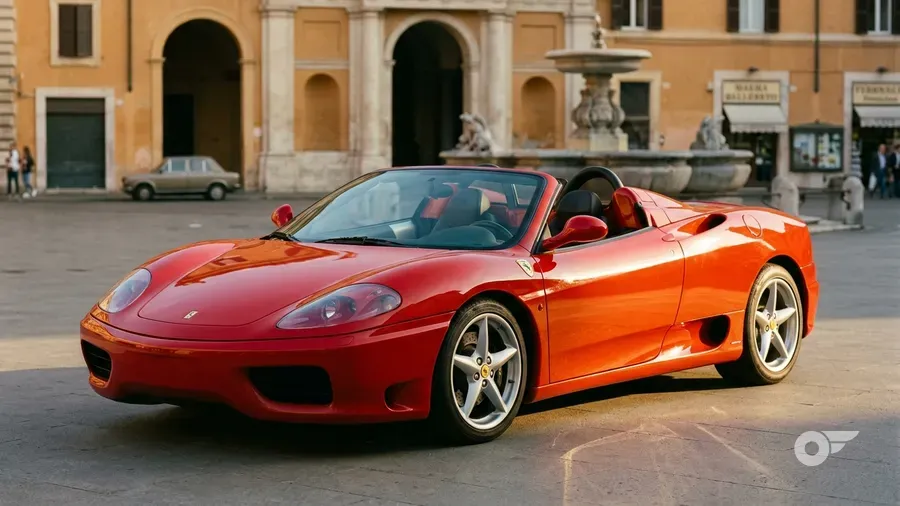
The convertible, with a powered folding top under a body-coloured tonneau. Mechanically identical to the coupe including the E-Diff and manettino. Factory manual Spiders are the rarest and most valuable ordinary F430s.

Scuderia Spider 16M · 2009

The open Scuderia, built in early 2009 to mark Ferrari's sixteenth Formula 1 Constructors' title, with a commemorative plaque on the rear grille. All were pre-sold before delivery. The most valuable F430 of all.

What owning one is like

An F430 is the most straightforward car in this family to live with, and the reason is one engineering decision: the F136 V8 uses chains, not belts, so the engine-out major service that defines 348 and F355 ownership simply does not exist here. What you budget for instead is the F1 system on the nine cars in ten that have it. The clutch is a normal single dry clutch worked by an electrohydraulic actuator, so it wears the way a manual clutch wears and city use destroys it, and the supporting hardware brings its own list: hydraulic pump, accumulator sphere, actuator seals, clutch position sensor. Exhaust manifolds crack. It is common enough that specialists treat it as an inspection item rather than a fault, and the risk is not the noise but debris from failing pre-cats finding its way back into the engine, so it is worth attending to early. Soft-touch plastics go sticky and stay sticky until refinished. None of this is unusual for the era, all of it is documented, and a well-kept F430 is a car you can drive properly and often.

Upkeep & parts

Running costs for the F430 are the lowest of these four by a wide margin, mainly because the belt service is gone. Servicing is ordinary, parts availability through Ricambi America and the European specialists is excellent, and the aftermarket for stainless manifolds and for refinishing sticky interior parts is mature and competitive. Budget the F1 clutch as a consumable and have wear read at every service so it stays a decision rather than an emergency, and treat the hydraulic pump and accumulator as items with a service life rather than as failures. A Scuderia adds carbon-ceramic brakes, which last a very long time and cost a great deal when they finally do not, so establish their remaining life before you buy. Ferrari's own approved network handles these cars comfortably, and independent specialists have twenty years of collective knowledge on the platform. FerrariChat's 360 and 430 forum is the working reference. Ferrari Classiche certification is now opening up as the earliest F430s pass twenty years old.

Country of origin
Italy
Class
Exotic
Production years
2004–2009
Units built
~16,750
Model
F430
Nickname
No nickname ("Scud" names the 430 Scuderia specifically, not the generation)
Body
Coupe, Spider
Layout
Mid-engine, RWD
Engine
4,308cc Tipo F136 E V8, flat-plane crank, chain-driven cams, 490 PS (483hp) at 8,500rpm; 510 PS (503hp) in the 430 Scuderia and Scuderia Spider 16M
Transmission
6-speed gated manual, 6-speed Graziano F1 automated manual (60ms shifts)
Designer
Pininfarina, under Frank Stephenson (Ferrari and Maserati design director)