Octane Files
Explore CarsFerrari 360 Modena

Ferrari 360 Modena

Overview

The 360 is where this line stopped being a niche. Ferrari threw away the steel structure and built an aluminium space-frame with Alcoa, 40 percent stiffer than the thing it replaced and 28 percent lighter even though the car grew about ten percent in every direction. Then it let aerodynamics run the styling. There are two separate radiator intakes in the nose instead of one central mouth, twin diffusers under the tail generating ground effect, and no rear wing at all, because the underside was doing the work. The pop-up headlights went, and with them the last of the wedge era. The V8 went to 3,586cc with titanium con-rods and 400 PS at 8,500rpm, run by drive-by-wire Motronic with traction control, and for the first time on a V8 Ferrari the steering was power-assisted as standard. It was also the first of these cars whose cam belts could be changed with the engine still in it, which is a bigger deal to an owner than any of the above. 17,653 were built in five years, more than the 348 and F355 together.

Distinctions

The defining attributes and collector status that make this car garage-worthy.

Octane Files Select
Renowned for its history, engineering, or cultural weight.

Collectibility scorecard

Rated 1 to 10 on the traits that matter for owning, driving, and holding on to a car like this.

Desirability
7/10
Rarity
4/10
Driving thrill
8/10
Investment trajectory
6/10
Usability
7/10
Ease of restoration
5/10
Cultural impact
7/10
Electronic dependence
Fully analogHeavily electronic

Bosch Motronic ME7.3 with drive-by-wire throttle runs the engine through two control units and two throttle bodies talking over CAN, deciding the actual throttle opening from pedal position, road speed, gearbox state and the traction control. ASR traction control is integrated with the ABS and switchable between Normal, Sport and off. The steering is power-assisted for the first time on a V8 Ferrari, the dampers are electronically controlled, and most cars left with an electrohydraulically actuated gearbox. This is a car where the electronics are in the loop everywhere, but there is still no stability control and no active differential; both arrive on the F430.

Market data

Demand tier, price trend, and typical values by condition. Our own assessment, not a quoted valuation.

Demand tier
EntrySolidHighBlue-chip

A dependable market. Well-kept cars hold their value and find ready buyers.

Value trajectory
AppreciatingStableCooling

Values are holding steady. What you pay today is what it's worth tomorrow.

Price by condition
Driver
$65k
Excellent
$95k
Concours
$150k

The 360 is the value floor of the modern Ferrari market and has been for a decade, which is why the band below is where it is. Tracked averages put an F1 Modena around 74,300 dollars and a manual Modena around 126,400, and that gap is the story of this car's market: the gearbox is worth more than the year, the mileage or the body style. UK guide values put a Modena in average condition near 61,500 pounds. Ordinary F1 cars have been broadly flat for several years, which is what the stable call reflects, while manuals have been climbing steadily and are the part of the market actually moving. The Challenge Stradale is in a separate market entirely, with a tracked average near 326,400 dollars and UK guide values around 181,400 pounds, and it is excluded from the band along with the Challenge, N-GT, GT and GTC race cars.

Values as of August 2026.

Buyer's guide

What anyone seriously considering this car should know first.

Why it's worth it
The car that made a Ferrari a usable proposition, and doubled the volume of the line
Callout
The first Ferrari V8 whose cam belts could be changed without dropping the engine out
What to watch for
The 360's reputation for being the easy one to own is earned, but it comes with a specific inspection list. The good news first: belts and tensioners are done with the engine in the car, so the service that dominates 348 and F355 ownership is an ordinary garage job here. What replaces it as the big-ticket item is the F1 gearbox on the majority of cars. Have the clutch wear measured properly rather than estimated, and get the actuator, the hydraulic pump and the accumulator checked, because a car that lived in traffic will have chewed through clutches and the hydraulics fail in ways that leave the car stranded rather than limping. Exhaust manifolds crack. This is a family trait, it is visible on inspection and it has a well-established aftermarket fix, but a cracked manifold is not a bargaining chip a seller will always concede. Soft-touch plastics on switches, vent surrounds and console panels go tacky and can only be stripped and refinished, never wiped clean. On Spiders, cycle the roof fully. On a Challenge Stradale, check for Challenge-series use, because a fair number were tracked.

The Story

Driving character

The 360 is the first car in this family that flatters rather than tests you. The aluminium structure is noticeably stiffer than the F355's steel, and the payoff is a car that stays composed over bad surfaces and lets the suspension do its job instead of arguing with the chassis. Power steering arrives, quicker than the F355's at 2.7 turns lock to lock, and while it filters a little of the feel the old car had, it makes the 360 a car you can drive across a country. The engine is the reason to own one. It pulls cleanly from low revs, which the 348 and F355 never really did, then hardens through 6,000 and screams to 8,500 with the induction noise sitting directly behind your head under a glass cover. The F1 gearbox in period was slow and clumsy by modern standards and it still is, but it is quick enough not to spoil the car and it suits the way most owners use one. The manual is better, and the gate is the thing you will remember. The Challenge Stradale is a different car altogether: harder, noisier, more urgent, and one of the great Ferrari driving experiences.

Design

This is the first modern Ferrari where aerodynamics drove the shape rather than decorating it. Goran Popović's exterior, done under Lorenzo Ramaciotti at Pininfarina, replaces the single central mouth of every V8 Ferrari before it with two separate radiator intakes flanking a body-coloured nose, a layout borrowed from the sports prototypes of the 1960s and adopted here because the radiators needed to move. The tail carries twin diffusers rather than a wing, which is why the shape stays so clean from behind, and the underbody is flat between them. The pop-up headlights are gone for the first time on a mid-engine V8 Ferrari, replaced by fixed lenses under glass, and the car looks a generation newer for it. The engine sits under a glass cover, on display, a piece of theatre Ferrari has repeated ever since. Ramaciotti filed the US design patent himself in 1999. It is not everybody's favourite Ferrari shape, and the rounded flanks have aged less gracefully than the F355's, but the logic underneath it set the template for every V8 Ferrari since.

Motorsport pedigree

The 360 took the family from a one-make series into serious international GT racing. The 360 Challenge replaced the F355 Challenge for the 2001 season, with fewer than 200 built and 416 PS, and it kept the one-make championship running across Italy, Europe and North America. The real work was done by Michelotto of Padua, the same firm that had built the racing 308s and 348s. Its 360 N-GT made over 547 PS unrestricted and became the car to have in the FIA GT Championship's N-GT class, where Andrea Bertolini and Fabrizio De Simone took the 2003 title in a Ferrari 360 Modena Pirelli. Michelotto also built 20 360 GTs between 2001 and 2004 at 436 PS and 1,070kg, and then the 360 GTC from 2004, restricted to 479 PS and capable of about 550 without the air restrictors. The cars ran Le Mans and Sebring in privateer hands without taking a class win, which is the honest limit of the record. What they did do is give Ferrari a competitive customer GT programme again, and the F430 GTC that followed turned that into Le Mans victories.

In culture

The 360 is the Ferrari that became ordinary, and that is its cultural significance rather than any single film. There are more than 17,000 of them, they were built during the years Michael Schumacher was winning everything, and by 2002 a red Ferrari in a television establishing shot was as likely to be a 360 as anything else. It did the screen work you would expect: a Spider in Charlie's Angels in 2000, a Spider in xXx in 2002, a Modena in Rush Hour 2, a Spider in 2 Fast 2 Furious. None of those is the car's defining appearance, because it does not have one, and the reason is that the 360 was everywhere. The best story attached to it is private. In August 2000 Gianni Agnelli secretly commissioned a one-off 360 Barchetta, chassis 120020, as a wedding present for Luca Cordero di Montezemolo. It has no roof, no roll hoops and a wind deflector where the windscreen should be, and it was never for sale.

Owning One

Why collectors want it

The 360 is the cheapest way into a modern, usable mid-engine Ferrari, and that is not a backhanded compliment. It has the aluminium chassis, the eight-thousand-five-hundred-rpm V8, the ground-effect underbody and a service regime that does not require the engine to come out, so it is the first car in this family you can genuinely use without arranging your finances around it. The hierarchy is unusually steep for a car this common. At the very top, the 360 Challenge Stradale, which is the connoisseur's pick and now trades at several times an ordinary Modena: lighter by up to 110kg, 425 PS, Enzo-derived carbon-ceramic brakes, and a Fiorano lap Ferrari claimed was three and a half seconds quicker. Then the gated manuals, which are a small minority of the run and pull a large premium over the F1 cars that made up most of it. Then the Spiders, then the F1 coupes, which are the entry point and the most likely to have been used hard.

Which one to look for

The Challenge Stradale is the one to want and everyone knows it, which is why it costs several times a Modena. 2003 and 2004 only, 425 PS, up to 110kg stripped out through carbon mirrors, Lexan windows, Alcantara and deleted soundproofing, carbon-ceramic brakes taken from the Enzo, and a claimed three and a half seconds a lap at Fiorano over a standard car. Ferrari has never published how many were built; the independent VIN registry works to about 1,300, of which 119 were right-hand drive. Below it, the gearbox decides everything. The gated six-speed manual was the minority choice when new and is the majority preference now, and the premium over an F1 car is the largest single number in the 360 market. Among the standard cars the Modena coupe is the driver's choice and the Spider the softer, more numerous one at 7,565 built against 8,800 coupes. The 360 Challenge, 360 N-GT, 360 GT and 360 GTC are race cars, built by Michelotto, and belong in a different conversation entirely.

360 Barchetta · 2000

A one-off, chassis 120020, built on the Spider with the roof mechanism and roll hoops removed, a different engine cover and a wind deflector in place of the windscreen. Gianni Agnelli commissioned it secretly as a wedding present for Luca Cordero di Montezemolo.

360 Challenge · 2000–2005

The one-make race car, replacing the F355 Challenge for the 2001 season. 416 PS, 1,250kg, slicks, full cage and safety equipment. Ran the Italian, European and North American Ferrari Challenge championships.

360 Challenge Stradale · 2003–2004

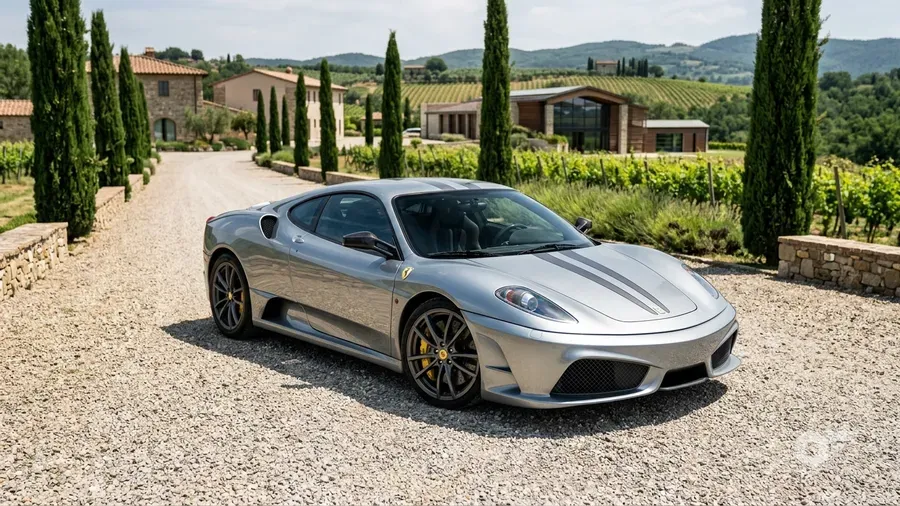
The connoisseur's 360 and the start of the modern lightweight-special line that runs on to the 430 Scuderia, 458 Speciale and 488 Pista. 425 PS, 1,430kg after up to 110kg was stripped out with carbon mirrors, Lexan windows, Alcantara trim and deleted soundproofing, plus carbon-ceramic brakes derived from the Enzo which saved a further 16kg. Ferrari claimed 3.5 seconds a lap quicker at Fiorano than a Modena. Sold as 20 percent track, 80 percent road.

360 GT · 2001–2004

Michelotto's customer GT racer, 436 PS and 1,070kg, campaigned by privateer teams in international endurance racing including Le Mans and Sebring.

360 GTC · 2004–2005

The final development of the racing 360, restricted to 479 PS and capable of about 550 without restrictors, at 1,100kg. The last Michelotto 360 before the F430 GTC took over.

360 Modena · 1999–2004

The launch car, shown at Geneva in 1999. Aluminium space-frame, 400 PS at 8,500rpm, twin rear diffusers and no wing, power-assisted steering as standard, and a choice of gated six-speed manual or F1 paddle shift. 1,493kg.

360 N-GT · 2001–2003

Michelotto's FIA GT car and the fastest 360 of all. Over 547 PS with the air restrictors removed. Andrea Bertolini and Fabrizio De Simone took the 2003 FIA GT N-GT class title in one.

360 Spider · 2000–2004

The full convertible, with a powered folding top that stows under a hinged rear tonneau. 60kg heavier than the coupe at 1,553kg and the more numerous choice in some markets. Same engine, same gearbox options.
What owning one is like

The 360 is the point at which owning one of these stopped being an event and started being a car. Belts and tensioners are done with the engine in place, so the service that dominates 348 and F355 ownership costs a fraction here, and the engine itself is strong and happy at high revs. The bills that do arrive come from three places. F1 gearbox clutches wear like manual clutches because that is what they are, and a car used in traffic will get through them, while the actuator seals, the accumulator and the hydraulic pump are all known failure points that leave the car immobile rather than limping. Exhaust manifolds crack with age and heat, and the aftermarket stainless replacement is the accepted answer. Soft-touch plastics turn sticky and cannot be cleaned, only refinished, which is now a small industry of its own. Beyond those, the list is short: Spider roof mechanisms want exercising, the catalytic converters are expensive when they go, and the electronics are period-Italian but far better than what came before.

Upkeep & parts

This is the easiest car in the family to keep, and the parts position is excellent. Ricambi America and the European specialists list belts, tensioners, clutch kits and F1 hydraulic components as ordinary stock items, aftermarket stainless manifolds are a solved problem, and there is a well-developed trade in refinishing sticky interior parts. Budget the belt service on a three-year cycle, but budget it as a normal job rather than an engine-out event. On an F1 car, plan for a clutch as a consumable and have wear read at every service so it is a decision rather than a surprise. The Challenge Stradale adds carbon-ceramic discs that are extremely durable but very expensive when finally worn, so establish their condition before you buy one. Ferrari Classiche now certifies 360s as the earliest cars pass twenty years old. ChallengeStradale.com is the definitive VIN registry for the CS, Club Challenge Stradale is where those owners talk, and FerrariChat's 360 and 430 forum carries the general diagnostic knowledge.

Country of origin
Italy
Class
Exotic
Production years
1999–2004
Units built
~17,653
Model
360 Modena
Nickname
No nickname ("CS" names the Challenge Stradale specifically, not the generation)
Body
Coupe, Spider
Layout
Mid-engine, RWD
Engine
3,586cc Tipo F131 V8, flat-plane crank, titanium connecting rods, 400 PS (395hp) at 8,500rpm; 425 PS in the Challenge Stradale
Transmission
6-speed gated manual, 6-speed Graziano F1 automated manual
Designer
Goran Popović (Pininfarina, under Lorenzo Ramaciotti)