Octane Files
Explore CarsFerrari 348

Ferrari 348

Overview

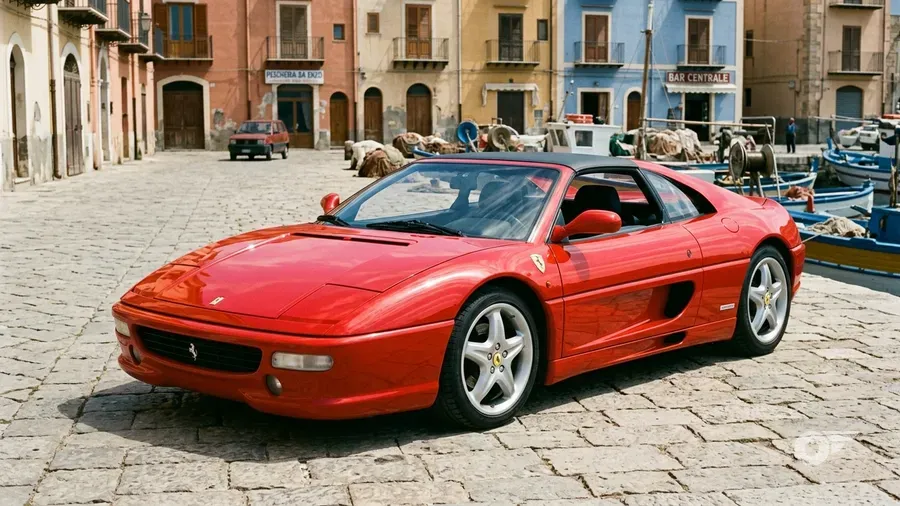
The 348 had two jobs and got credit for neither. It replaced the 328, the most reliable Ferrari anyone had built to that point, and it had to carry the V8 line into the 1990s against a Japanese car that was about to make exotics look badly assembled. Ferrari turned the engine ninety degrees, mounting the 3.4-litre V8 longitudinally with the gearbox across the car behind it, which is where tb and ts come from. The tubular frame went too, replaced by a pressed-steel monocoque with welded-on panels. The styling took the Testarossa's straked side intakes and shrank them. On paper this was a serious step, and Frankfurt gave it Best in Show in September 1989. On the road it was the car that snapped, and the Honda NSX arrived the following year to say so in public at less than half the price. Ferrari revised the rear geometry mid-run, then gave the last cars 320hp and the GTB, GTS and Spider names. 8,844 were built. It is the cheapest way into a mid-engine Ferrari, and the reasons for that are exactly the reasons to understand it first.

Distinctions

The defining attributes and collector status that make this car garage-worthy.

Octane Files Select
Renowned for its history, engineering, or cultural weight.

Collectibility scorecard

Rated 1 to 10 on the traits that matter for owning, driving, and holding on to a car like this.

Desirability
6/10
Rarity
6/10
Driving thrill
7/10
Investment trajectory
6/10
Usability
5/10
Ease of restoration
4/10
Cultural impact
6/10
Electronic dependence
Fully analogHeavily electronic

Bosch Motronic engine management and ABS are the extent of it. There is no traction control, no stability control, no electronic damping and no drive-by-wire. The throttle is a cable, the steering is unassisted rack and pinion, and the five-speed gated shift is mechanical and the only transmission ever fitted. The engine management can strand you if a sensor fails, which is why this is not a 1, but nothing between your right foot and the rear tyres is making a decision on your behalf.

Market data

Demand tier, price trend, and typical values by condition. Our own assessment, not a quoted valuation.

Demand tier
EntrySolidHighBlue-chip

A dependable market. Well-kept cars hold their value and find ready buyers.

Value trajectory
AppreciatingStableCooling

Values are climbing. The market wants more of these than exist.

Price by condition
Driver
$60k
Excellent
$85k
Concours
$125k

Tracked averages sit around 86,600 dollars across all 348s, with the tb at roughly 69,900, the ts at 79,500 and the Spider at 78,400, so the body-style hierarchy is flatter here than on most Ferraris. The band below describes the volume cars. The two specials sit outside it entirely: the 50 GT Competiziones trade in six figures well beyond any standard car, and the 100 numbered Serie Speciales carry a clear premium over an equivalent ts. Late 320hp GTB and GTS cars are the strongest part of the ordinary market. The single biggest swing factor is not body style or year but whether the engine-out belt service has been done recently and documented, which can move a car by the price of the service twice over.

Values as of August 2026.

Buyer's guide

What anyone seriously considering this car should know first.

Why it's worth it
The Ferrari the press stopped being polite about, and the reason the F355 exists
Callout
The Ferrari Challenge one-make series was invented in 1993 for this car
What to watch for
Everything about buying a 348 comes down to one line in the service file. The cam belt cannot be reached with the engine in the car, so the major service means dropping the engine and gearbox out of the bottom, and the labour alone typically runs six to eight thousand dollars. A car with a recent engine-out and the invoices to prove it is worth meaningfully more than the same car without them, and the gap is wider than most sellers admit. Ask for the paperwork, not the recollection. Establish which side of the factory's suspension revision the car sits on, because Ferrari changed the rear mounting points and the alignment specification during the run, and a car set up to the earlier numbers behaves differently at the limit. Have the geometry checked either way. The pressed-steel monocoque means rust is a live question in a way it never was on a glassfibre 308, so look hard at sills, floors and the front bulkhead. Soft-touch switchgear turns sticky. Pop-up headlight motors and door mechanisms are the usual electrical grumbles. A Serie Speciale carries a numbered plaque on the passenger door post.

The Story

Driving character

The 348 rewards a driver who commits and punishes one who dithers, which is the whole story of its reputation. The steering is unassisted and talks constantly, the gated five-speed wants a warm gearbox and a firm hand and will baulk into second until it gets one, and the flat-plane V8 does its real work above 4,000rpm with a hard metallic edge that no cross-plane engine makes. It is not a fast car by modern numbers and it never was. What it is, is short in the wheelbase, mid-engined and analogue, with the mass concentrated behind you and nothing electronic waiting to catch a mistake. Get the entry right and it rotates beautifully. Get it wrong, run out of road and lift, and it will keep rotating. Period testers said so plainly and the factory agreed enough to change the rear geometry during production. Late cars on modern rubber and correct alignment are a good deal more benign than the reputation suggests, and a 348 driven properly is one of the most involving things Ferrari sold in the 1990s.

Design

Pininfarina drew the 348 as a scaled Testarossa and never pretended otherwise. The straked side intakes are the signature and they are functional, feeding the side-mounted radiators the new longitudinal engine layout required, but they read as family resemblance first and engineering second. The tail is the other half of the trick: full-width slatted panel, four round lamps behind it, the same visual language the Testarossa used to look wider than it was. The nose is flat, low and almost featureless, with pop-up headlights and a shallow air dam. The 1993 GTB and GTS quietly cleaned it up, losing the slatted tail treatment for body-coloured panels and a plainer rear, and to a lot of eyes that is the better-resolved car. This was the last Ferrari design overseen by Leonardo Fioravanti as Pininfarina's chief stylist, and it closes the wedge era that started with the Berlinetta Boxer. The F355 that followed abandoned the straight line entirely.

Motorsport pedigree

The 348 is the reason the Ferrari Challenge exists. Ferrari created the one-make series in 1993 for owners of the 348 Challenge, an Italian and European championship in the first year with North America added in 1994, and the opening race ran at Monza on 28 March 1993 with Paolo Rossi winning in car number 5. The car was a 348 tb with 320hp, slick tyres, a roll cage, a six-point harness and a circuit breaker, and it ran until 1995 before the F355 Challenge took over. Every mid-engine V8 Ferrari since has had a Challenge car. In serious competition, Michelotto of Padua built the racing 348s that took Oscar Larrauri to eight GT2 class wins in the Italian Supercar Championship, and it was a Michelotto car that produced the generation's best day: at Le Mans in 1994 the 348 GTC/LM chassis 97553 finished 11th overall and fourth in class, making it the first Ferrari to finish that race since the 512 BB LMs of 1982. A Shelton Brothers 348 took 16th overall at the Daytona 24 Hours the same year.

In culture

The 348's screen record is thin and it is honest to say so. It turns up as background metal in Scent of a Woman and a handful of early-1990s films rather than as anyone's hero car, and no video game made it famous. Its cultural weight sits somewhere else. This was the first completely new Ferrari announced after Enzo Ferrari's death in August 1988, developed under him and launched without him, and it arrived at the exact moment the motoring press stopped granting Maranello the benefit of the doubt. The 1990 group tests that put the Honda NSX above it were a genuine event in the culture of the hobby: for the first time, buyers were told in print that a Ferrari was not automatically the best car in its class. Ferrari's response over the next decade is the story the rest of this line tells. The name enthusiasts gave the car, Baby Testarossa, has outlived every road test that panned it.

Owning One

Why collectors want it

The 348 is the cheapest way into a mid-engine Ferrari, which is the argument both for it and against it. What the money buys is a flat-plane V8, a gated five-speed that is the only gearbox the car was ever offered with, unassisted rack and pinion steering, and no traction control, no stability control and no electronic aid of any kind beyond ABS. Nothing else wearing a prancing horse offers that combination at this price, and nothing new ever will again. The hierarchy inside the generation is steep. At the top sit the 50 GT Competiziones, lightweight cars with carbon-Kevlar panels and F40 Evoluzione brakes, trading in a market of their own. Below them the 100 numbered Serie Speciales built for North America. Then the 1993-on GTB, GTS and Spider, which carry the 320hp engine and every revision the factory made along the way. The tb and ts are the volume cars and the way in. Values have climbed steadily rather than sharply, pushed by the same thing pushing every unassisted analogue supercar.

Which one to look for

The 50 GT Competiziones are the grail and they are barely 348s by the end: carbon-Kevlar doors and bumpers, F40 Evoluzione brakes, F40-style seats with four-point belts, 18-inch split-rim Speedlines, 1,280kg, an official 320bhp that specialists believe was closer to 340, and 11 of the 50 in right-hand drive. Below that, the 100 Serie Speciales, all North American, numbered on a door-post plaque, with 312hp, a rear track widened by 50mm, shorter gearing and unique tail lights. Then the 1993 revision, which is the one that matters to ordinary buyers: the GTB, GTS and Spider got 320hp, higher compression and the benefit of every chassis change made since 1989, so a late car is simply a better car than an early one. The Spider is the only full convertible in the family and the rarest of the three volume bodies at 1,090 built, against 4,228 ts and 2,894 tb. The Challenge cars are race conversions and Ferrari has never published how many were built.

348 Challenge · 1993–1995

The car the Ferrari Challenge was invented for. A 348 tb with 320hp, slicks, modified brakes, dynamic air intakes, a roll cage, six-point harness, fire extinguisher and circuit breaker. Ran the Italian and European series from 1993 and North America from 1994, then handed over to the F355 Challenge.

348 GT Competizione · 1993–1994

The peak of the 348 and one of the rarest modern V8 Ferraris. Carbon-Kevlar doors and bumpers, F40 Evoluzione brakes, F40-style seats with four-point harnesses, stripped trim, 18-inch split-rim Speedlines and 1,280kg, 90kg under a 348 GTB. Officially 320bhp, widely believed to be more. Built to mark Oscar Larrauri's GT2 class success with the Michelotto race cars, and 50 cars happened to satisfy GT homologation.

348 GTB · 1993–1996

The 1993 revision of the berlinetta. 320 PS, higher compression, revised gearing and the cumulative benefit of every chassis change made since 1989, plus a cleaner body-coloured tail in place of the slatted Testarossa treatment. The rarest of the standard closed cars.

348 GTS · 1993–1996

The targa version of the 1993 revision, sharing the GTB's 320 PS engine, gearing and cleaned-up rear. Built in even smaller numbers than the GTB.

348 Serie Speciale · 1992–1993

A North America-only run, numbered 1 to 100 on a plaque set into the passenger door post. 312hp, rear track widened by 50mm, shorter final drive, free-flow exhaust, unique tail lights, revised front spoiler and colour-coded skirts. Twelve were built in 1992 and the remaining 88 in 1993.

348 Spider · 1993–1996

The first full convertible mid-engine V8 Ferrari, with a proper folding soft top rather than a lift-out panel. Shares the 320 PS engine and the 1993 revisions. Heavier than the closed cars and the only one of the three bodies that carried on into the F355 era as a shape Ferrari kept offering.

348 tb · 1989–1993

The launch berlinetta. Fixed roof, 300 PS from the 3.4-litre V8, five-speed gated manual, and the car every period road test was written about. The b is for berlinetta and the t is for the transverse gearbox behind the longitudinal engine.

348 ts · 1989–1993

The targa, and the one most buyers actually chose. Identical mechanically to the tb with a lift-out roof panel that stows behind the seats. Outsold the berlinetta comfortably and still trades slightly above it.
What owning one is like

A sorted 348 is a straightforward car to live with and an unsorted one is an expensive lesson, and the difference is almost entirely documentation. The belt service is the headline: it comes round on the calendar rather than the odometer, and it needs the engine out, so owners plan for it years ahead and buyers should read the file before they read the advert. The engine itself is stout and there are cars well past 50,000 miles running on original internals. Beyond that, expect the era's usual grumbles. Soft-touch plastics on switches and vents break down and go tacky, and the only real fix is stripping and refinishing them. Pop-up headlight motors fail. The gearbox baulks into second until it warms up, which is normal and not a fault. Exhaust manifolds crack with age, as they do on every car in this family. Air conditioning is period-Italian. None of it is mysterious, all of it is known, and the specialist network for these cars is deep enough that nothing here counts as an adventure.

Upkeep & parts

Parts supply is genuinely good, which surprises people expecting an orphan. Ricambi America and the European Ferrari specialists carry service kits, belts, tensioners, clutches and most trim, and the mechanical parts are shared widely enough across the 348 and Mondial t that availability is not the problem. Labour is. Budget for the engine-out major every three years or 30,000 miles, whichever arrives first, at roughly six to eight thousand dollars in labour before parts, and do the water pump, tensioner bearings, seals and clutch inspection while the engine is on the bench because you are paying for the access either way. A clutch is the other predictable spend. Find a specialist who has done a 348 belt service before rather than a generalist who will learn on yours. Ferrari Classiche will certify a 348 now that the cars are over twenty years old, and the factory archive holds build records for every one of them. FerrariChat's 348 and 355 sub-forum is where the accumulated knowledge actually lives.

Country of origin
Italy
Class
Exotic
Production years
1989–1996
Units built
~8,844
Model
348
Nickname
Baby Testarossa
Body
Coupe, Targa, Spider
Layout
Mid-engine, RWD
Engine
3,405cc Tipo F119 V8, flat-plane crank (300 PS / 296hp in tb and ts; 320 PS / 316hp in GTB, GTS and Spider from 1993; 312hp in the North American Serie Speciale)
Transmission
5-speed gated manual (the only gearbox offered)
Designer
Pininfarina (final design overseen by chief stylist Leonardo Fioravanti)