Octane Files
Browse CarsCadillac Eldorado 7th Gen

Cadillac Eldorado 7th Gen

Overview

Cadillac redesigned everything for 1965, and for once the important changes were under the car rather than on it. The tubular X-frame that had carried every Cadillac since 1957 gave way to a perimeter frame with proper side rails, which let the engine sit six inches further forward, lowered the transmission tunnel and saved around 300 pounds. A new four-link rear suspension went in behind it, the quad headlamps stacked vertically so the grille could spread the full width of the nose, and the side glass curved for the first time in the division's history. The Eldorado came along and picked up a new name on the way. The Biarritz badge lapsed after 1964 and the car was sold as the Fleetwood Eldorado: one body style, one engine, and fender skirts back on after their single year away. The 429 carried over at 340 hp with the Turbo Hydra-Matic behind it. Cadillac built 2,125 for 1965 and 2,250 for 1966, the latter its best model year to that point at 196,675 cars. Nobody buying one that autumn knew it, but this was the end of something. The 1967 Eldorado would be a front-drive coupe on the Toronado's architecture, and no Eldorado ever drove its rear wheels again.

Distinctions

The defining attributes and collector status that make this car garage-worthy.

Octane Files Select
Renowned for its history, engineering, or cultural weight.

Collectibility scorecard

Rated 1 to 10 on the traits that matter for owning, driving, and holding on to a car like this.

Desirability
5/10
Rarity
6/10
Driving thrill
4/10
Investment trajectory
4/10
Usability
5/10
Ease of restoration
5/10
Cultural impact
4/10
Electronic dependence
Fully analogHeavily electronic

Nothing manages the engine. The 429 has one Carter four-barrel, points and a condenser, and a rod running from the pedal to the linkage. What keeps it off the fully analog mark is everything bolted around that: an alternator, power windows and a power seat, a hydraulic top driven by an electric pump, an automatic level control system with its own compressor and control valve, and on a 1966 the heated seat option, which decides for itself to come on below 50 degrees and to switch off again once the cabin heater catches up. None of it is computerised. A great deal of it is wired, and the wiring is what owners actually spend their evenings on.

Market data

Demand tier, price trend, and typical values by condition, based on recent sales data.

Demand tier
EntrySolidHighBlue-chip

A dependable market. Well-kept cars hold their value and find ready buyers.

Value trajectory
AppreciatingStableCooling

Values are holding steady. What you pay today is what it's worth tomorrow.

Price by condition
Driver
$25k
Excellent
$55k
Concours
$110k

Condition sets the price on these, not the year. classic.com's generation average is about $59,700, but the recorded range runs from $9,850 for a 1966 in March 2026 up to $150,700 for a 1965 in January 2026, and conceptcarz's aggregate of forty public sales of the 1966 car puts the median at $26,250 with excellent examples in the high thirties. Between those poles sit results like $99,500 on Bring a Trailer for a 1966 in October 2025 and $36,300 for a 1965 two months earlier. That is what happens to a car whose restoration costs several times its market value: good ones are scarce and tired ones are cheap. It sits in the Solid tier for the same reason its predecessor does, which is that it is hard to tell from a de Ville convertible and so commands only a modest premium over one. Last-of-line status is the argument for movement, and it has not been priced in yet.

Values as of August 2026.

Buyer's guide

What anyone seriously considering this car should know first.

Why it's worth it
The last rear-wheel-drive Eldorado ever built
Callout
For 1965 Cadillac built 2,125 Eldorados and 19,200 de Ville convertibles on the same body
What to watch for
A badge proves nothing on a car this close to an ordinary Cadillac, so start with the trim. A Fleetwood Eldorado wears Fleetwood crests on the hood and deck lid, carries no bodyside moulding at all apart from wide bright rocker trim, and has a rear grille the de Ville and Calais did not get. The 1965 convertible is body style 68467. Fender skirts are correct on both years, whitewalls were standard Eldorado equipment, and a 1966 should have walnut on the door and rear panels. Automatic level control was part of the Fleetwood specification, so check that the compressor and the rear Superlift shocks still hold the tail up. Then the usual full-size convertible survey, done patiently: floors, trunk pan, rockers, lower fenders, door bottoms, rear quarters, body mounts, and above all the structure around the top well, where years of a leaking roof do their damage out of sight. Cycle the top twice and watch the cylinders, hoses and pump while it moves. Drums at all four corners should pull the car up straight without a hard pedal. The expensive parts of this car are its Eldorado-only trim and its plating, never its engine.

The Story

Driving character

The first thing the 1965 chassis does is stop the car feeling like a boat with a spine. The perimeter frame is stiffer than the X-frame it replaced, and with the engine six inches further forward the car settles into a corner instead of leaning away from it. Nobody would call it agile. It is 224 inches long and weighs the better part of two and a half tons before anyone gets in, and the drums at all four corners want thinking about before a downhill bend rather than during one. What it does is cover ground. The 429 makes 480 lb-ft and does its work below 3,000 rpm, the Turbo Hydra-Matic changes gear without ever announcing itself, and the level control keeps the tail up whether the trunk is empty or holding four people's luggage. Catalogue and period figures put it a shade under nine seconds to 60 mph and a top speed in the low 120s, which is enough to make the point and not enough to matter. Drive a 1966 straight after a 1965 and the steering is the difference. The variable-ratio box makes that first quarter turn mean something, and parking stops being a two-handed event.

Design

1965 is the year Bill Mitchell's sheer look finished its work at Cadillac. The fins, a fixture since 1948, were flattened into a downward-canted edge that most people simply read as gone, and the quad headlamps stacked vertically, which let the grille run the full width of the nose and gave the car its wide-eyed stare. Side glass curved for the first time in the division's history, frameless on the convertible, so the car looks lower with the roof down than any Cadillac before it. The Eldorado's own identity here is made by subtraction: no bodyside moulding at all, wide bright rocker trim, Fleetwood crests on the hood and deck lid, and a rear grille of its own. Park it next to a de Ville convertible and the empty flank is what gives it away. For 1966 the grille mesh coarsened and gained a thick centre bar, the cornering lamps became separate rectangles, the rear was freshened and the whole car wore less brightwork. One curiosity sits behind the generation. GM Styling and Fisher Body built XP-850, a 1965 Fleetwood Eldorado fitted with a flush Infora top and a powered glass window, chasing Lincoln's flush roofline. It never reached production.

Motorsport pedigree

Cadillac entered nothing, and by 1965 there was nothing in the catalogue to enter with. The 429 came one way only, a single four-barrel and 340 hp, and had done since 1964; the last Eldorado you could order with more carburettors than a de Ville was a 1960. Add a 224-inch body, drum brakes at all four corners and an automatic with no manual alternative anywhere in the range, and no class in North American racing had a box this car fitted into. The clearest measure of where the engine stood is who was not buying it. In exactly these years European constructors were shopping in Detroit for V8s, and they came home with Chevrolet and Chrysler. Iso's Grifo and the Gordon-Keeble both took the 327, and Jensen's 1966 Interceptor took the Chrysler 383. Nobody built a grand tourer around a Cadillac 429. What did go racing was the hardware being prepared to replace this car. Hurst's Hairy Olds, an exhibition machine carrying a supercharged Oldsmobile 425 and a Toronado transaxle at each end, ran at Bakersfield in March 1966 specifically to show off Oldsmobile's new chain-driven front-drive package. That package became the 1967 Eldorado's.

In culture

The 1965 body is one of the most recognisable American shapes of the decade, and almost none of that recognition belongs to the Eldorado. When a film needs a mid-sixties Cadillac it casts a de Ville, sometimes the same one twice. The cream 1966 Coupe de Ville that Michael Madsen drove in Reservoir Dogs was his own car, restored and repainted decades later to become Rick Dalton's in Once Upon a Time in Hollywood. The Eldorado's own screen record is thinner than that. The best catalogued sighting of a 1965 Fleetwood Eldorado is a background car in an episode of the Batman television series, identified by spotters from its bare flank rather than from any badge. That is the honest position, and it says something true about the car. In 1966 Cadillac had its best model year yet at 196,675 cars, and the Eldorado was 2,250 of them, sitting in showrooms beside de Villes it barely differed from. A name that had meant an entirely separate machine in 1953 now meant a very well trimmed convertible, and the public largely stopped being able to point at one. The nameplate got its distinctiveness back in 1967, in a way nobody could miss.

Rivals

Cars from other manufacturers that competed for the same buyers when new.
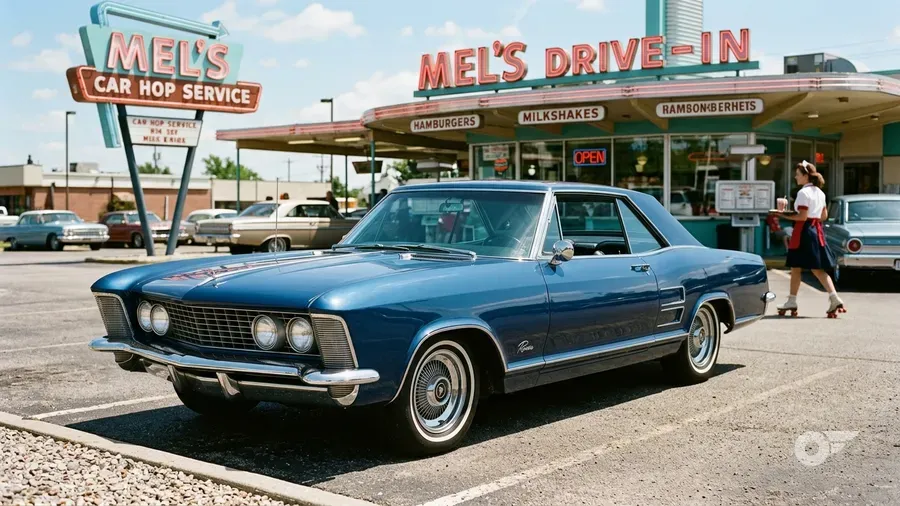
Buick Riviera 1st Gen

Buick Riviera 1st Gen

USA·Grand Tourer·1963–1965
Buick Riviera 2nd Gen

Buick Riviera 2nd Gen

USA·Grand Tourer·1966–1970

Ford Thunderbird 4th Gen

We haven’t profiled this car yet. Request to add

Chrysler Imperial 2nd Gen

We haven’t profiled this car yet. Request to add
Lincoln Continental 4th Gen

Lincoln Continental 4th Gen

USA·Luxury·1961–1969

Owning One

Why collectors want it

Two arguments carry this car. The first is that it is the best rear-drive Eldorado to actually use: the perimeter frame, the four-link rear axle and the Turbo Hydra-Matic make it quieter and far more composed than any X-frame Cadillac, and a 1966 adds variable-ratio steering that takes the vagueness out of the first quarter turn. The second is arithmetic. Cadillac built 4,375 of these across two years while selling de Ville convertibles by the tens of thousands, so the car is genuinely scarce and the market has never priced it that way. classic.com's generation average is around $59,700, while conceptcarz's aggregate of forty public sales of the 1966 car puts the median at $26,250. The same car in the right clothes made $99,500 on Bring a Trailer in October 2025, and a 1965 reached $150,700 in January 2026. That spread is the opportunity and the warning in one number: condition and documentation set the price here, not the year on the title. Within the generation, 1966 owns the last-of-line story that markets eventually notice and 1965 owns the engineering. Both are still cheap for a Fleetwood-badged convertible built in four figures.

Which one to look for

One body, one engine, no trim ladder, so the decision is a model year and an options list. The 1965 is the engineering year, and everything that makes this generation worth having arrived with it: the perimeter frame, the new rear suspension, curved side glass, stacked headlamps, and a tilting and telescoping steering column as standard equipment. The 1966 is the better car to drive and the better story to tell. Variable-ratio power steering is standard, which quickens the lock for parking and slows it down at speed, the rear end was freshened, there is noticeably less chrome on it, and it is the last rear-drive Eldorado Cadillac ever built. It also carries the one option worth hunting: heated front seats, carbon cloth pads built into the cushions and backs, $78.95, thermostatically triggered below 50 degrees. No production car had offered them before, they stayed on the books only through 1968, and the take rate was low enough that finding a car so equipped is a genuine event. After that, air conditioning is what moves money and leather is worth having. The rest of the sheet is detail.

What owning one is like

Everything about owning one starts with the dimensions. This is 224 inches of car on a 129.5 inch wheelbase, which fits no modern parking bay and turns around in about the space of a small roundabout, and the marque's own reference figures for fuel consumption run from 8 to 14 mpg depending entirely on your right foot. After that it is ordinary 1960s American convertible ownership carried out at scale. Rust settles in the floors, trunk pan, rockers, lower fenders, door bottoms, rear quarters and body mounts, and above all in the structure around the top well, because a roof that has leaked for years soaks the metal underneath it. The top is hydraulic, run by an electric pump, and the cylinders, hoses and pump are consumables rather than surprises. The level control system adds a compressor and a pair of Superlift shocks to the list of things that can quietly stop working. Power windows, the power seat, switches, relays and grounds all age, and chasing an intermittent circuit is the classic winter evening with one of these. The mechanical side is the easy part. The 429 is understressed, the Turbo Hydra-Matic is close to indestructible, and the drums are fine when properly adjusted.

Upkeep & parts

The rule with these is that anything Cadillac built 180,000 of is cheap and anything it built 2,000 of is not. Engine, transmission, brake, suspension and cooling parts are shared with every other 1965 and 1966 Cadillac and are still catalogued by the specialist suppliers, so a rebuild is an ordinary bill. Rubber, weatherstrip and rust repair panels for the full-size cars are reproduced. What costs real money is anything with Eldorado or convertible in front of it: the Fleetwood crests and rocker trim, the rear grille, top frame hardware, correct interior board, and plating. Chrome and pot metal will outrun mechanical work on any restoration of one of these, so budget for the top and the brightwork first and the engine last. Fuel is premium, since compression is 10.5 to 1. The knowledge base is unusually strong for a car at this price. The Cadillac and LaSalle Club runs a museum and research centre and an active forum, and the New Cadillac Database is a free archive of production and specification records most marques would envy, including the year-by-year Eldorado tables that let you check what a seller is telling you.

Country of origin
USA
Class
Luxury
Production years
1965–1966
Units built
~4,375
Model
Eldorado
Nickname
No nickname (Biarritz names the 1956 to 1964 Eldorado convertibles specifically, not this generation)
Body
Convertible
Layout
Front-engine, RWD
Engine
429ci OHV V8, 340hp
Transmission
3-speed Turbo Hydra-Matic automatic
Designer
Bill Mitchell (GM Design direction)