Octane Files
Browse CarsCadillac Eldorado 6th Gen

Cadillac Eldorado 6th Gen

Overview

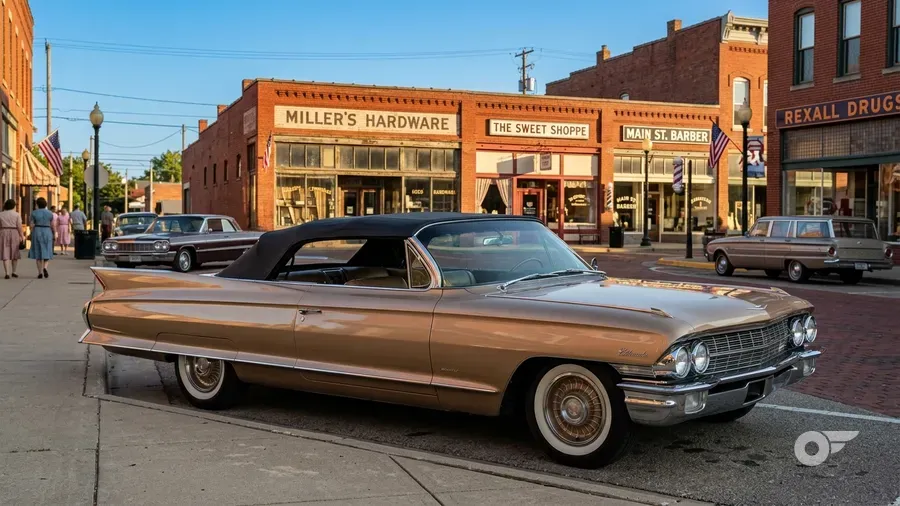
The Eldorado spent 1961 and 1962 as little more than a script on the flank of an ordinary Cadillac convertible, and 1963 is where the division started giving it something back. The whole line was rebodied that year, flatter and squarer, with the front fenders pushed 4.625 inches further forward and the fins cut down again. The Eldorado moved onto a Fleetwood body, which mattered: only the Sixty Special and the Series 75 carried Fleetwood coachwork, and no Cadillac convertible had worn the Fleetwood wreath and crest since 1941. Underneath, the 390 V8 was completely reengineered and lightened, though Cadillac made little of it because the displacement and the 325 hp rating had not moved. For 1964 the engine grew to 429 cubic inches and 340 hp, GM's new three-speed Turbo Hydra-Matic replaced the old four-speed unit, and Comfort Control arrived as the industry's first fully automatic heating and air conditioning system. Cadillac built 1,825 for 1963 and 1,870 for 1964, out of more than 329,000 cars across the two model years. This is the quiet Eldorado, the last one on the X-frame chassis and the last built while Cadillac still had fins worth the name.

Distinctions

The defining attributes and collector status that make this car garage-worthy.

Octane Files Select
Renowned for its history, engineering, or cultural weight.

Collectibility scorecard

Rated 1 to 10 on the traits that matter for owning, driving, and holding on to a car like this.

Desirability
5/10
Rarity
6/10
Driving thrill
4/10
Investment trajectory
4/10
Usability
5/10
Ease of restoration
5/10
Cultural impact
4/10
Electronic dependence
Fully analogHeavily electronic

Nothing manages the engine. The 390 and the 429 breathe through a single four-barrel carburettor and fire on points and a condenser, and the throttle is a rod to the linkage. What lifts the car above fully analog is everything bolted around that: an alternator in place of a generator from 1963, power windows, power vent windows, a six-way power seat, a power trunk lock, a hydraulic top run by an electric pump, and on a 1964 the Comfort Control system, which holds a chosen temperature by itself once the dial is set. None of it is computerised and none of it can strand you at the roadside, but a great deal of it is wired, and that wiring is what owners actually spend their evenings chasing.

Market data

Demand tier, price trend, and typical values by condition, based on recent sales data.

Demand tier
EntrySolidHighBlue-chip

A dependable market. Well-kept cars hold their value and find ready buyers.

Value trajectory
AppreciatingStableCooling

Values are holding steady. What you pay today is what it's worth tomorrow.

Price by condition
Driver
$30k
Excellent
$65k
Concours
$115k

The 6th Gen is the value end of the classic Eldorado market and has been for years. classic.com's generation average sits around $63,000 against roughly $91,000 for the 1961 to 1962 cars, and the gap is not about condition. It is that this is the hardest Eldorado to tell from an ordinary Cadillac, so it commands the smallest premium over a Series 62 or de Ville convertible. Real results cluster tightly: $60,500 for a documented unrestored 1964 at RM Sotheby's Hershey in 2024, $62,580 for a 1963 at ACC Auctions in early 2025, with a recorded low of $16,500 in April 2024. The thin top of the market belongs to properly restored 1963s, one of which reached roughly $120,000, and Hagerty's guide puts a condition-two 1963 above $108,000. Values are flat rather than falling. The catalyst that would move them, a broad rediscovery of mid-sixties Cadillac styling, has not arrived yet.

Values as of August 2026.

Buyer's guide

What anyone seriously considering this car should know first.

Why it's worth it
The first Fleetwood-bodied Cadillac convertible since 1941, and the first car of any kind with a Turbo Hydra-Matic
Callout
For 1964 the only thing separating an Eldorado from a de Ville convertible was the missing fender skirts
What to watch for
Start with the serial number, because on a car this close to an ordinary Cadillac a badge proves nothing. The 1963 Eldorado convertible is body style 6367E and its serial reads 63E followed by six digits; the auction record is full of the pattern. Then look for what the Eldorado had and a Series 62 did not: the Fleetwood wreath and crest on the rear quarters, Fleetwood rocker mouldings, and on a 1964 car open rear wheel openings, because the skirts came off that year. A 1964 wearing skirts has been dressed by somebody. Rust follows the usual full-size convertible map and rewards being methodical: floors, trunk floor, lower quarters, rockers, body mounts, windshield frame, and above all the metal around the top well, where thirty years of a leaking top do their work out of sight. Cycle the top fully, twice, and watch the hydraulic cylinders and lines while it moves. The expensive faults on these cars are cosmetic rather than mechanical: pitted pot metal, correct interior board, convertible weatherstrip and chrome. A tired 429 is the cheap problem here, not the dear one.

The Story

Driving character

Close to two and a half tons of Cadillac moving off from rest is not fast by any measurement, and it is still one of the more satisfying things you can do in a 1960s car. The 429 does its work below 3,000 rpm: 480 lb-ft, delivered without drama, through a converter that never lets you feel a shift arrive. Drive a 1963 and a 1964 back to back and the transmission is the first difference you notice. The old four-speed Hydra-Matic changes gear with a mechanical shrug you can feel through the seat; the Turbo Hydra-Matic simply gets on with it. Steering is assisted to the point of numbness, which everybody complains about and nobody minds once they stop treating the car as a sports car. Brakes are drums at all four corners and want planning, particularly downhill with the top down and five people aboard. What the car is genuinely good at is covering distance quietly. The X-frame chassis and long soft coils isolate almost everything, the body is long enough that the road stops registering, and at seventy the loudest thing in the car is the wind coming over the windscreen header.

Design

The 1961 and 1962 Cadillacs carried a second fin low on the rear quarter, so the car showed four fins from behind. Bill Mitchell thought the tail looked like a rocket ship, and for 1963 the lower pair were gone. What replaced them is the start of Mitchell's sheer look at Cadillac: flat, taut sides with the sculpturing pressed out of them, a crisp shoulder line and fins trimmed back to a blade. The front fenders were pushed 4.625 inches further forward, which lengthened the nose and reset the proportions of the whole car, and the slightly V-shaped grille grew taller with outboard extensions carrying small round parking lamps. The Eldorado's own markings are deliberately quiet: the Fleetwood wreath and crest on the rear quarters, Fleetwood rocker mouldings, and the same rectangular grille mesh as the Sixty Special. For 1964 the grille became bi-angular, V-shaped in both planes and split by a body-coloured bar, the fins were redrawn as fine blades in their seventeenth consecutive year, and the rear wheel openings were opened up. Losing the skirts made the car look faster and made it look less like an Eldorado.

Motorsport pedigree

Cadillac ran no competition programme in 1963 or 1964, and there was nowhere obvious to take one. No series anywhere had a class for a 5,000 pound luxury convertible, the division's customers were buying silence rather than lap times, and Cadillac's engineering effort in these two years went into an automatic climate control system rather than a cylinder head. So the Eldorado never wore a number. Its transmission did. The three-speed Turbo Hydra-Matic fitted to the 1964 Eldorado, de Ville and Sixty Special was the first application anywhere of the unit the world came to know as the TH400, and it turned out to be one of the toughest automatics ever drawn. Its planetary gearset and its entirely mechanical control logic were strong enough that drag racers adopted it and then never let it go. Sixty years on, specialist builders still assemble TH400s for bracket cars and for Pro Modifieds making thousands of horsepower, and the reason given is always the same: nothing electronic to fail, and a gearset that does not care what you bolt to it. A luxury convertible with air conditioning and a six-way seat introduced the drag strip's default automatic.

In culture

The 1963 Cadillac has an odd little place in American art: it is where the tailfin officially stops. Cadillac Ranch, the row of ten Cadillacs buried nose down west of Amarillo by the Ant Farm collective in 1974, runs from a 1949 Club Sedan to a 1963 Sedan de Ville, and the entire point of the piece is the rise and fall of the fin. The line ends on the model year this generation opens with. Bruce Springsteen borrowed the title for a song on The River in 1980 and opened it with parts rather than a whole car: Eldorado fins, whitewalls and skirts. Which is quietly funny, because the 1964 Eldorado is the one Cadillac deliberately built without skirts. The car itself is scarce on screen, and honestly so. Through the 1960s the de Ville is the Cadillac that gets cast, because the de Ville is the Cadillac everybody recognises, and the Eldorado of these two years looks so nearly identical to it that no set dresser had a reason to pay the difference. The badge mattered enormously in a Cadillac showroom in 1963. It has never mattered much to a camera.

Rivals

Cars from other manufacturers that competed for the same buyers when new.
Rolls-Royce Silver Cloud III

We haven’t profiled this car yet. Request to add
Buick Riviera 1st Gen

Buick Riviera 1st Gen

USA·Grand Tourer·1963–1965

Chrysler Imperial 2nd Gen

We haven’t profiled this car yet. Request to add
Lincoln Continental 4th Gen

Lincoln Continental 4th Gen

USA·Luxury·1961–1969

Owning One

Why collectors want it

This is the cheapest way into a fin-era Eldorado, and that is most of the argument. The 6th Gen sits at the bottom of the 1953 to 1964 Eldorado market because it is the least separate car in the line: one body style, no exclusive engine, and by 1964 a shape a passer-by reads as an ordinary Cadillac. classic.com's generation average is around $63,000, against roughly $91,000 for the 1961 to 1962 cars and considerably more again for the finned 1959s. Inside the generation the hierarchy is narrow but real. The 1964 is the better machine, with the 429, the Turbo Hydra-Matic and Comfort Control. The 1963 is the better object, still skirted, still visibly a Fleetwood, and the first year of a new body. Money follows documentation and originality rather than either year in particular: an unrestored 1964 with its build sheet made $60,500 at RM Sotheby's Hershey in 2024, and a properly restored 1963 has been to roughly $120,000. What you get for that is a Fleetwood-bodied convertible from the most confident years Cadillac ever had, at a price that has not caught up with what the badge meant in 1963.

Which one to look for

There is one body, no trim ladder and no option package that turns this into a different car, so the choice is simply which of the two years you want. The 1963 is the purer object. It is the first year of the new body, it still wears fender skirts, and the Fleetwood wreath and crest on the rear quarters separate it from every Series 62 convertible in the car park. It uses the redesigned 390, still rated at 325 hp, behind the four-speed Hydra-Matic Cadillac had run for years. The 1964 is the better machine. The 429 brings 340 hp and 480 lb-ft, and the three-speed Turbo Hydra-Matic that arrived with it is smoother and far stronger. Comfort Control, the first fully automatic climate system in the industry, is a 1964 feature worth hunting for and a genuine talking point at any show. Against that, 1964 lost the skirts, and with them most of what visually separated an Eldorado from the new de Ville convertible. On the options sheet, air conditioning, leather and bucket seats change the car more than anything else available, and air conditioning is worth real money today.

What owning one is like

The size is the first thing you live with. Two hundred and twenty-three inches of car on a 129.5 inch wheelbase does not fit a modern parking space, does not turn around in a suburban street, and drinks in proportion. Everything after that is ordinary 1960s American car ownership done at scale. Rust collects in the floors, trunk floor, lower quarters, rockers and body mounts, and on a convertible it is the area around the top well that catches people out, because a top that has leaked for thirty years soaks the structure underneath it. The top mechanism is hydraulic, driven by an electric pump, and cylinders and lines are a known consumable. So is the wiring, which on a car with power windows, power vent windows, a power seat and a power trunk lock has plenty of chances to go intermittent. Pot-metal trim pits and costs real money to replate properly. The mechanical side is the easy part: the 390 and the 429 are understressed, the drums work well when adjusted and freshly shod, and the Turbo Hydra-Matic in a 1964 is close to indestructible. Nothing here is mysterious. Nothing here is quick either.

Upkeep & parts

The mechanical parts are easy and the pretty parts are not, and any budget for one of these should be written in that order. Engine, brake and suspension components for a 1963 or 1964 Cadillac are still catalogued by the specialist suppliers, convertible tops for 1961 to 1964 cars are made to original dealer patterns with hydraulic cylinders and pumps on the shelf, and rust repair panels exist. What costs money is chrome, pot-metal ornamentation, correct interior board, and the Eldorado's own Fleetwood trim, which was made in the low thousands rather than the tens of thousands and is hunted accordingly. Budget for the top and the brightwork before you budget for the engine. The knowledge base is unusually good for a car this far down the desirability ladder. The Cadillac and LaSalle Club runs a museum and research centre and an active forum, the New Cadillac Database is a free online archive of production and specification records most marques would envy, and there is a community site devoted specifically to 1963 and 1964 Cadillacs. Fuel consumption is what it is. Nobody buys one of these to economise on anything.

Country of origin
USA
Class
Luxury
Production years
1963–1964
Units built
~3,695
Model
Eldorado
Nickname
No nickname
Body
Convertible
Layout
Front-engine, RWD
Engine
390ci OHV V8, 325hp (1963); 429ci OHV V8, 340hp (1964)
Transmission
4-speed Hydra-Matic automatic (1963), 3-speed Turbo Hydra-Matic automatic (1964)
Designer
Bill Mitchell (GM Design direction)