Overview
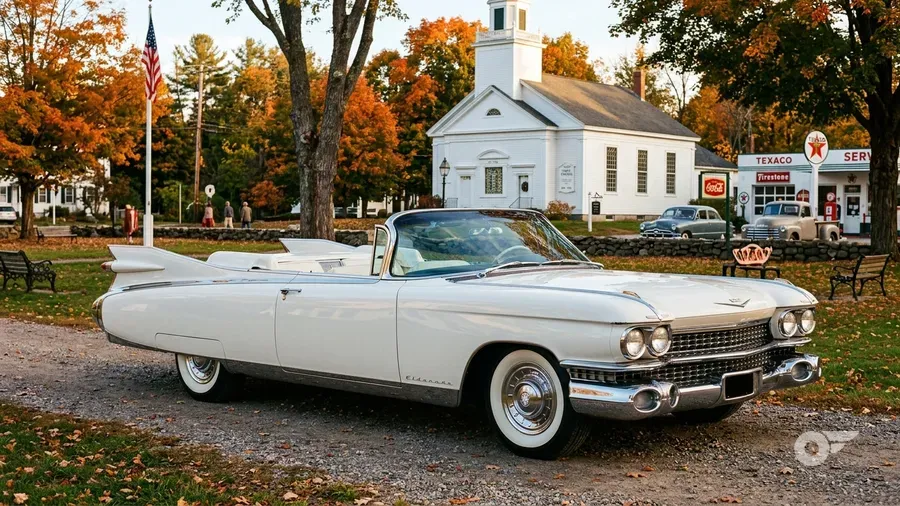
For 1961 the Eldorado stopped being three cars and became one. The Seville hardtop and the Pininfarina Brougham both ended with 1960, leaving the Biarritz convertible alone at the top of the range, and Cadillac quietly filed it as a subseries of the de Ville rather than a series of its own. What arrived was the first Cadillac shaped after Harley Earl's retirement, and it looks it. Bill Mitchell's studio cut the tailfins down, threw away the wraparound windshield the 1953 Eldorado had introduced to the company, and ran a second, lower fin along the bottom of the rear quarters that everybody calls the skeg. Four fins per car, for two model years, and never again. Underneath, the air suspension that had been tormenting Cadillac owners since 1957 was gone for good, replaced by rubber-isolated coil springs at both ends. The catch is what Cadillac took away with it. The triple-carburetor engine ended with 1960, so a 1961 Eldorado ran the same 325hp 390 as a Sedan de Ville, on the same body, wearing different script. Cadillac built 1,450 of them in 1961 and 1,450 again in 1962.
Distinctions
The defining attributes and collector status that make this car garage-worthy.
Collectibility scorecard
Rated 1 to 10 on the traits that matter for owning, driving, and holding on to a car like this.
Everything that actually moves this car is mechanical or hydraulic. The 390 runs a single four-barrel carburetor, breaker points and a mechanical fuel pump, with no injection and no engine management of any kind, and the four-speed Hydra-Matic shifts on hydraulic pressure and governor signals alone. Steering and brakes are hydraulically assisted rather than powered by anything with a circuit in it. What the car does carry is a great deal of 12-volt electrical equipment, and on an Eldorado most of it is standard rather than optional: power windows, power vent windows, a six-way power seat, a power trunk pull-down, and on 1962 cars cornering lamps wired to the turn signal. The Autronic Eye headlamp dimmer, which works off a photocell, was on the option list. None of it sits between the driver and the road. The one genuinely electro-mechanical system Cadillac had been fitting, the self-levelling air suspension, was deleted before this generation began.
Market data
Demand tier, price trend, and typical values by condition, based on recent sales data.
Strong, sustained collector demand. Good examples never wait long for a buyer.
Values are holding steady. What you pay today is what it's worth tomorrow.
The band describes the Biarritz convertible, which is the entire generation. Public results support it and show how wide the spread is: $31,900 for a 1961 in January 2022 at the bottom, $72,800 for a restored car at the Audrain sale in October 2021, $123,000 on Bring a Trailer in May 2024, and a generation high of $275,000 for a 1962 in October 2025. classic.com puts the generation average at $91,395 and benchmarks the 1961 Biarritz at $88,870, which is about right for a good honest car with a sound top and correct trim. The tier is High rather than blue-chip because the demand is for a handsome fin-era Cadillac convertible rather than for this model specifically, and the trajectory is stable rather than appreciating because a generation this small trades only a handful of times a year. On that volume one strong result moves the average, and the 2025 high is a car, not a trend.
Values as of August 2026.
Buyer's guide
What anyone seriously considering this car should know first.
The Story
Driving character
Two and a third tons, 325 horsepower, 430 lb-ft, and no urgency whatsoever about any of it. The 390 in this tune is a torque engine to the exclusion of everything else, so the car leaves a junction in one long uninterrupted shove and the four-speed Hydra-Matic changes gear somewhere below the threshold of interest. There is no hot version to go looking for. Cadillac deleted the triple-carburetor engine that had given the 1959 and 1960 Eldorado a genuine advantage, and from 1961 the halo car ran exactly what a Sedan de Ville ran. What this car does have over the one before it is composure. Coil springs at all four corners replaced the air suspension, and it rides better than the 1959 car and settles far more quickly after a bad surface. The steering is light, slow and completely mute, which is precisely what it was drawn to be. Four drums stop it eventually and want thinking about well in advance, though 1962 cars at least split the hydraulics into two circuits so one failure does not take the lot. Top down, the skegs give you something to aim with.
Design
This is Bill Mitchell's Cadillac, drawn by Chuck Jordan's studio with Dave Holls alongside him, and most of the work was subtraction. The 1959 fins came down to something a grown adult could own, the wraparound windshield went in the bin along with its dogleg pillars, and the flanks flattened out, reportedly under the influence of the slab-sided 1961 Lincoln Continental parked across town. Then the studio added a fin back. The skeg runs along the bottom of the rear quarter panel and finishes below the back-up lamps, so from behind the car shows four fins, two up and two down, and no other Cadillac generation does. It lasted exactly two model years. Mitchell decided the skegs made the tail look like a rocket ship and had them off the 1963 cars, and they never returned. The 1961 nose is the convex jewelled grille leaning back toward both the hood lip and the bumper; the 1962 is flatter and more upright with a thicker centre bar, adopted because the first version was thought inside GM to look too much like a Chevrolet. The Eldorado's own contribution to all of this is a script and a spear molding.
Motorsport pedigree
No Eldorado raced in 1961 or 1962, and the reason is more interesting than the absence. The 1957 AMA agreement, under which the American manufacturers swore off factory racing, still bound General Motors on paper in both years and by then almost nobody else. Pontiac had built its Super Duty engines anyway, Chevrolet had the 409, and by the summer of 1962 both were winning openly on hardware sold over the counter with factory part numbers on it. Henry Ford II tore up his company's copy of the agreement in June 1962 and went racing in the open. GM did not stop pretending until January 1963, when its divisions were ordered to shut their programmes down and withdraw the Super Duty 421 and the 427 mystery motor. Cadillac needed no ordering, because Cadillac had never gone near any of it. Nor did its engine have anything left to offer. The triple-carburetor 390 that made the 1959 and 1960 Eldorado quicker than the rest of the range was dropped after 1960, which left the halo car running the same 325hp four-barrel as every other Cadillac in the showroom. Whatever competition life the Cadillac V8 still had was lived in other people's cars, in drag racing's modified classes, without a dollar from Clark Street.
In culture
The odd thing about this generation is that its shape is everywhere and its badge is nowhere. When a film needs 1962 to arrive in a driveway it reaches for this Cadillac. Don Draper buys a blue 1962 Coupe de Ville in the second season of Mad Men, in the episode called The Gold Violin, and Green Book puts Don Shirley and Tony Vallelonga in a turquoise 1962 Sedan de Ville for a concert tour of the segregated South. Both of those are de Villes, and that is the point: in these two years the Eldorado looked like every other Cadillac, so the culture absorbed the shape and ignored the model name. The fins have outlasted all of it. Ant Farm buried ten Cadillacs nose down in a Texas field in 1974, spanning 1949 to 1963 in build order, to show the tailfin being born, growing monstrous and then dying, and 1961 and 1962 are the point in that sequence where it is visibly on the way out. Cadillac itself was doing fine. 1962 was the company's sixtieth anniversary and a record year at 160,840 cars, roughly three times what Lincoln and Imperial managed together.
Related cars
Cars from the same manufacturer family, like platform siblings or shared-era relatives.
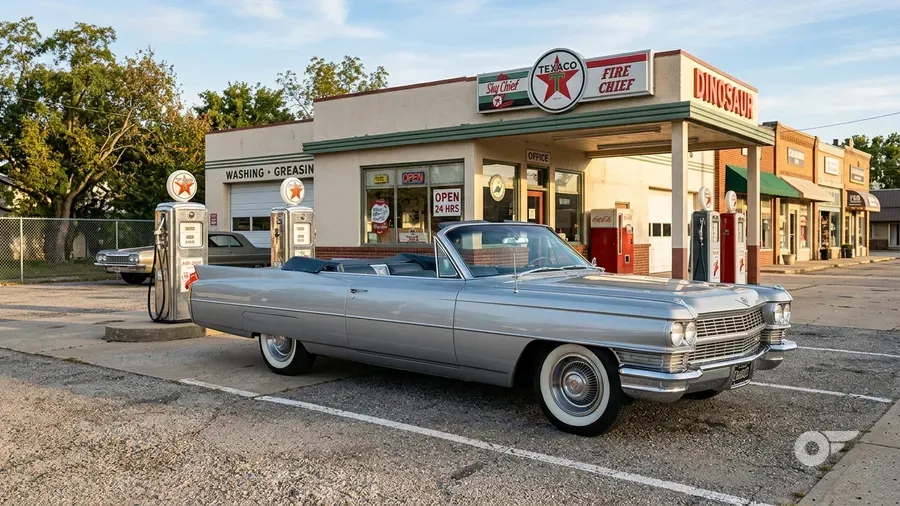

Cadillac Eldorado 6th Gen

Cadillac Eldorado 4th Gen

Cadillac Series 62 7th Gen
Rivals
Cars from other manufacturers that competed for the same buyers when new.
Rolls-Royce Silver Cloud II

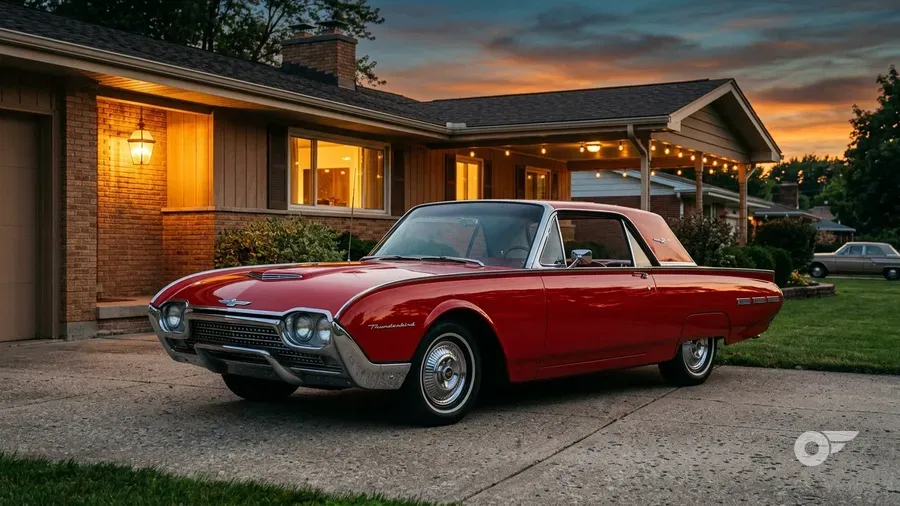
Ford Thunderbird 3rd Gen

Chrysler Imperial 2nd Gen

Lincoln Continental 4th Gen
Owning One
Why collectors want it
The 1959 car gets the posters and the 1967 car gets the engineering credit, which leaves these two years as the quietest way into a fin-era Eldorado. That is most of the argument, and the numbers support it. Cadillac built 2,900 across both years, fewer than the 1957 to 1958 generation managed and a rounding error against the 138,379 cars the company turned out in 1961 alone. The money has followed the shape rather than the badge: the generation averages $91,395 in public sales on classic.com, with the 1961 Biarritz benchmarked at $88,870. Inside the generation the hierarchy is unusually flat, because the range is. One body, one engine, two model years. What separates cars is condition, documentation and how heavily they were optioned, not which box the first owner ticked, which makes this an easier Cadillac to shop than most of its decade and a harder one to talk value into. The convertible top is the whole car, so a tired one is a project whatever the paint looks like, and a sorted one is the same good car as every other sorted one.
Which one to look for
There is one variant and it is the whole car: the Eldorado Biarritz convertible, 1,450 built in 1961 and 1,450 in 1962. The Seville hardtop and the Brougham ended with 1960 and nothing replaced them, so a 1961 Eldorado hardtop does not exist, and anything offered as one is a Coupe de Ville with ambitions. That leaves the year and the option list as the entire decision. Take 1961 if you want the shape as it was first drawn, with the convex jewelled grille slanting back toward the hood lip. Take 1962 for the better car to use, because that is the year Cadillac made the dual-circuit brake system standard and added cornering lamps, and because the flatter 1962 grille was a deliberate correction after the 1961 front end was judged inside GM to look too much like a Chevrolet. Options matter far more here than trim ever will. Factory air conditioning is the one to find, fitted to more than half the Cadillacs built in 1962, and after that E-Z Eye tinted glass, the signal-seeking radio, the Autronic Eye and the Controlled Differential, which is Cadillac's limited-slip.
What owning one is like
A 1961 or 1962 Eldorado is one of the easier big American convertibles to live with, as long as you know where its money goes. Mechanically it is a Cadillac like the other 138,379 the company built in 1961: the 390 is understressed and rebuildable by any competent shop, the Hydra-Matic is tough, and the move from air springs to coils means this generation does not carry the one system that made 1957 to 1960 cars a gamble. What needs attention is everything powered. The top runs on hydraulic cylinders and a pump that weep and slow with age, and the six-way seat, the windows, the vent windows and the trunk pull-down are all motors and switches of a certain age. Rust turns up in the usual places, floors, trunk pan, rockers and lower fenders, and in the middle of the X-frame. Brakes deserve respect: four drums, and on 1961 cars a single hydraulic circuit. Chrome is the quiet budget item, because there is a great deal of it and replating a whole car costs more than anyone expects. None of it is obscure, and none of it stops anybody.
Upkeep & parts
Support is good and pleasantly specialised. CPR Cadillac Restoration Parts has traded in NOS, reproduction and good used Cadillac parts since 1984, Caddy Daddy and The Parts Place both list 1961 to 1964 sheet metal, trim and hardware, and the convertible top trade is unusually well served: hydraulic cylinders, pumps and hose sets are stocked, and replacement tops are cut from original dealer patterns in period pinpoint vinyl or Stayfast canvas. That matters, because the top is the part of this car most likely to want money. Mechanical parts are shared with tens of thousands of ordinary Cadillacs and priced accordingly. The Eldorado-only items are few, which is the upside of a generation that was mostly trim: a script and a lower body spear molding, rather than the unique rear quarters and stainless beauty panels that make a 1957 Eldorado so expensive to put right. Budget for chrome and interior work instead. The Cadillac and LaSalle Club is the one to join, with a Museum and Research Center covering these years, and the New Cadillac Database is the best free reference anywhere, including the Eldorado production tables that show how few of these were built.