Octane Files
Browse CarsBuick Skylark 2nd Gen

Buick Skylark 2nd Gen

Overview

For 1964 the Skylark stopped being a small car with a good engine and became Buick's intermediate. GM revived the A-body designation that autumn for four new mid-size cars, and Buick's version threw out almost everything that had defined the Skylark to that point. The Y-body unibody gave way to a perimeter frame, the wheelbase went from 112 inches to 115, and the 318 pound aluminum V8 was gone, replaced by a 225 cubic inch V6 and a new iron block 300 V8 that carried the old engine's aluminum heads for exactly one model year. The Skylark came out of the change with its own series number, sitting above the Special and the Special Deluxe at the top of Buick's A-body range rather than dressing up the bottom of it. What happened next is why the generation matters. In January 1965 Buick answered the Pontiac GTO with a 236 dollar option package called Gran Sport, which dropped the full size Wildcat's 401 cubic inch Nailhead V8 into a Skylark two door. The Gran Sport became a series of its own for 1966, then split into the GS 400 and the GS 340 for 1967, the year the Nailhead was retired and Buick's modern big block took its place.

Distinctions

The defining attributes and collector status that make this car garage-worthy.

Octane Files Select
Renowned for its history, engineering, or cultural weight.

Collectibility scorecard

Rated 1 to 10 on the traits that matter for owning, driving, and holding on to a car like this.

Desirability
6/10
Rarity
4/10
Driving thrill
6/10
Investment trajectory
6/10
Usability
7/10
Ease of restoration
5/10
Cultural impact
6/10
Electronic dependence
Fully analogHeavily electronic

Nothing on these cars is electronic. Fuel arrives through a carburetor, a Carter four barrel on the 1965 and 1966 Gran Sport and a Rochester Quadrajet on the 1967 GS 400, fed by a mechanical pump. Ignition is a breaker point distributor with centrifugal and vacuum advance. Steering is recirculating ball, braking is hydraulic drums until front discs appeared on the option list for 1967, and both the two speed and three speed automatics shift off a hydraulic valve body. The closest thing to a modern system is the belt driven Air Injection Reactor pump fitted to California cars for emissions, and that is still just a pump.

Market data

Demand tier, price trend, and typical values by condition, based on recent sales data.

Demand tier
EntrySolidHighBlue-chip

A dependable market. Well-kept cars hold their value and find ready buyers.

Value trajectory
AppreciatingStableCooling

Values are holding steady. What you pay today is what it's worth tomorrow.

Price by condition
Driver
$10k
Excellent
$21k
Concours
$35k

The band describes the volume car, a 300 or 340 powered Skylark hardtop or four door in honest driver condition. classic.com's tracked sales put the average standard Skylark of this generation at 20,447 dollars, with a low of 5,250 dollars in May 2026, so the entry point is genuinely low. Gran Sport cars answer to a different set of numbers, averaging 28,976 dollars with a top recorded result of 66,000 dollars for a 1965 GS in May 2026, and they are the part of the market with real movement in it. Because the 1965 Gran Sport was an option package and cannot be proven by VIN, documented cars carry a premium over undocumented ones that has nothing to do with condition.

Values as of August 2026.

Buyer's guide

What anyone seriously considering this car should know first.

Why it's worth it
The generation that moved the Skylark onto the A-body and gave Buick its first Gran Sport
Callout
Buick called its 401 cubic inch V8 a 400 to slip under GM's limit on engine size in intermediates
What to watch for
The most useful thing to know is which model year you are looking at, because the Gran Sport changed its legal identity halfway through the run. For 1965 it was an option package on a Skylark two door, which means the VIN says Skylark and nothing else. An original build sheet or window sticker is the only real proof, and Buick tucked build sheets under carpets and behind trim rather than filing them anywhere sensible. From 1966 the Gran Sport had its own series, so the second and third digits of the VIN read 46 and the car identifies itself. A 1965 GS therefore needs paperwork in a way a 1966 does not. Next, check which engine you are actually buying: the 1965 and 1966 cars use the 401 Nailhead, the 1967 GS 400 uses a completely new engine, and the two share almost nothing, so parts, machine work and expectations all change with the year. Rust follows the A-body pattern. The rear window channel goes first, then the lower quarters, trunk floor, front floor pans and the frame. A vinyl roof hides the window channel damage, and patch panels for exactly that area are reproduced because so many cars need them.

The Story

Driving character

The Nailhead is the whole personality of a Gran Sport, and it is not the personality the badge suggests. Its valves are famously small and vertical, which caps what it will do at the top of the range, and Buick did not care. All 445 lb-ft arrives at 2,800rpm and the car simply leaves, hard and early, then loses interest above 4,400. Car Life got 7.4 seconds to 60mph and a 15.3 second quarter mile at 88mph out of one in 1965, which put it level with anything wearing a GTO badge. What blunts the effect is the transmission. Most were sold with the two speed Super Turbine 300, smooth and durable and giving the engine nowhere to work, so the floor shifted three speed and the Muncie four speed are what the car deserves. The 401 also weighs 685 pounds and puts 58.3 percent of the car on its front tires, so a GS understeers early and is steered with the throttle as much as the wheel. The 1967 400 fixes the top end and pulls cleanly to 5,000rpm. The 300 and 340 cars are a different vehicle, soft and quiet and perfectly happy about it.

Design

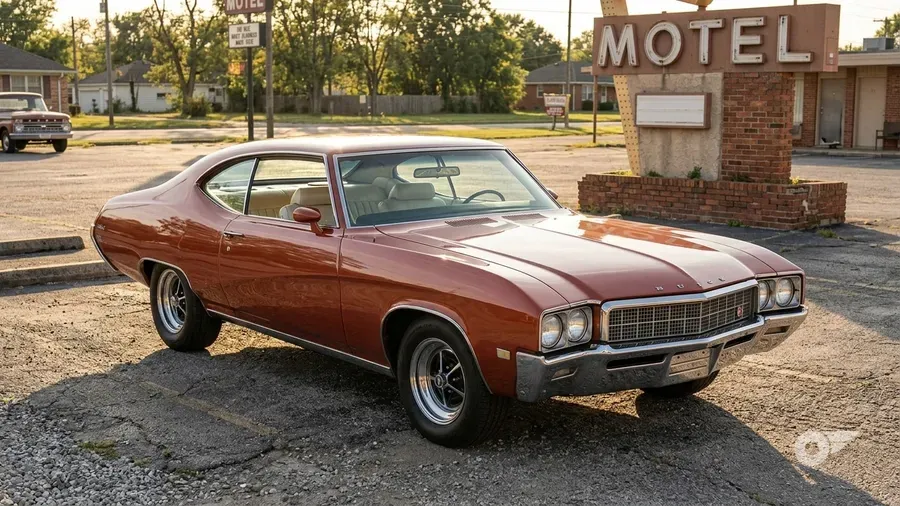
Buick's problem in 1964 was that the Skylark and the Special were the same car underneath, so the difference had to be applied rather than shaped. The Skylark got brightwork the Special did not, emblems on the roof quarters and rear fenders, twin strips down the roof of the coupes, and metallic inserts along the body sides. It worked better than that description suggests, largely because the underlying A-body shape is clean. The 1966 restyle is where it gets interesting. The sheet metal was reworked to read lower and wider, a full length lower body molding replaced the inserts, simulated vent grids appeared on the front fenders, the wheel arches gained kick ups, and the sail panels were stretched back past the rear window so the glass sits recessed. A four door hardtop replaced the pillared sedan the same year. For 1967 Buick added rear fender skirts, worn by no other year of this generation, and brought the four door sedan back alongside the hardtop. The outlier of the family is the Skylark Sport Wagon, on a 120 inch wheelbase with a raised roof and four tinted glass panels over the second row.

Motorsport pedigree

Buick had no factory racing program and was not permitted one. GM's January 1963 edict pulled every division out of organized competition, and Buick, the division that sold comfort, was never going to argue the point. What the ban did not cover was dealers, and that is where this car's competition history actually happened. Buick built a high compression version of the 401 for customers who drag raced, sold through the parts counter rather than the option sheet, then went further in 1966 with a run of pilot cars now known as the Flint Flyers: ultra high compression 401s in Gran Sport bodies, with metallic brake linings and a horsepower figure Buick declined to publish, listing the engine's rating as unestablished. GM management killed the program before most of the planned cars were built and ordered the survivors returned and scrapped. Retired GM engineer Ken Kayser found the one that got away and documented the story at length. Accounts still disagree on the RPO letter and on how many cars were planned, which is what happens when a program is cancelled before anyone writes it down.

In culture

Very few cars get a courtroom scene, and none has a better one. The 1964 Skylark convertible at the center of My Cousin Vinny is the car two students are accused of driving away from a murder in, and the film's entire resolution turns on Mona Lisa Vito explaining why it cannot have been: the Skylark has a solid rear axle, so it could not have laid two even marks with one wheel up on a curb, and it was not available with positraction. Marisa Tomei won the Academy Award for Best Supporting Actress for those few minutes. The layer underneath is better than the scene. Curbside Classic and The Autopian have both taken the testimony apart, and the awkward finding is that the 1963 Pontiac Tempest the film points at instead was not offered with a limited slip differential, while the 1964 Skylark was. Positraction is a Chevrolet trade name in any case, and the two cars share neither a wheelbase nor a silhouette. The half that holds up is the half that matters: the Skylark's rear axle really is solid, and the Tempest's rear suspension really is independent.

Owning One

Why collectors want it

These are the cheapest surviving way into the first wave of GM intermediates, and the reason is simply that Buick was not the division anybody was watching. Across 348,892 Skylarks and Gran Sports the market has settled into a clear order. Ordinary Skylarks, the hardtops and four door cars with a 300 or 340 V8, average around 20,400 dollars in classic.com's tracked sales, which buys almost nothing in a 1964 to 1967 GTO or Chevelle. The Gran Sport cars average close to 29,000 dollars and account for every headline result, including a 1965 GS that sold for 66,000 dollars in May 2026. The interesting part of the market sits between those two numbers. The Gran Sport is genuinely scarce, 15,780 in 1965, 13,816 in 1966 and 13,813 GS 400s in 1967, and it is the only one of the four GM intermediates that got its division's biggest existing engine rather than a motor designed for the class. It still costs a fraction of an equivalent 442 or GTO. Buyers have started to notice; the badge has not caught up yet.

Which one to look for

The base cars are honest and cheap and there is no ladder inside them, so the ranking starts at the Gran Sport. The 1965 car is the one with the story: a 236 dollar option package, the 325hp 401 Nailhead, and a shell built on the heavier convertible frame whichever of the three body styles you ordered. 15,780 were built. The 1966 Gran Sport is the better one to buy because it identifies itself in the VIN, and it is scarcer at 13,816. For 1967 the range split in two. The GS 400 took Buick's new 400 cubic inch big block at 340hp, aluminum front brake drums with cast iron liners, and 13,813 sales across three bodies. The GS 340 was the cut price version at 3,692 built, and it is not a Skylark at all: it used the Special two door hardtop and came only in Arctic White or Platinum Mist with red hood scoops and stripes. Rarer still is the California GS, a Los Angeles zone promotion on the pillared Special coupe with the same 340. The grail is a Gran Sport convertible, 2,147 in 1965 and 2,047 in 1966.

California GS · 1967

A regional promotion created by Los Angeles zone Buick dealers midway through 1967, aimed at young buyers who wanted the look for a payment they could manage. It used the pillared Special coupe body with the same 260hp 340 four barrel as the GS 340, the two speed Super Turbine automatic, a black vinyl roof, chrome wheels, the Ride and Handling package, an Air Injection Reactor pump for California emissions, and its own badging. Unlike the GS 340 it was not limited to two paint colors.

GS 340 · 1967

The cut price Gran Sport, and strictly speaking not a Skylark: it used the Special two door hardtop body rather than the Skylark shell. Power came from the 340 cubic inch small block V8 with a four barrel carburetor, 260hp and 365 lb-ft, an engine descended from the aluminum 215 of 1961. Buick made it unmistakable by restricting it to Arctic White or Platinum Mist paint with red hood scoops, red rocker stripes and red wheels. It is included here because the 1967 Gran Sport range is one story, not two.

GS 400 · 1967

The Gran Sport renamed for the engine it now carried. Buick's Nailhead was retired after 1966 and replaced by an all new 400 cubic inch big block with a domed wedge chamber, larger ports and 2.00 inch intake valves, rated 340hp at 5,000rpm and 440 lb-ft at 3,200rpm. It came with a Rochester Quadrajet, aluminum front brake drums with cast iron liners, and the three speed Super Turbine 400 automatic on the option list. Four piston front discs were available. Almost nothing in the engine bay carries over from the 1965 and 1966 cars.

Skylark Gran Sport · 1965-1966

Buick's answer to the GTO, launched in January 1965 as a 236 dollar option package on the Skylark pillared coupe, sport coupe and convertible. It brought the full size Wildcat's 401 cubic inch Nailhead V8, badged 400 to satisfy GM's ceiling on intermediate engine size, rated 325hp and 445 lb-ft at 2,800rpm, plus stiffer springs, heavy duty shocks and a thicker front anti roll bar. Every 1965 car was built on the heavier convertible frame. For 1966 the Gran Sport became a series in its own right, which is the single most important difference between the two years for a buyer.
What owning one is like

These are simple cars and they age in predictable ways. The body sits on a perimeter frame, so the frame itself is a wear item at the rear kick ups and the shock mounts, and the body rusts above it at the rear window channel, the lower quarters, the trunk floor and the front floor pans. A vinyl roof is close to a guarantee of trouble in the window channel underneath. The engines are the easy part in every case but one. The 300 and 340 small blocks are undemanding and cheap, and the 1967 400 shares its architecture with the later 430 and 455 so parts follow it around. Only the 401 Nailhead sits awkwardly, stout enough in itself but with a smaller specialist trade behind it than any other Buick V8 of the era. The 1964 only 300 with aluminum heads is its own small puzzle, since its water heated aluminum intake will not swap with any later 300 or 340 manifold. Everything before 1967 stops on four drums fed by a single circuit master cylinder, which is worth knowing before you lean on the torque.

Upkeep & parts

The mechanical side of this car is subsidized by its cousins. Frame sections, floor pans, suspension, brakes and most of the running gear are shared with the 1964 to 1967 Chevelle, GTO and 442, so OPGI, Year One, The Parts Place and Holley all stock the ordinary items, and there are patch panels made specifically for the Skylark and GS rear window channel because everybody needs them eventually. Where the money goes is trim. Skylark specific moldings, emblems, the 1967 fender skirts and Gran Sport badging were fitted to far fewer cars than their 1968 to 1972 equivalents and are reproduced thinly, so buy the complete car rather than the cheap one. Nailhead work wants a specialist rather than the nearest machine shop, and Centerville Auto Repair's reference material on the 215, 300 and 340 is the sort of thing owners bookmark. The community is the real asset here. The Buick GS Club of America and the V8Buick forum cover this generation properly between them, and Team Buick's reference library holds the factory production tables you will want the day somebody tells you their 1965 hardtop is a Gran Sport.

Country of origin
USA
Class
Muscle
Production years
1964–1967
Units built
348,892
Model
Skylark
Nickname
No nickname
Body
Coupe, Convertible, Sedan
Layout
Front-engine, RWD
Engine
225ci Fireball V6 (155hp 1964-1965, 160hp 1966-1967); 300ci V8, 2-barrel (210hp); 300ci V8, 4-barrel (250hp, 1964-1965); 340ci V8, 2-barrel (220hp, 1966-1967); 340ci V8, 4-barrel (260hp, 1966-1967); 401ci Nailhead V8 badged 400 (325hp, Gran Sport, 1965-1966); 401ci high-compression Nailhead V8 (dealer-installed drag option, 1966); 400ci V8 (340hp, GS 400, 1967)
Transmission
3-speed manual; 3-speed manual, floor shift; 4-speed manual (V8 only); 2-speed Super Turbine 300 automatic; 3-speed Super Turbine 400 automatic (1967)
Designer
David "Dave" Holls (Buick Design Chief, 1964–1967 A-body styling); William "Bill" Mitchell (GM Vice President of Design, executive oversight)