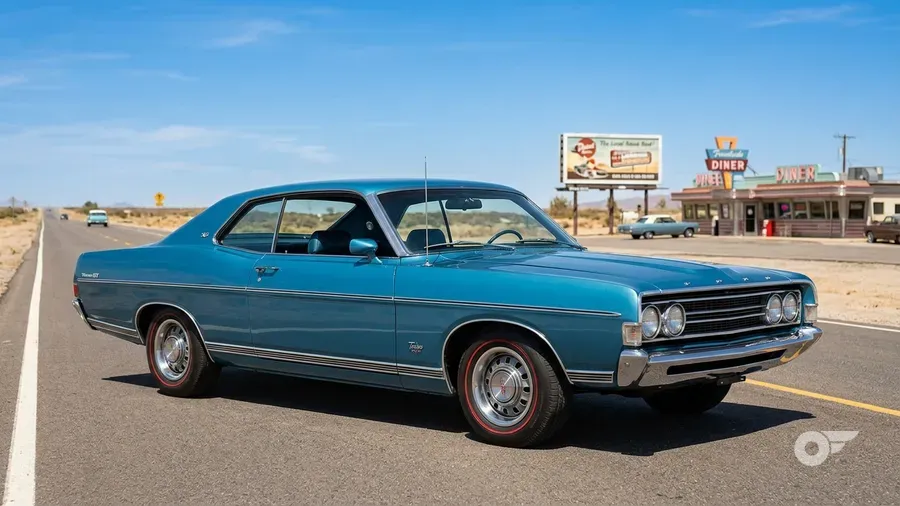
Ford Torino 1st Gen
USA·Muscle·1968–1971

The defining attributes and collector status that make this car garage-worthy.

Rated 1 to 10 on the traits that matter for owning, driving, and holding on to a car like this.
Demand tier, price trend, and typical values by condition, based on recent sales data.
Values as of August 2026.
What anyone seriously considering this car should know first.
Cars from the same manufacturer family, like platform siblings or shared-era relatives.
Cars from other manufacturers that competed for the same buyers when new.
Not a GT, and never badged as one. Ford dropped the R-code 427, dual four-barrels on a medium-riser intake breathing through a fiberglass ram-air hood, into plain Fairlane 500 two-door hardtops fitted with fiberglass and aluminum panels and almost nothing inside. The 1966 cars existed to clear the NHRA's 50-car minimum, and the NHRA agreed in advance to class them in B/Stock, where they ran mid-11-second quarters at over 110mph. A W-code 427 with a single four-barrel was also offered. These are the fastest cars of the generation and, by an enormous margin, the most valuable: the highest recorded Fairlane sale of any kind is a 1966 R-code four-speed at $296,000. They are also why auction averages for the whole Fairlane line read higher than any ordinary car actually sells for.
The bucket-seat Fairlane without the big block. The 500XL took the Fairlane 500 hardtop and convertible and added front buckets with a console and floor shifter, bucket-style rear seating, deluxe wheel covers, its own badging and courtesy lights in the door armrests, while leaving the engine choice open from the 200ci six upward. It is the car most often mistaken for a GT, and because GT stripes, badges and wheel covers are all available from a catalogue today it is also the car most often dressed as one. For a buyer who wants the interior and the look without the weight, the thirst and the price of a 390, the XL is the sensible choice and by a wide margin the cheaper one.
The manual-transmission car. For 1966 the GT came with the S-code 390 4V rated at 335hp as standard equipment, a 3-speed manual as the base gearbox and a 4-speed on the options list at $183, along with heavy-duty springs and shocks, a thicker sway bar, wider rear drums, an upgraded cooling system, bucket seats, a console, faux hood scoops and a rocker-level body stripe. For 1967 Ford made a 200hp two-barrel 289 the standard engine and moved the 390 to the options list, at 270hp in two-barrel form and 320hp with the four-barrel; front disc brakes became standard the same year. A verified 1966 four-speed hardtop is the version enthusiasts chase, since most buyers took the automatic.
Same car, automatic transmission, different badge. GTA meant the SportShift Cruise-O-Matic, which Ford announced in September 1965 as offering full manual selection of all three forward gears. Car Life's testers found the promise only half kept: every shift arrived after a noticeable pause, and asking for first gear above about 25mph left the car freewheeling until road speed dropped. Motor Trend still ran an early 335hp GTA to 60mph in 6.8 seconds and through the quarter mile in 15.2 seconds at 92mph. The GT and GTA badges were exclusive to the 1966 and 1967 model years, and GTA was never used on a Fairlane again.
The top of the Fairlane wagon range, reintroduced for 1966, and the only body style in the generation nobody was making performance claims for. The Squire sat above the base and 500 wagons, carried woodgrain panels down its flanks and around the tailgate, and rode the 113-inch wagon wheelbase shared with the Falcon and the Mercury Comet rather than the 116 inches of the sedans and hardtops. It took the same engine list as the rest of the line, the 390 included, so a big-block Squire is a car the factory would genuinely build. Survivors are far scarcer than the production numbers suggest, because wagons in this class were used until they were used up, and the woodgrain and its surrounds are the hardest trim on any Fairlane to put right.