Octane Files
Browse CarsDodge Coronet 5th Gen

Dodge Coronet 5th Gen

Overview

Dodge had been putting the Coronet name on full-size cars since 1949, then parked it. It came back for 1965 on Chrysler's intermediate B-body, and for the next six model years it was simultaneously the car that paid Dodge's bills and the car almost every famous Dodge of the era was built out of. The 1966 Charger is a Coronet with four panels changed. The Super Bee is a Coronet with the trim taken out and the 383 Magnum left in. The R/T badge Dodge still stamps on cars today went on a Coronet first, for 1967, a full year before there was a Charger R/T. Meanwhile the volume version did volume work: four-door sedans, station wagons, police and taxi fleets, slant-six cars bought by people who never gave horsepower a thought. Dodge moved more than a million of them in six years. That spread is the whole story. The same 117-inch shell could leave the line with a 145hp six or a 425hp Hemi, and the difference in the showroom was a few option boxes and a signature. For 1971 the two-doors moved to the Charger and the muscle-era Coronet was over. Collectors chase the loud end. The car itself was overwhelmingly the quiet end, in enormous numbers.

Distinctions

The defining attributes and collector status that make this car garage-worthy.

Octane Files Select
Renowned for its history, engineering, or cultural weight.

Collectibility scorecard

Rated 1 to 10 on the traits that matter for owning, driving, and holding on to a car like this.

Desirability
7/10
Rarity
3/10
Driving thrill
7/10
Investment trajectory
6/10
Usability
7/10
Ease of restoration
8/10
Cultural impact
5/10
Electronic dependence
Fully analogHeavily electronic

Carbureted from end to end, with no engine computer, no electronic fuel metering, and no electronic assistance to the steering, brakes or throttle. Every control is a direct mechanical linkage: cable to the carburetor, rods and hydraulics to four drum brakes, a recirculating-ball box to the steering arms. Ignition is breaker points and a condenser for the whole run, because Chrysler's transistorized electronic ignition did not appear until May 1971 and did not become standard across the line until 1973, both of which fall after this car ended. The only electrical systems on board are lights, gauges, wipers and the optional power accessories. Even the one late change to the valvetrain went the analog way: the 426 Hemi swapped solid lifters for hydraulic ones in 1970, which removes a maintenance job without adding a single electronic component.

Market data

Demand tier, price trend, and typical values by condition, based on recent sales data.

Demand tier
EntrySolidHighBlue-chip

A dependable market. Well-kept cars hold their value and find ready buyers.

Value trajectory
AppreciatingStableCooling

Values are climbing. The market wants more of these than exist.

Price by condition
Driver
$18k
Excellent
$35k
Concours
$58k

The Coronet market has split in two. Documented R/T and Hemi cars have moved hard: classic.com puts the fifth-generation R/T average near $69,900 against roughly $52,400 for all fifth-generation Coronets, and a 1969 Hemi R/T convertible made $770,000 in January 2026. conceptcarz, working from 230 recorded 1970 Coronet sales, gives a median of $45,000 with excellent cars between $45,000 and $69,300, and a 2026 year-to-date median of $77,000 across five sales, which it reads as roughly 42 percent above the historical average. That is a small sample, so treat the direction as real and the size of it as provisional. The ordinary cars have not followed. A 1967 R/T sold at $26,000 in October 2025, and Hagerty rates a good-condition 1968 Coronet 500 with the 383 at $19,200. The tier stays at Solid because the volume car is genuinely a Solid car, even though the R/T sitting on the same shell trades a full tier above it. The band below describes that volume car, a 318 or 383 two-door hardtop, and deliberately excludes the Hemi and R/T cars above it and the four-doors and wagons below it.

Values as of August 2026.

Buyer's guide

What anyone seriously considering this car should know first.

Why it's worth it
The first Dodge to wear an R/T badge, and the car the Charger and the Super Bee were built from
Callout
First Dodge to wear the R/T badge, a year before the Charger
What to watch for
Start with the VIN, because the badges prove nothing here. On a 1968 to 1970 car the first character is the car line and the second the price class, so WS is a Coronet R/T, WM a Super Bee, WP a Coronet 500 and WH a Coronet 440. Characters three and four are the body: 23 for the two-door hardtop, 21 for the pillared coupe, 27 for the convertible. The fifth is the engine, J for the 426 Hemi and L for the 440 four-barrel. Read the VIN, the fender tag and the block casting together, pay the premium for a car that still has its broadcast sheet, and treat Galen Govier's decoding work as the authority once real money is involved. Cloning is easy and common, because a base Coronet and an R/T are the same shell with different trim. Then look at metal. The B-body rust map runs through the trunk floor and the rear frame rails under it, the lower quarters and wheel arches, both inner and outer rockers, the floors beneath the carpet, and the steel around the hood hinges. Four-wheel drums were standard and front discs cost $72.95 in 1968, so a factory-disc claim is worth proving. Four-doors and wagons are honest cars, but their glass and brightwork are far harder to find than a hardtop's.

The Story

Driving character

Torsion bars at the front, leaf springs and a live axle behind, a 117-inch wheelbase, and a car that weighs well over 3,500 pounds. It rides better than the specification suggests and steers worse. A 318 or a two-barrel 383 Coronet is a relaxed thing, the TorqueFlite shuffling through gears you never asked about, the engine loafing along at a low uninterested rumble. The 440 Magnum changes the personality without changing the manners: 375hp and 480 lb-ft already working just off idle, so the car simply leaves, usually without a downshift. Old Cars Weekly quotes a period 440 R/T at 6.9 seconds to 60 and 15.1 through the quarter at 94mph. The Hemi is a different vehicle. It idles unevenly, it wants revs because the two Carter four-barrels have no interest in part throttle, and streetmusclemag gives a period Hemi Coronet 6.1 seconds to 60 and 14.5 in the quarter. It also stacks a great deal of iron over the front wheels, which four-wheel drums do not appreciate. Every version asks you to look a long way up the road. Brake early, turn in early, and it becomes enormously satisfying in a way nothing modern bothers to be.

Design

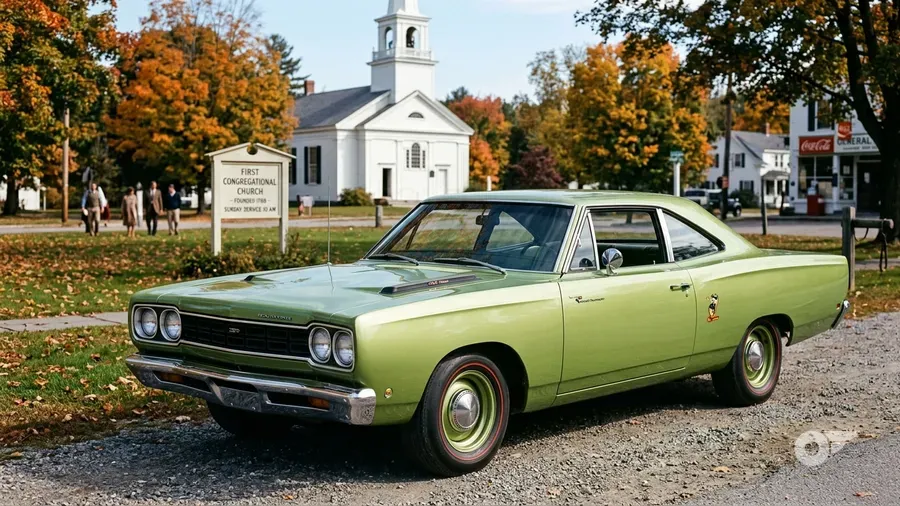
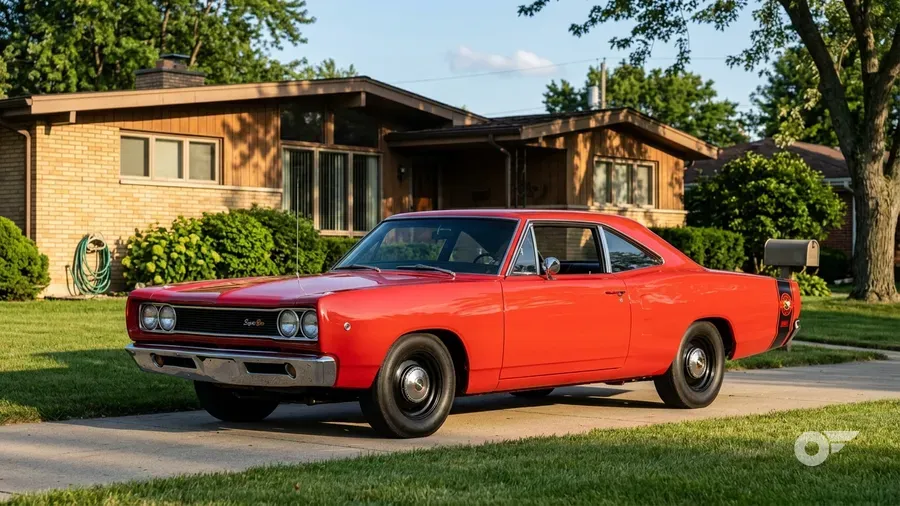
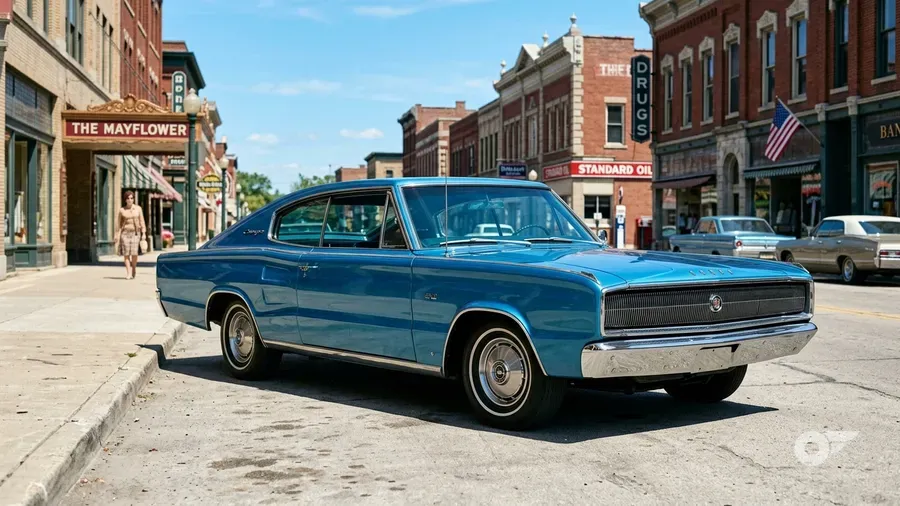
Two distinct bodies live inside these six model years. The 1965 car was upright and plain, a mildly reworked version of what Dodge had been building since 1963. For 1966 Chrysler's rectilinear house style arrived, all straight edges and a long scallop down the flank, and it is still the cleanest thing the nameplate ever wore. The 1968 restyle is the famous one: a coke-bottle B-body credited to Richard Sias and his team, double-diamond in profile with a scalloped door, given its own grille and quarters so it read as a Coronet and not a Charger. Sias's Coronet work was well enough received that pieces of it went into the 1968 Charger. On R/T and Super Bee cars a power-bulge hood carried simulated vents and dual bumblebee stripes wrapped the tail, both part of the Scat Pack campaign Dodge launched for 1968 behind a cartoon bee in goggles and a crash helmet. 1969 changed the grille and lamps only. For 1970 the nose became a twin-loop bumper, two chrome ovals split by a body-colour tongue, and it is the one styling decision on this car almost nobody defends. R/T sales fell by roughly two thirds that year.

Motorsport pedigree

The Coronet's racing life happened mostly on a drag strip, and it started before the street cars got interesting. For 1965 Dodge built the A990: a lightweight Coronet with acid-dipped panels, aluminium front sheet metal, no radio, no heater, lightweight seats, and a 12.5:1 426 Race Hemi hand-assembled at Chrysler's Marysville plant. Most sources give 101 Dodges, built at Lynch Road in January 1965 and carrying a WO serial prefix, though a few say 105. Then Chrysler went further. A batch of Coronets and Plymouth Belvederes, usually given as five of each, went to Amblewagon in Detroit, which moved the front wheels forward ten inches and the rear axle forward fifteen, leaving a 110-inch wheelbase and a silhouette that looks wrong from every angle. NHRA answered by capping A/FX wheelbase changes at two percent, banning the cars from the class they were built for. AHRA took them in as Ultra Stock and unsanctioned match racing took them everywhere else, and Dick Landy went 39 wins and one loss with his across the 1965 season. What those cars started became the funny car. In NASCAR the Coronet was Dodge's weapon before the fastback Charger arrived: David Pearson took the 1966 Grand National title for Cotton Owens with 15 wins, running Coronets early in the season.

In culture

The Coronet's fame belongs to Dodge's advertising more than to the car. It carried the Dodge Rebellion through 1966 and 1967, with Pamela Austin making around twenty commercials as the Dodge Rebellion Girl, menaced by sharks and falling off drawbridges and signing off every time with the line that the Dodge Rebellion wants you. Dodge dropped her after 1967 on the theory that she was overshadowing the cars. Then came the Scat Pack for 1968, launched with three models: the Charger R/T, the Dart GTS and the Coronet R/T. That campaign's helmeted cartoon bee is still on Dodge products. On screen the Coronet works almost entirely as scenery, which is its own kind of weight. A 1969 four-door is what Al Pacino and his accomplices drive to the bank at the start of Dog Day Afternoon, cast precisely because it is the most anonymous object on a Brooklyn street. Coronets fill the traffic and the police fleets of late-sixties American film and television the same way. No Coronet was ever a poster car and none ever will be. What it has instead is a presence in the background of an entire decade, which is what happens to a car that sells by the hundred thousand while nobody thinks of it as special.

Owning One

Why collectors want it

This is the cheapest way into a Chrysler B-body, and the same nameplate holds one of the biggest muscle car results ever recorded. classic.com puts the fifth-generation Coronet R/T average near $69,900 and the average across all fifth-generation Coronets near $52,400, and in January 2026 a 1969 Hemi R/T convertible made $770,000. At the other end, a 1967 R/T changed hands at $26,000 in October 2025 and Hagerty rates a good-condition 1968 Coronet 500 with the 330hp 383 at $19,200. The hierarchy inside that spread reads cleanly: documented Hemi cars alone at the top, then 440 Magnum R/Ts, then Super Bees, then 383 Coronet 500 hardtops, then the 318 and slant-six cars, then the four-doors and wagons almost nobody remembers were built at all. The argument for the ordinary ones is that mechanically they are the same car. Same torsion bars, same TorqueFlite, often the same 383, the same shell a Super Bee uses, and a parts catalogue that does not care how many doors you ordered. Very little else from 1965 to 1970 gives you this much genuine American intermediate for the money, and nothing else puts you this close to Hemi-era Mopar history for five figures.

Which one to look for

The pecking order is the one Dodge printed, only much steeper now. The Coronet R/T arrived for 1967 as the first Dodge to wear the badge: 375hp 440 Magnum standard, 426 Hemi optional, heavy-duty suspension and brakes, a power-bulge hood with simulated vents, bumblebee tail stripes, hardtop or convertible only. 10,181 were built that first year, 9,553 of them hardtops. Then 10,849 for 1968, 7,238 for 1969, and 2,615 for 1970 after the twin-loop bumper landed badly. Hemi R/Ts are the grail and the counts say why: 230 for 1968 (94 four-speeds and 136 automatics), 107 for 1969, and somewhere between 13 and 15 for 1970 depending which source you believe, one or two of them convertibles depending on the source. Before the R/T existed the Hemi simply went into ordinary Coronets, and around 732 buyers took one for 1966: 340 Coronet 500 hardtops, 288 Coronet 440 hardtops, 49 Deluxe two-door sedans, 34 base two-door sedans and 21 Coronet 500 convertibles. The Super Bee, a Coronet stripped down around the 383 Magnum, ran from mid-1968 until it moved to the Charger body for 1971. Under all of that, a Coronet 500 hardtop with the four-barrel 383 is the sensible buy: bucket seats, console, the good brightwork, real speed, and none of the authentication anxiety.

A990 Super Stock · 1965

Not a trim so much as a factory race car sold through dealers: acid-dipped panels, aluminium front sheet metal, no radio, no heater, lightweight seats and a 12.5:1 426 Race Hemi hand-assembled at Chrysler's Marysville plant. Built to satisfy NHRA Super Stock rules and effectively undriveable on the road.

Coronet 440 · 1965–1970

The mid-range trim, and the source of decades of confusion: 440 is a trim level here, not an engine. A Coronet 440 can be a slant six. Cloth and vinyl interior, more brightwork than the Deluxe, offered as a hardtop, sedan, convertible and wagon. VIN car line code WH.

Coronet 500 · 1965–1970

The top civilian trim: bucket seats, console, full carpeting and the best brightwork, with a V8 mandatory for 1965. With the four-barrel 383 it is the smart buy of the whole generation, giving you the good interior and real performance without the authentication anxiety of an R/T. VIN car line code WP.

Coronet Deluxe · 1965–1970

The plain one, a step above the stripped base car and usually a six or a 318 in a two-door or four-door sedan. Worth knowing because the Hemi option box did not care which trim you ordered, which is how a small number of Deluxe two-door sedans left the factory with 425hp.

Coronet R/T · 1967–1970

The first Dodge to wear the R/T badge, a year before the Charger R/T existed. The 375hp 440 Magnum was standard and the 426 Hemi optional, alongside heavy-duty suspension and brakes, dual exhaust, a power-bulge hood with simulated vents and bumblebee tail stripes. Hardtop and convertible only. VIN car line code WS.

Super Bee · 1968–1970

Dodge's answer to the Plymouth Road Runner and a Coronet underneath: the 335hp 383 Magnum standard, a four-speed with a Hurst shifter, bench seat, minimal trim and the bumblebee stripe that named it. The 1969 A12 cars added the 440 Six Pack under a lift-off fibreglass hood. It left the Coronet line and moved to the Charger body for 1971. VIN car line code WM.
What owning one is like

Mechanically this is about as forgiving as a sixty-year-old car gets. The slant six, the 318, the 383 and the 440 are cast-iron engines that tolerate neglect and grumble for years before they actually quit, the TorqueFlite is one of the best automatics anybody built in the period, and the torsion-bar front end wants bushings, ball joints and an alignment rather than anything exotic. The real work is rust, and the B-body has favourites: the trunk floor and the rear frame rails beneath it, the lower quarters and wheel arches, inner and outer rockers, the floor pans under the carpet, and the steel at the hood hinges. Buy the cheapest car on offer and you will spend more on steel than the finished thing is worth. After that it is a short list of known items. Four-wheel drums fade if you use them properly, and most owners end up fitting the factory front disc setup. Hemi cars through 1969 want their valve lash checked and their two Carter four-barrels kept in balance, which is a large part of why so few Hemi cars get driven. Heater boxes leak. Convertible frames and top mechanisms are a project of their own. Nothing here is mysterious and nothing needs a specialist.

Upkeep & parts

This is one of the better-supported old cars in America. Classic Industries and OER catalogue reproduction quarter panels, quarter skins and patch panels for the 1968 to 1970 Coronet in OE-gauge steel with the side marker and filler openings already cut, and the 1966 to 1970 B-body shares floor pans, inner and outer rockers, the lower cowl and the inner wheelhouses across Dodge and Plymouth, so those are catalogue items rather than swap-meet finds. Drivetrain supply is effectively unlimited: the 318, 383, 440 and TorqueFlite were built in the millions and every machine shop in the country knows them. MyMopar hosts the factory service manuals, parts books, wiring diagrams and paint chip charts as free downloads, which is the first bookmark any owner should make, and Classic Industries publishes a workable VIN and fender tag guide covering B-bodies from 1962 on. For B Bodies Only is where the day-to-day knowledge lives, with roughly 42,500 members and 3.6 million posts, and the Super Bee Registry will decode a fender tag free if your Coronet is wearing bee stripes. Budget for trim rather than mechanicals: model-specific brightwork, glass and interior parts for the 1965 to 1967 cars, and for four-doors and wagons of any year, are what take months to find.

Country of origin
USA
Class
Muscle
Production years
1965–1970
Units built
~1.2 million
Marque
Model
Coronet
Nickname
No nickname ("Super Bee" names the 1968-70 performance model specifically, not the generation)
Body
Sedan, Coupe, Convertible, Wagon
Layout
Front-engine, RWD
Engine
225ci Slant Six (145hp), 273ci V8 (180hp, 1965-1967), 318ci V8 (230hp), 361ci V8 (265hp, 1965-1966), 383ci V8 (2-barrel and 4-barrel, up to 335hp), 426ci Street Wedge V8 (365hp, 1965), 426ci Race Hemi V8 (1965 A990 Super Stock only), 426ci Street Hemi V8 (425hp, 1966-1970), 440ci Magnum V8 (375hp, 1967-1970), 440ci Six Pack V8 (390hp, 1969-1970)
Transmission
3-speed manual, 4-speed manual, 3-speed TorqueFlite automatic
Designer
Richard Sias