Octane Files
Browse CarsBuick Skylark 1st Gen

Buick Skylark 1st Gen

Overview

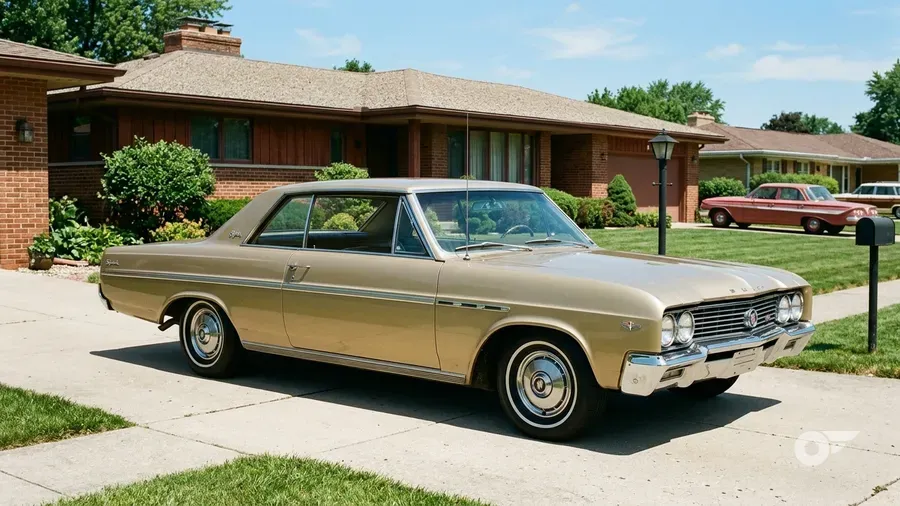
Buick spent 1961 trying to sell a compact car to people who did not want a compact car, and the Skylark is how it solved the problem. GM's three senior compacts landed that autumn on a new unibody Y-body platform, and the Buick version, the Special, carried something no rival had: a 215 cubic inch V8 with an aluminum block and aluminum heads, 318 pounds all in. Halfway through the model year Buick added a top rung called Skylark. It was a two door coupe with a vinyl roof, its own emblems and taillight housings, turbine wheelcovers, and a four barrel version of the aluminum V8 rated at 185hp. It was a trim level rather than a model, and 12,683 people bought one anyway. That was enough for Buick to promote it. For 1962 the Skylark got its own 4300 series number, a convertible, and a pillarless hardtop roof the Special could not order, while the Special line took Motor Trend's Car of the Year on the strength of its new Fireball V6. For 1963 the whole car was re-skinned to look like a shrunken full size Buick. Then it ended. For 1964 the Skylark moved onto the intermediate A-body and left the aluminum V8 behind.

Distinctions

The defining attributes and collector status that make this car garage-worthy.

Octane Files Select
Renowned for its history, engineering, or cultural weight.

Collectibility scorecard

Rated 1 to 10 on the traits that matter for owning, driving, and holding on to a car like this.

Desirability
5/10
Rarity
6/10
Driving thrill
5/10
Investment trajectory
6/10
Usability
6/10
Ease of restoration
5/10
Cultural impact
4/10
Electronic dependence
Fully analogHeavily electronic

Nothing on the car is electronic. The 215 runs a four barrel Rochester carburetor, a mechanical fuel pump and a breaker point distributor with centrifugal and vacuum advance. Braking is hydraulic drums at all four corners with no anti-lock hardware, steering is recirculating ball, and both the two speed automatic and the manual gearboxes are controlled entirely by linkage and hydraulics. Every input the driver makes reaches its component mechanically.

Market data

Demand tier, price trend, and typical values by condition, based on recent sales data.

Demand tier
EntrySolidHighBlue-chip

The accessible way in. Prices still forgive mistakes, and the upside is real.

Value trajectory
AppreciatingStableCooling

Values are holding steady. What you pay today is what it's worth tomorrow.

Price by condition
Driver
$8k
Excellent
$16k
Concours
$28k

This is one of the last genuinely cheap ways to buy an early sixties GM car with a V8 and no apologies, and the sale data says so plainly. Across 27 tracked auction results the 1962 Skylark's median sits around 8,500 dollars and its average around 10,500. The 1963 car reads much the same across 25 sales, a median near 9,750 and an average near 11,450. The top of the market is the outlier rather than the norm: the highest recorded 1962 result is 28,600 dollars and the highest 1963 result is 49,500. Current year averages on both years are running well above their historical figures, which looks like momentum, but the samples are small enough that two strong convertibles move the number, so the trajectory reads stable rather than climbing. Condition and the state of the aluminum V8 decide price far more than the model year does.

Values as of August 2026.

Buyer's guide

What anyone seriously considering this car should know first.

Why it's worth it
The car that turned Skylark from a one-off 1953 halo into a Buick model line
Callout
Its all-aluminum V8 weighed 318 pounds, lighter than many four-cylinder engines of the day
What to watch for
Buy the cooling system, then buy the body. The 215's aluminum block and heads carry cast iron cylinder liners and iron valve seat inserts, and the engine's whole bad reputation is galvanic: owners who ran plain water, alcohol antifreeze or the wrong inhibitor package ended up with aluminum migrating into the radiator core and corrosion in the water pump and the front accessory housing. Buick was issuing service bulletins about antifreeze brands at the time. Pull the radiator cap, look for grey sludge, ask what has been in it and how often it was changed, and treat a long term barn car's cooling passages as unknown until somebody proves otherwise. Then look at the shell. There is no separate frame under this car, so the floors, rockers, cowl and trunk floor decide what it is worth. Third, confirm you are actually looking at a Skylark. The style numbers to know are 4317 for the 1961 coupe, 4347 for the 1962 and 1963 hardtop and 4367 for the convertible. Skylark specific trim, the emblems, taillight housings and turbine wheelcovers, is scarce and particular, which is exactly why a Special wearing a Skylark badge is worth ruling out before money changes hands.

The Story

Driving character

A Skylark is not fast and was never trying to be, but it is light in a way almost nothing else wearing a V8 badge was in 1962. The hardtop weighs about 2,760 pounds and the engine ahead of the front axle accounts for 318 of them, so the car turns in without the nose heavy shove that defines most American V8s of the period. The 215 is the character. It is quiet, smooth and unusually willing to rev for a Buick, and with the four barrel Rochester it makes its power high enough up the range that you notice: 200hp at 5,000rpm in 1963 was not a Buick habit. The transmission decides how much of that you actually get. The two speed Dual Path Turbine Drive is what most cars have, and it flattens the engine's best trick by never letting it spin. The three speed manual on the column, or the Borg-Warner four speed, turn the same car into something you can work with. Everything else is period: recirculating ball steering, drums at all four corners, a 112 inch wheelbase, and a tight little cabin that sits closer to a European coupe than to anything else on a Buick lot.

Design

The 1961 and 1962 cars are the good ones to look at. The Y-body shape is crisp and small in scale, with a shallow greenhouse and a delicate roof, and Buick did the Skylark the right way: not a badge and stripe job, but a set of specific pieces. Its own emblems, its own taillight housings, lower body side moldings, turbine style wheelcovers and a vinyl covered roof, over a plush all vinyl interior with bucket seats on the option sheet. From 1962 the Skylark got a piece of hardware the Special could not order at all, a pillarless hardtop roof, and that is the clearest visual tell between the two cars. It is also what made the Skylark read as a small expensive car rather than a dressed up cheap one. For 1963 Buick threw the sheet metal away and started again. The new body is boxier and deliberately echoes the full size Buicks, with a blunter nose and small fins riding the rear fenders, and it lasted exactly one model year before the A-body arrived. The 1963 car is the one that looks most like a Buick and least like itself.

Motorsport pedigree

Buick never raced the Skylark and there was no factory programme behind it. The competition record belongs to the engine, and the engine's record is better than the car's. In 1962 Mickey Thompson took the 215 to Indianapolis, bored out to 256 cubic inches and mounted behind the driver, at a moment when the Speedway was still a front engine Offenhauser monopoly. Three cars were entered and one qualified, with a rookie named Dan Gurney in it, seventh fastest at 147.886mph. Gurney was running inside the top dozen on lap 92 when the transaxle let go, and he was classified 20th. Thompson took the Speedway's Mechanical Achievement Award for the effort, and the rear engine layout he was demonstrating would own Indianapolis within a few seasons. The other half of the story is Australian. Repco built its Formula 1 V8 around the same GM aluminum block family, choosing the Oldsmobile F-85 casting over Buick's own because it carried six head studs per cylinder instead of five, and Jack Brabham won the 1966 drivers' and constructors' championships with it, in a car that carried his own name.

In culture

The famous Skylark is not this one. The metallic green convertible the third act of My Cousin Vinny turns on is a 1964, which puts it a generation later and on a different platform. The 1961 to 1963 cars have almost no screen life at all, and chasing one would be the wrong story anyway, because this car's cultural weight is under the hood and it is genuinely large. The 215 aluminum V8 that made a Skylark a Skylark was sold to Rover in January 1965 after GM gave up on it, and Rover built it into the 2000s, in Range Rovers, Land Rovers, TVRs, Morgans and the MGB GT V8. The Fireball V6 that arrived alongside it in the Special had an even stranger life. Buick sold the tooling to Kaiser Jeep in 1967, watched it become the Dauntless 225, and bought it back from a cash starved AMC in 1974 when the fuel crisis suddenly made a small six valuable again. It grew into the Buick 3800, which GM kept building into the 2000s. Two of the most durable engines the American industry produced started here and in the car parked next to it.

Rivals

Cars from other manufacturers that competed for the same buyers when new.

Chevrolet Nova 1st Gen

Chevrolet Nova 1st Gen

USA·Vintage·1962–1965

Mercury Comet 1st Gen

We haven’t profiled this car yet. Request to add

Chevrolet Corvair 1st Gen

We haven’t profiled this car yet. Request to add

Owning One

Why collectors want it

The first Skylark is the cheapest way into a genuinely interesting early sixties GM car, and the reason is that hardly anyone kept one. 97,977 were built across three model years, a rounding error next to the million-plus Chevy IIs Chevrolet turned out in roughly the same window, and an aluminum V8 with a corroded cooling system was not something people spent money on when these were ten year old used cars. What survives is a light, well trimmed, V8 powered compact that costs a fraction of the muscle era Skylarks parked further along the same model page. The hierarchy inside the generation is easy to read because there is no options ladder to climb. The 1961 coupe is the scarce one at 12,683 cars, one model year only, and the only Skylark sold as a trim level of the Special rather than as its own series. The convertibles are the money, 8,913 in 1962 and 10,212 in 1963, and they are what the market actually chases. The 1963 cars wear a body that was built for a single year. Past that you are buying condition and an honest engine, which is exactly the sort of market where a good car is still findable.

Which one to look for

There is no trim ladder here, because the Skylark was itself the trim. Every one built between 1961 and 1963 came with the four barrel 215 aluminum V8 and no other engine, which is the single most useful thing to know when shopping: the 198 Fireball V6 and the 155hp two barrel V8 belong to the Special and Special Deluxe, not to this car. So you rank by year and by body. The 1961 coupe is the collector's pick on scarcity, 12,683 cars in one model year, and the only Skylark that was formally a trim level of the Special. The 1962 and 1963 convertibles are what the market wants and they price accordingly. The 1962 hardtop is the volume car and the easiest one to buy well, 34,060 built, and it carries the pillarless roof the Special never got. The 1963 cars have the one year re-skin and the strongest engine, 200hp against 190 for 1962 and 185 for 1961. If you want the turbocharged version of this engine, it is not here. That was Oldsmobile's Jetfire, on the same platform, in the same two years.

What owning one is like

Living with one comes down to coolant discipline and rust, in that order. The aluminum block and heads carry cast iron liners and iron valve seats, which is a lot of dissimilar metal sharing one cooling system, and the 215's reputation was built entirely by owners who did not respect that. Plain water, alcohol based antifreeze, or a long interval between changes, and the engine starts shedding aluminum into the radiator core; the water pump and the front accessory housing are usually the first parts to show it. Run a proper inhibited coolant, change it on schedule, and the engine is quietly one of the better designs of its decade. The bodies rust the way every early sixties unibody rusts, at the floors, rockers, cowl and trunk, and there is no frame underneath to hide behind. The two speed automatic is durable but dull and does the engine no favours. Beyond that these are simple cars with a small parts count, and the two things people fear most about them, an exotic aluminum engine and an orphan platform, turn out to be the two things a specialist industry has already solved.

Upkeep & parts

The mechanical side is better supported than the car's obscurity suggests, because Rover kept the engine alive for decades after Buick abandoned it. D&D Fabrications built a business on the Buick and Oldsmobile 215 and its Rover descendants, and stocks blocks, heads, cranks, bearings, front covers and gasket sets for an engine GM stopped making in 1963. Later Rover heads will physically go onto a 215, which hands you a route around corroded originals that owners of most orphan engines never get. Ordinary service parts are easy, since the ignition, brakes, suspension and steering come out of GM's early sixties parts bin. Body and trim are where the money and the waiting go. Skylark specific emblems, taillight housings, lower body mouldings and turbine wheelcovers were fitted for three model years to fewer than 100,000 cars, with no reproduction industry of any scale behind them, so buy the complete car rather than the cheap one and plan on the swap meet. The Buick Club of America is the deep resource, and V8Buick is where the practical answers live.

Country of origin
USA
Class
Luxury
Production years
1961–1963
Units built
97,977
Model
Skylark
Nickname
No nickname
Body
Coupe, Convertible
Layout
Front-engine, RWD
Engine
215ci aluminum V8, 4-barrel (185hp 1961, 190hp 1962, 200hp 1963)
Transmission
3-speed manual, 4-speed manual (Borg-Warner T-10), 2-speed Dual Path Turbine Drive automatic
Designer
William "Bill" Mitchell (GM Vice President of Design, executive oversight)