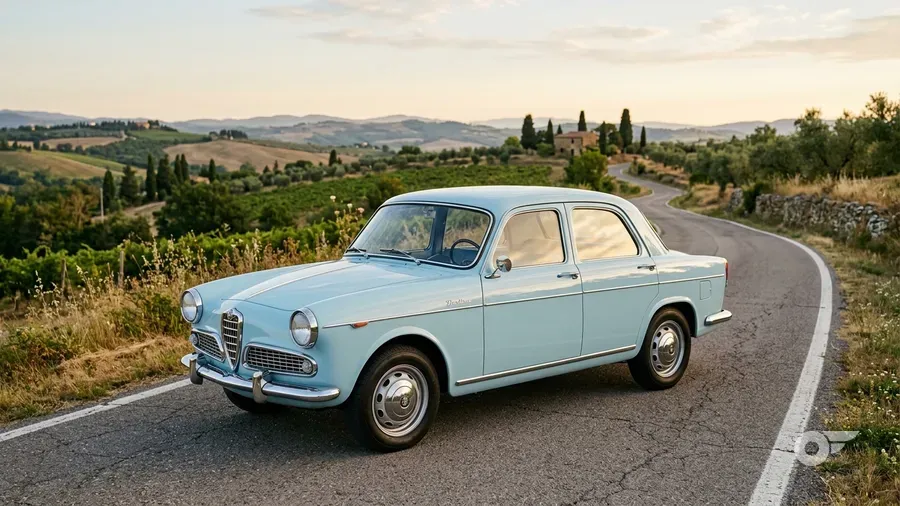
Alfa Romeo Giulietta
Italy·Sports·1954–1965

The defining attributes and collector status that make this car garage-worthy.

Rated 1 to 10 on the traits that matter for owning, driving, and holding on to a car like this.
Demand tier, price trend, and typical values by condition. Our own assessment, not a quoted valuation.
Values as of July 2026.
What anyone seriously considering this car should know first.
Cars from the same manufacturer family, like platform siblings or shared-era relatives.
Cars from other manufacturers that competed for the same buyers when new.
The volume seller and the sleeper buy: a five-speed 1290cc twin cam of 82hp sharing its engine family with the GT 1300 Junior coupe, quicker than the price suggests and mechanically identical in feel to the bigger cars. Twin-carb 1300 Super replaced it at the top of the 1.3 class from 1970.
The founding Giulia, launched at Monza on 27 June 1962: 92hp single-carb 1570cc twin cam, column-shift five-speed, split bench front seat and strip speedometer, marketed as a six-seater. Drum brakes until servo discs arrived during 1963; floor shift optional from May 1964, standard from 1966. The purist's period piece.
The final form: black plastic grille and a flat bootlid that deleted the traditional centre spine, in 1.3 and 1.6 petrol versions. From June 1976 the Nuova Super Diesel added a 1760cc Perkins four of 54hp, Alfa Romeo's first diesel passenger car and the slowest Giulia made. Today the cheapest honest entry into 105 sedan ownership.
The definitive Giulia: the TI Super's twin-Weber induction detuned to a torquier 98hp (102hp from 1969) in a fully trimmed body, with servo discs standard from the start. Top-spec status shown on the C-pillar by the gold Bollino d'Oro badge, then the Biscione serpent. Rationalised into Super 1.3 and Super 1.6 form for 1972-74.
The grail of the range and Alfa's first true homologation-special sedan. The 1570cc twin cam wore two Weber 45 DCOE carburettors for 112hp, dry weight fell to 910kg via magnesium wheels, Plexiglas rear windows, deleted trim and mesh in place of the inner headlights, and green quadrifoglios marked the wings and tail. Every car was white except one red and one grey. Raced across Europe after FIA homologation on 2 May 1964; the direct ancestor of the GTA.