Octane Files
Browse CarsSpyker C8 1st Gen

Spyker C8 1st Gen

Overview

Spyker had been out of business for seventy-five years when Victor Muller and Maarten de Bruijn restarted it in 1999. De Bruijn had already built the car once, privately: the Silvestris V8, an Audi-engined prototype he worked on through the first half of the 1990s and finally showed at Goodwood in 1999. The production version landed at the Birmingham Motor Show in 2000 as the C8 Spyder, an open two-seater on an aluminium spaceframe with a hand-formed aluminium body, Audi's 4.2 litre 40-valve V8 behind the seats and 400 PS.

Everything else in this generation grew out of that car. The Laviolette coupe added a fixed glass canopy in 2001, the Double 12 S swapped in a Mader-prepared BMW racing V8, the Spyder T went twin-turbo, and the run closed with a long-wheelbase Laviolette and the LM85.

Twelve years, and Spyker never came close to volume. Fewer than 300 cars of every type left Zeewolde in the company's first decade. In that same window the company floated on Euronext, bought a Formula 1 team and, in January 2010, bought Saab from General Motors. The C8 is the object all of that was built around.

Distinctions

The defining attributes and collector status that make this car garage-worthy.

Octane Files Select
Renowned for its history, engineering, or cultural weight.

Collectibility scorecard

Rated 1 to 10 on the traits that matter for owning, driving, and holding on to a car like this.

Desirability
7/10
Rarity
9/10
Driving thrill
8/10
Investment trajectory
7/10
Usability
4/10
Ease of restoration
3/10
Cultural impact
5/10
Electronic dependence
Fully analogHeavily electronic

The engine is thoroughly of its decade: Audi's 4.2 litre 40-valve V8 with electronic injection and full ECU management, joined by electrically operated doors, keyless entry and air conditioning. Everything the driver actually touches is mechanical. The six-speed Getrag is worked through an exposed rod linkage, the AP Racing brakes run without a servo so the pedal needs real effort, and there is no traction control to tidy up a clumsy throttle. No paddles, no drive modes, no stability programme, no adjustable dampers. It sits in the middle of the scale because the powertrain is 2000s Audi while the chassis and the controls belong to a much older idea of a sports car.

Market data

Demand tier, price trend, and typical values by condition, based on recent sales data.

Demand tier
EntrySolidHighBlue-chip

Strong, sustained collector demand. Good examples never wait long for a buyer.

Value trajectory
AppreciatingStableCooling

Values are climbing. The market wants more of these than exist.

Price by condition
Driver
$265k
Excellent
$390k
Concours
$600k

A thin market with a clear direction. The Classic Valuer counts fifteen public Laviolette sales at a median around £301,000 and an 88 percent sell-through, and the results climb steadily: £208,471 at RM Sotheby's in February 2020, £457,262 at Monterey in August 2024 for the sub-125km 2008 Geneva show car ($582,500), and £503,382 on Bring a Trailer in June 2026, which at about $670,000 is the highest recorded C8 sale. Open Spyders trade below coupes, a 7,500-mile 2006 car with fresh engine-out service making $270,111 in August 2024. The band here describes those two volume cars, not the Double 12 S or the LM85. With so few sales a year, one exceptional car drags the apparent average a long way, so read the median rather than the record.

Values as of August 2026.

Buyer's guide

What anyone seriously considering this car should know first.

Why it's worth it
The Dutch supercar whose maker went from a Zeewolde workshop to Formula 1 and owning Saab
Callout
The six-speed gearbox is worked through an open steel linkage left on show above the tunnel, so you watch the rods move as you shift
What to watch for
Start with the paperwork, because no two C8s are the same car. Each was built to order, so the build record tells you what the colour, the trim, the wheels and the steering wheel are meant to be, and a car wearing somebody else's ideas is harder to sell on. Early cars carried the four-spoke propeller steering wheel, later dropped for a bought-in item on safety grounds, so establish which one belongs to the car in front of you. Mileage is the second question, and it cuts the opposite way from a normal exotic. Most survivors have covered very little, so the risk is not wear but sitting: tired fluids, dried seals, perished rubber, sticky brakes. A recent major service is worth more than a low odometer reading, and on this car major service can mean engine out. That is how the C8 is built, not a warning sign. The 2006 Spyder that sold on Bring a Trailer in 2024 had exactly that work done, plus a new door actuator, and it made money. Then check the electric doors cycle cleanly and look hard at the aluminium bodywork. Panels are hand-formed to order, so accident repair is a commission rather than a parts order.

The Story

Driving character

The noise arrives first. PistonHeads' road test called it possibly the best V8 exhaust note ever, in those words, and nobody who has stood behind one at full throttle argues hard. Underneath the sound, the C8 is far more mechanical than its price and its decade suggest. There is no brake servo, so stopping takes a deliberate shove. There is no traction control. The Getrag six-speed moves in short, switch-like throws and you watch the linkage do it. Put 400 PS behind a driver in a car of roughly 1,275 kg and that combination rewards precision and punishes flailing. It is broadly neutral with a hint of understeer, barely rolls, and will get loose at one end or the other if you attack a corner instead of flowing through it. It rides better than expected, thanks to inboard Koni dampers on double wishbones. The seats are among the best fitted to anything. The steering is light and the wheel itself beautifully judged, though the lock is limited enough to turn a multi-storey car park into an event. This is not a hyper-alert Italian mid-engined car. It is a loud, muscular, tactile one.

Design

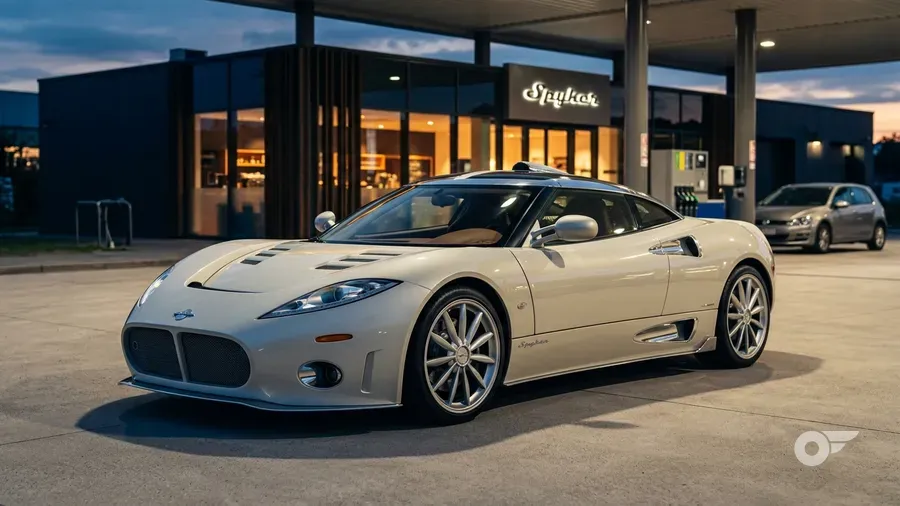
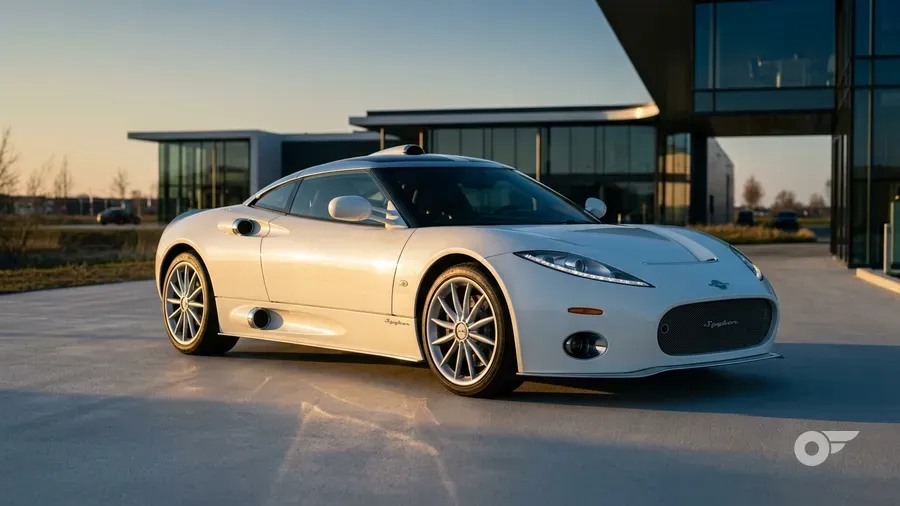
Every visual decision traces back to aircraft. Spyker built aeroplanes during the First World War, and the badge, a propeller crossed with a spoked wheel, comes from there. So do the Aeroblade wheels, whose spokes are propeller blades, the engine-turned aluminium dashboard, the rows of aluminium toggle switches, and the original four-spoke propeller steering wheel that safety compliance eventually pushed out. The signature detail is the one that costs money and adds nothing: the gear linkage runs exposed above the transmission tunnel, polished, and it moves when you shift. Around it, quilted leather covers nearly every surface, in a colour chosen car by car. The body is hand-formed aluminium over an aluminium spaceframe, with doors that rise rather than swing and a windscreen that meets the body without a rubber gasket. The Laviolette's contribution is a fixed glass canopy with a roof intake, which resolves the open car's rather upright profile. Maarten de Bruijn drew all of it, and it is closer to one person's car than almost anything else built in the 2000s: the shape follows his own Silvestris prototype from the 1990s, reproportioned. The Laviolette name honours the Belgian engineer behind Spyker's 1903 six-cylinder four-wheel-drive racer.

Motorsport pedigree

Spyker Squadron took the C8 to Le Mans nine times between 2002 and 2010, and the record is a lesson in how hard the race is from a standing start. The Double 12 R came first, carrying a Mader-BMW V8 of 480 bhp. It crashed on its competition debut at Sebring in 2002, then retired from Le Mans that June after 142 laps. In 2003 it ran to the finish but was not classified, 229 laps in. The Audi-engined Spyder GT2-R took over from 2005 and failed to finish at all three of its Le Mans attempts, including both cars in 2006 and again in 2007. The Laviolette GT2-R broke the run. After a 43-lap retirement in 2008, the 2009 car shared by Tom Coronel, Jeroen Bleekemolen and Jaroslav Janiš came home 25th overall and fifth in GT2, the marque's best result at the race. The 2010 entry backed it up with 27th and ninth in class. That mattered enough to Spyker to build a road car about it. The Laviolette LM85 wore the GT2-R's burnt orange and gunmetal, was announced as 24 cars for the 24 hours, and took its 85 from the number on the team's race cars.

In culture

For a company that built fewer than 300 cars, the C8 got around. Its biggest screen moment is the opening of Basic Instinct 2 in 2006, where Sharon Stone's character drives a black Laviolette through London at speed and off the road into the water at Canary Wharf. Spyker leaned into it and announced a limited edition built to the film car's specification, jet black over red, on magnesium Aeroblade wheels. Before that, Top Gear put Jeremy Clarkson in a C8 Spyder in its fourth series in 2004 and sent the Stig round the track in it, which is how most British enthusiasts learned the marque existed at all. The deeper reach is through games. The Laviolette appeared in Gran Turismo 4, 5 and 6, in Project Gotham Racing 4 and in Test Drive Unlimited, the LM85 turned up in Forza Motorsport 3 and 4, and the Spyder GT2-R raced in GRID and GTR Evolution. A generation of players has driven a Spyker without ever seeing one. Then there is the business chapter. Between the Formula 1 team and the Saab purchase, Spyker spent several years in newspapers that have no motoring section.

Rivals

Cars from other manufacturers that competed for the same buyers when new.
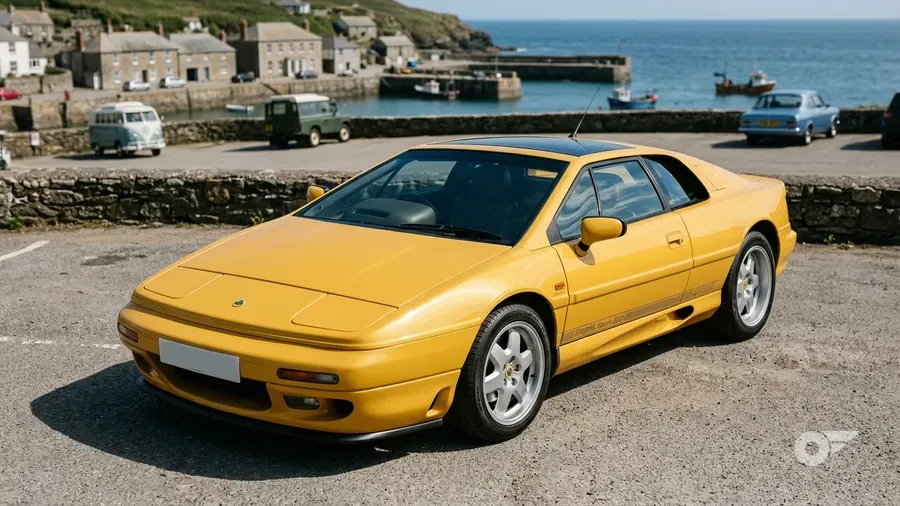
Lotus Esprit

Lotus Esprit

UK·Sports·1976–2004
Porsche 911 996

Porsche 911 996

Germany·Sports·1998–2004
Honda NSX NA1/NA2

Honda NSX NA1/NA2

Japan·Exotic·1990–2005

Lamborghini Gallardo

We haven’t profiled this car yet. Request to add

Owning One

Why collectors want it

Rarity here is not a marketing line. Fifty-five Laviolette coupes were built between 2001 and 2009, the Double 12 S ran to about fifteen cars, and Spyker's entire first decade produced fewer than 300 vehicles of every type. Every one was specified individually, which is why auction catalogues keep calling colour combinations unique and are telling the truth.

The hierarchy inside the generation is clear. The Laviolette coupe leads. The Classic Valuer counts fifteen public Laviolette sales at a median around £301,000 with an 88 percent sell-through, and the direction is steeply up, from £208,471 in February 2020 to £503,382 in June 2026. RM Sotheby's took $582,500 for a 2008 Laviolette at Monterey in 2024, a car that had covered under 125 kilometres from new. Open Spyders sit below the coupes: a 7,500-mile 2006 example made $270,111 on Bring a Trailer in the same month.

What the money is actually buying is craft nobody else was attempting at this price. Machined aluminium instead of moulded plastic, quilted leather instead of trim panels, working linkages left visible on purpose. This is the rare modern exotic where the cabin is the reason to own the car.

Which one to look for

The Spyder is where most people should start. It is the original car, the one Top Gear filmed and the press drove, and it is the most numerous, which makes it the sanest way in. The Laviolette coupe, from 2001, is the connoisseur's pick and the market has agreed. Fifty-five were built, the fixed glass canopy with its roof intake is the best resolution of the shape, and it carries the strongest results. The one everybody underweights is the Double 12 S, built from 2002 to 2007 and named for S.F. Edge's 1922 Brooklands record. It dropped the Audi engine for a Mader-prepared BMW 4.0 litre V8 offered in five states of tune from 400 to 620 bhp. Roughly fifteen were made. It is the closest thing to a road-going Spyker Squadron car and almost nobody remembers it exists. Around those sit three more. The Spyder T of 2003 twin-turbocharged the Audi V8 to 525 PS on a wider track. The 2008 Laviolette LWB stretched the wheelbase from 2,575 to 2,675 mm for buyers who found the standard car tight. The LM85, announced as 24 cars in the GT2-R's burnt orange and gunmetal, is the one with a racing story attached to it.

Double 12 S · 2002–2007

The road version of the Double 12 R racer and the only C8 that abandoned the Audi engine, using a Mader-prepared BMW 4.0 litre V8 in five states of tune from 400 to 620 bhp. Quoted at 4.5 to 3.8 seconds to 60 mph and 300 to 345 km/h depending on tune. Named for S.F. Edge's 1922 Brooklands record, run as two 12-hour stints because night racing was banned there.

Laviolette · 2001–2009

The first C8 coupe, unveiled at AutoRAI 2001. Same 400 PS Audi V8 and six-speed manual as the Spyder, with a fixed glass canopy roof and a roof-mounted air intake in place of the folding top. Named for Joseph Valentin Laviolette, the Belgian engineer behind the 1903 Spyker 60 HP.

Laviolette LM85 · 2009–2012

Road-going tribute to the Spyker Squadron Le Mans effort, finished in the GT2-R's two-tone Burnt Orange over Gun Metal. Standard 400 PS Audi V8. The name joins Le Mans to 85, the number the team's cars carried at the race.

Laviolette LWB · 2008–2012

Long-wheelbase Laviolette shown at the 2008 Geneva Motor Show, stretching the platform from 2,575 mm to 2,675 mm in response to customers who found the standard cabin tight. Standard 400 PS Audi V8.

Spyder · 2000–2009

The car that started the modern marque, shown at the Birmingham Motor Show in 2000. Open two-seater on an aluminium spaceframe with a hand-formed aluminium body, Audi's 4.2 litre 40-valve V8 behind the seats at 400 PS, six-speed Getrag manual, around 1,275 kg. Soft top and hardtop were both offered.

Spyder T · 2003–2007

Twin-turbocharged development of the Spyder, taking the 4.2 litre Audi V8 to 525 PS. Wider track, uprated tyres, revised suspension and aerodynamics to cope with the extra output.

What owning one is like

The reassuring half of this car is the drivetrain. The V8 and the six-speed transaxle are Audi and Getrag hardware, understood by people well outside the marque, and they are not the fragile part. The demanding half is everything Spyker made itself. Bodywork is hand-formed aluminium, so a damaged panel is fabricated rather than ordered. Trim is quilted to order in a colour the first owner chose. The electric doors have actuators that fail in the end. The 2006 Spyder sold on Bring a Trailer in 2024 had one replaced, and that reads as a normal line in a C8's history rather than a horror story. The bigger reality is behavioural. Most C8s have covered very little ground, and cars that sit acquire problems that cars that run never get: dried seals, tired fluids, seized calipers, dead batteries. Major work often means lifting the engine out, which sounds dramatic and is simply how the car goes together. Spyker has been through bankruptcy twice, so no dealer network stands behind these cars. What exists instead is a small, tightly connected owner community and a handful of specialists who know individual cars by chassis number, and for something this rare that turns out to be enough.

Upkeep & parts

Split the car in half and the logistics make sense. Audi's 4.2 V8, the Getrag gearbox, the AP Racing brakes and the Koni dampers all come from firms that still exist, so routine servicing is a question of finding a competent independent rather than hunting unobtainable components.

The Spyker-made half needs planning. Aluminium panels, quilted leather, the Aeroblade wheels and the machined switchgear were all made in tiny numbers by a company that has since failed twice. Sourcing them runs through the owner network rather than a parts counter, so budget time as much as money.

That community carries real weight. The Official Spyker Owner Forum at spykerowner.com is the central meeting point and keeps its own informal register, and a short list of specialists is trusted marque-wide, among them the Dutch expert Jasper den Dopper, whom RM Sotheby's cited when it catalogued a Laviolette in 2024. Spyker is back under Victor Muller with the brand's intellectual property recovered and a new car promised for 2026, so factory goodwill may improve, though nobody should buy on that basis.

Budget for an engine-out major service, and for dry storage that keeps a low-mileage car healthy.

Country of origin
Other
Class
Exotic
Production years
2000–2012
Units built
Not recorded
Model
C8
Nickname
No nickname ("Laviolette" names one coupe variant specifically, not the generation)
Body
Coupe, Roadster
Layout
Mid-engine, RWD
Engine
4.2L Audi 40-valve V8 (400 PS), 4.2L twin-turbocharged Audi V8 (525 PS, Spyder T), 4.0L Mader-BMW V8 (400-620 bhp in five states of tune, Double 12 S)
Transmission
6-speed Getrag manual transaxle
Designer
Maarten de Bruijn