Octane Files
Browse CarsRenault 5 Turbo

Renault 5 Turbo

Overview

Jean Terramorsi watched Lancia win rallies with the mid-engined Stratos and decided Renault needed something similar, except Renault did not build cars like the Stratos. It built the 5, a front-drive supermini selling in millions. So the 5 was taken apart. Flins supplied bare two-door shells, Heuliez at Cerizay cut them about and hung pressed aluminium doors, roof and hatch on them, and Alpine at Dieppe fitted a turbocharged 1,397cc four where the back seat had been, driving the rear wheels. The rear quarters had to grow 11.25cm each side to cover the tyres, which is the entire reason the car looks the way it does.

The first 400 existed only to satisfy Group 4 homologation, and Alpine got them finished by the end of 1980. Then demand kept going: 1,820 Turbo 1s by the count most sources use, followed by 3,167 of the cheaper steel-panelled Turbo 2 through to April 1986. In January 1981, on its first World Championship start, Jean Ragnotti won the Monte Carlo Rally in one. Almost nothing else has gone from parts-bin improvisation to a Monte win that quickly.

Distinctions

The defining attributes and collector status that make this car garage-worthy.

Legend
A car that transcended the hobby, known far beyond the people who drive them.
Homologation Special
Built for the road only because racing rules demanded it.
Poster Car
The car on the bedroom wall, the one people dreamed about before they could drive.
Octane Files Select
Renowned for its history, engineering, or cultural weight.

Collectibility scorecard

Rated 1 to 10 on the traits that matter for owning, driving, and holding on to a car like this.

Desirability
9/10
Rarity
8/10
Driving thrill
8/10
Investment trajectory
7/10
Usability
3/10
Ease of restoration
4/10
Cultural impact
8/10
Electronic dependence
Fully analogHeavily electronic

Fuel is metered by Bosch K-Jetronic, which is continuous mechanical injection: a sensor plate, a plunger and fuel pressure, with no map, no load sensing and nothing to reflash. Boost is controlled by a pneumatic capsule reading pressure either side of the compressor and operating a wastegate. There is no ABS, no traction control, no power steering and no engine management computer of any kind. The one genuinely electronic system is the breakerless transistorised ignition, which is why this sits at 2 rather than 1. Programmable ignition and modern fuel pumps are common retrofits, and both push an individual car further up this scale than the factory ever did.

Market data

Demand tier, price trend, and typical values by condition, based on recent sales data.

Demand tier
EntrySolidHighBlue-chip

Strong, sustained collector demand. Good examples never wait long for a buyer.

Value trajectory
AppreciatingStableCooling

Values are holding steady. What you pay today is what it's worth tomorrow.

Price by condition
Driver
$72k
Excellent
$118k
Concours
$170k

The band describes a Turbo 2, the volume car at 3,167 of the roughly 4,987 built. Recorded Turbo 2 sales from late 2025 into the first half of 2026 cluster tightly, in the region of USD 114,000 to USD 125,000 for good cars, and the model's Bring a Trailer record still stands at USD 160,000 from 2023. Turbo 1s trade around forty percent higher on median. That gap, and the flatness of the recent Turbo 2 results, is why this reads stable rather than appreciating: the climb has already happened, roughly a doubling across fifteen years, and the last five recorded sales sit on top of one another. Competition cars are a separate market entirely and sit outside this band. A 1983 Maxi 5 Turbo prototype took EUR 216,720 at Artcurial's Renault Icons sale in December 2025, against an EUR 80,000 to 120,000 estimate.

Values as of August 2026.

Buyer's guide

What anyone seriously considering this car should know first.

Why it's worth it
The Renault 5 with the back seat taken out and a turbocharged engine put there instead
Callout
Won the Monte Carlo Rally on its first World Championship start, January 1981
What to watch for
Everything expensive about a 5 Turbo is structural, and almost none of it is where you would look first. The car began life as an ordinary steel R5 shell that Heuliez then cut about, so it rusts where an ordinary R5 rusts and in a set of places no ordinary R5 has. Go through the sills, the boxed cavity between the front wheel arch and the front floor, the front crossmember and the chassis legs around the anti-roll bar mounts, both inner front wings, the A-posts and the screen surrounds. Check the impact tube in the now-empty front engine bay is present and straight. Rear arches and the quality of past repairs around them tell you most of the rest. Panels are the other half of the problem. Turbo 1 aluminium doors, roof and hatch are expensive when they can be found at all, and a Turbo 1 wearing steel has been rebuilt at some point. Mechanically it is calmer than the reputation suggests. The Cléon-Fonte four is a Renault workhorse, but K-Jetronic seizes after long storage, fuel pumps rarely survive it, and a clutch replacement costs more than the rest of the service list together.

The Story

Driving character

There is a beat of nothing, and then everything. The T3 wants revs before it does anything at all, so the first part of a corner exit is a 1.4-litre pushrod four working alone and the second part is 160hp arriving at a 970kg car with sixty percent of its weight over the driven axle. Learning where that step falls is most of learning the car. The engine sits directly behind the bulkhead, so what you hear is induction, wastegate and transmission whine rather than exhaust, and the cabin gets hot. The steering is unassisted and quick, and the short wheelbase and wide rear track mean it turns in far harder than a hatchback silhouette prepares you for. Lift mid-corner and the back will come round, though it goes and returns predictably rather than viciously. What surprises people is the gearchange. It is the Renault 30 saloon's five-speed turned through 180 degrees, and it moves with the long, slightly vague action of the family car it came from, in the middle of a car that does nothing else like a family car.

Design

The trick is that the front two thirds are left alone. Doors, glasshouse, tailgate outline and even the face are recognisably the 5 that French families bought by the million, and that is exactly what makes the back half land. The rear quarters are 11.25cm wider each side, with full-height intakes down their leading edges feeding the engine, the intercooler hidden inside one of the flares, and hot air leaving through vents flanking standard 5 tail lights. The nose is left with almost nothing to do. The radiator has moved rearward, air entering the front grille exits through the bonnet, and the only thing under there is the spare wheel. Marc Deschamps and Alpine's Yves Legal are the names attached to the shape, with Bertone responsible for the Turbo 1 cabin: an asymmetric steering wheel, an instrument binnacle nothing like the donor car's, and a colour scheme committed enough to be difficult, red bodywork with blue trim or blue with red. Swapping that for the R5 Alpine dashboard is the single change that separates the Turbo 1 from the Turbo 2 in most people's affections.

Motorsport pedigree

Four World Championship wins, and their shape tells the story better than the count does. Ragnotti and Jean-Marc Andrié won the 1981 Monte Carlo on the car's first World Championship start, in Group 4, against a field that included the new four-wheel-drive Audi Quattro. The same crew won the 1982 Tour de Corse. Both came on tarmac, which was never a coincidence: a light rear-drive car with a huge rear track stayed competitive on sealed roads long after four-wheel drive had settled the loose stuff. For Group B, Renault Sport enlarged the engine to 1,527cc, not chasing power but because the 1.4 turbo multiplier then rated it at 2,138cc and unlocked wider wheels. That car, the Maxi 5 Turbo at 350PS, gave Ragnotti and Pierre Thimonier the 1985 Tour de Corse. The fourth win is the strangest. At the 1986 Rally of Portugal, Joaquim Santos put an RS200 into spectators on the opening stage, killing three, and every works team withdrew. Joaquim Moutinho and Edgar Fortes, privateers in a 5 Turbo, won the event. Group B was abolished eight weeks later.

In culture

In France this is not really a collector car, it is a piece of the early eighties. The 5 was the car everyone's family had, so a 5 with hips and an engine in the back was a joke the whole country got instantly, and it went straight onto bedroom walls at the moment Renault was also winning Formula 1 races with a turbo. It travelled further than that. A Turbo 2 does a chase sequence in Never Say Never Again in 1983, a strange credit for a car never officially sold in the United States, where the handful that arrived came through the grey-market conversion trade. Sports Car International ranked it ninth among the sports cars of the 1980s in 2004. The console generation met it through Gran Turismo, which carried the R5 Turbo Rallye '85 across four titles, and through the Forza and DiRT series. The clearest measure of its standing is what Renault has done with the name. The electric 5 Turbo 3E, due in 2027, is limited to 1,980 cars, a reference to the year this one arrived.

Rivals

Cars from other manufacturers that competed for the same buyers when new.
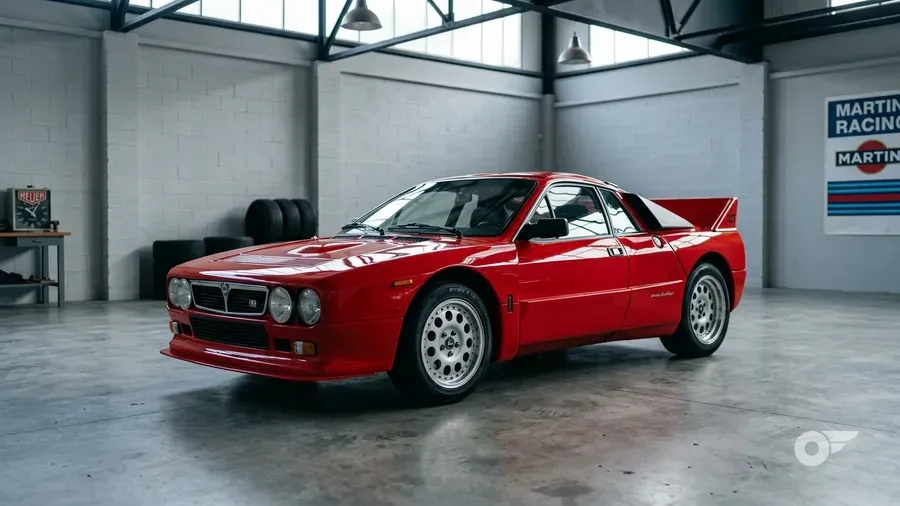
Lancia Rally 037

Lancia Rally 037

Italy·Sports·1982–1984
Peugeot 205 GTI

Peugeot 205 GTI

France·Sports·1984–1994
Lancia Delta HF

Lancia Delta HF

Italy·Sports·1986–1994

Owning One

Why collectors want it

Homologation specials are collectible because the road car is an accident of the rulebook, and few wear the accident as plainly as this one. Everything strange about a 5 Turbo, the hips, the two seats, the engine breathing over your shoulder, exists because 400 of them had to be built before Renault Sport could go rallying. That is a better story than a fast hatchback, and the market has worked it out.

The hierarchy inside the generation is clear, and it is not the usual one. The Turbo 1, with its pressed aluminium doors, roof and hatch and the Bertone cabin in red or blue, is the connoisseur's car and trades at a median roughly forty percent above a Turbo 2. Below it sits the Turbo 2 itself, which is what most people buy and where most of the money changes hands. The sleeper is the Type 8221, the 200-car batch built in 1984 and 1985 with an alloy roof and a 1,437cc engine purely so the works Maxi could run wider wheels. It was recognised late, it is priced accordingly, and it is finite.

Which one to look for

Start with the split the badge hides. The Turbo 1, built from June 1980 to September 1982, carries pressed aluminium doors, roof and hatch and the Bertone interior, with its asymmetric steering wheel and a cabin done in red with blue trim or the reverse. The Turbo 2, from July 1982 to April 1986, traded all of that for steel panels and the R5 Alpine's dashboard, which is why there are nearly twice as many and why they cost less. Performance barely moved. The one worth hunting is the Type 8221, known as the Turbo 2 Evolution and identified by that number in the VIN. Two hundred were built across 1984 and 1985 with no customer orders behind them, carrying an aluminium roof and a 1,437cc C7K engine, and they exist purely so the works Maxi could be homologated into a wider tyre class. Below those sit the competition versions Renault Sport sold directly: the Cévennes at 180PS and the Tour de Corse at 210PS on the factory's own progression of works outputs, the latter twenty cars in Renault Sport yellow with white bumpers plus a dozen converted from Cévennes cars. The Maxi 5 Turbo is a works car and never was a road car.

Cévennes

The first competition specification, named for the Critérium des Cévennes and sold through Renault Sport rather than the showroom. Uprated engine, competition suspension and cage. Renault's own progression of works outputs puts it at 180 PS. It is the version that did the early development work before the Group 4 cars proper appeared.

Maxi 5 Turbo · 1985–1986

The works Group B car, not a road car. The engine grew to 1,527cc as the C7K, which mattered less for power than for classification: the FISA turbo multiplier of 1.4 rated it at 2,138cc, moving it into the 2,000-2,500cc bracket and unlocking wider wheels at the price of a higher minimum weight. 350 PS by 1984. This is the car Ragnotti and Pierre Thimonier won the 1985 Tour de Corse in.

Tour de Corse · 1983

Built to meet the new Group B rules, and delivered in Renault Sport yellow with white bumpers, roof trim and lower body. Sixteen-point cage in place of the earlier ten-point, quoted at 930kg. Renault Sport sold it complete or as an adaptation kit for an existing car. Wikipedia's works output progression puts the Tour de Corse specification at 210 PS; specialist sources say 285hp, which is likely a later state of tune.

Turbo 1 · 1980–1982

The homologation car itself. Pressed aluminium doors, roof and rear hatch, a strengthened shell and the Bertone interior with its asymmetric steering wheel and committed two-tone scheme, usually red bodywork with blue trim or the reverse. 1,397cc Cléon-Fonte four with Bosch K-Jetronic and a Garrett T3, 160 PS at 6,000rpm, 970kg. The lighter and rarer of the two road cars, and the one the market pays for.

Turbo 2 · 1982–1986

The cost-reduced version, and the one most people actually buy. Steel doors, roof and hatch in place of aluminium, the R5 Alpine's dashboard and seats instead of Bertone's, and a lot of trim in dark grey rather than red or blue. Same 1,397cc engine and same 160 PS, with performance essentially unchanged at 0-100km/h in 6.9 seconds. Heavier than a Turbo 1, though sources disagree on by how much.

Turbo 2 Evolution (Type 8221) · 1984–1985

The road car nobody ordered. Renault built a batch of 200 with no customer demand behind them, purely to homologate the works Maxi into a class with wider wheels. An aluminium roof returns, the engine grows to 1,437cc as the C7K-700 with an uprated turbocharger, crankshaft, head and gasket, and there are aerodynamic and suspension geometry changes. Identified by 8221 in the VIN. The connoisseur's pick among the road cars.

What owning one is like

Owning one is less fraught than the price suggests and more fiddly than the simple mechanical layout implies. The engine is an ordinary Renault pushrod four with a turbo bolted to it, and it will cover proper mileage as long as it is kept cool, which is the whole trick. Cooling and head gaskets are the recurring theme on early cars, and the T3 does not enjoy a diet of short cold journeys. Anything that has sat needs the fuel system treated as one job, pumps and K-Jetronic together, because the metering unit seizes. The bodyshell is where the real money lives. It corrodes in the places an ordinary R5 corrodes plus every cavity Heuliez created, and a bad one hides all of it behind fresh paint. A clutch replacement is a genuinely large bill. Gearbox internals are getting harder to find. The cabin is hot, loud and strictly two-seat, and rearward visibility is what you would expect with an engine in the way. None of that stops people using them hard, and most owners do.

Upkeep & parts

Parts divide cleanly into cheap and alarming. Engine, brakes, suspension and service items are largely shared with other Renaults of the period, and specialists including Arnaud Ventoux Pièces and Auxal in France, plus GTO Racing in the UK, stock 5 Turbo 1 and 2 components off the shelf. Routine upkeep is genuinely modest for a car in this price bracket.

Then there is everything unique to it. Gearbox internals are increasingly scarce. Turbo 1 aluminium doors, roof and hatch are the hardest single thing to solve, and the flared composite panels are not far behind. Treat a clutch as a planned event rather than a service line.

The club matters more here than the general aftermarket does. Club IT5, the International Turbo 5, exists for this car specifically, covers the Cévennes and Tour de Corse versions as well as the road cars, runs regional sections and an annual gathering, and remanufactures parts that had simply stopped existing. On a model with under five thousand cars built, that is the difference between a restoration being possible and being theoretical.

Country of origin
France
Class
Sports
Production years
1980–1986
Units built
~4,987
Marque
Model
5 Turbo
Nickname
No nickname ("Maxi Turbo" names the 1985 works Group B evolution specifically, not the road generation)
Body
Hatchback
Layout
Mid-engine, RWD
Engine
1,397cc Cléon-Fonte C6J turbocharged OHV inline-four, 160 PS at 6,000rpm; 1,437cc C7K-700 turbocharged inline-four (200-car Type 8221 Group B homologation batch, 1984-1985)
Transmission
5-speed type 369 manual
Designer
Marc Deschamps, Yves Legal (Alpine), Bertone (Turbo 1 interior)