Octane Files
Explore CarsNissan Z-Car Z31

Nissan Z-Car Z31

Overview

The Z31 is the Z that sold in numbers nobody expected and gets remembered for none of it. Nissan built 329,900 between July 1983 and 1989, and 270,144 of those were American cars. Two enormous opening years, 75,351 and 74,551, then a halving, then a collapse to 4,227 in the final year as the Z32 came into view.

It earned those numbers by being new in ways the 280ZX was not. The straight six was gone, replaced by the VG, Japan's first mass-produced V6 and its first at 60 degrees, and the body was drawn to a drag coefficient of 0.30. The American turbo made 200 hp at a moment when a Corvette made 205, and the equipment list ran to electronically adjustable dampers, a digital dash, speakers built into the seat backs and a synthesised voice that told you the door was open.

What it did not do is convince the people who wanted a sports car. The Z31 handled and accelerated better than the car it replaced and it still arrived as a grand tourer, wedge-shaped and softly sprung, so the argument that started with the 280ZX carried straight through it.

Distinctions

The defining attributes and collector status that make this car garage-worthy.

Octane Files Select
Renowned for its history, engineering, or cultural weight.

Collectibility scorecard

Rated 1 to 10 on the traits that matter for owning, driving, and holding on to a car like this.

Desirability
5/10
Rarity
3/10
Driving thrill
5/10
Investment trajectory
5/10
Usability
7/10
Ease of restoration
6/10
Cultural impact
5/10
Electronic dependence
Fully analogHeavily electronic

A 3, and comfortably so for 1983. Every Z31 ran electronic fuel injection with Nissan's ECCS engine management, and the options list added three-way electronically adjustable dampers, a full digital instrument cluster, electronic climate control, seat-mounted Body Sonic speakers and a voice synthesiser wired to the doors, lights, handbrake and fuel level. What it does not have is anything electronic between the driver and the road: no ABS as standard, no traction control, a cable throttle and a mechanical wastegate. The electronics manage the engine and decorate the cabin. They do not drive the car.

Market data

Demand tier, price trend, and typical values by condition. Our own assessment, not a quoted valuation.

Demand tier
EntrySolidHighBlue-chip

The accessible way in. Prices still forgive mistakes, and the upside is real.

Value trajectory
AppreciatingStableCooling

Values are holding steady. What you pay today is what it's worth tomorrow.

Price by condition
Driver
$8k
Excellent
$16k
Concours
$30k

The Z31 has been the cheapest classic Z for so long that its price is closer to a habit than a valuation, and Entry is the honest tier. Stable rather than appreciating is a deliberate call: the generation has not shown the sharp lift that took the RX-7 FC, the Supra A70 and the S30 upward after 2020, and with 329,900 built there is no shortage of cars. The variable is the Fairlady 200ZR, which was never sold outside Japan, is now fully importable to the United States, and is the only Z31 with a genuine collector argument behind it. Classic and Sports Car put UK 200ZR values at 5,000 to 25,000 pounds in 2023, which is one variant in one market on one date and is quoted here rather than turned into a band. The band itself rests on classic.com aggregates: naturally aspirated cars average 12,534 dollars and turbos 16,045, while the Shiro Special, the collector Z31 in the American market, averages 22,140 with a verified high of 30,333 dollars in October 2021. It describes a good turbo car, and it excludes the 102,200 dollars paid for a 1984 300ZX race car in September 2022, which is not a road-car result.

Values as of August 2026.

Buyer's guide

What anyone seriously considering this car should know first.

Why it's worth it
The first Z with a V6, and Japan's first mass-produced V6 arrived in it
Callout
The first car in history with an LED centre brake light, in 1987
What to watch for
Work out which of the three Z31s you are looking at before anything else, because the car changed twice. Cars from 1984 to 1985 are the Zenki type, 1987 to 1989 the Kouki, and 1986 sits between with features of both. The Kouki got the aerodynamic bumpers, the fog lamps inside the air dam and the full-width tail lights. From 1988 the turbo swapped a Garrett T3 for a low-inertia T25 and compression rose from 7.8:1 to 8.3:1, which is the sharper engine and the one to want. After that, buy on electrics and body. The Z31 was heavily equipped by 1984 standards and everything it was equipped with is now forty years old: three-way adjustable dampers, digital instruments, electronic climate control, the Body Sonic seat speakers, and the Voice Warning System that muted the radio to talk to you until Nissan dropped it for 1987. Establish what actually works before you agree a price, because none of it is quick to chase. Then look underneath, and at the T-tops, which is the same conversation as any Z of the period. A turbo with a full service history is a good car; one without is a gamble on somebody else's oil changes.

The Story

Driving character

The Z31 is quicker and better tied down than the 280ZX and still not a sports car, and both halves of that are worth saying. The VG30ET sets the character: a soft, wide, undramatic V6 that makes its torque low and pushes the car along without ever sounding like it is working. There is real lag from the T3 cars, less from the T25 cars of 1988 and 1989, and no drama in the delivery at any point. The chassis kept the 280ZX's wheelbase and its struts and semi-trailing arms, but the retune worked, and the three-way adjustable dampers on the turbo cars genuinely change the car between settings rather than pretending to. The steering is light, body control is decent, and nothing about it asks for commitment. The 200ZR is the outlier and the reason the Z31 is worth another look. Swap the V6 for the RB20DET and the whole car sharpens: higher compression, lower boost, a genuinely flexible engine, and the hard-edged noise a good straight six makes when it is being used. It feels like a later generation of car wearing the same body.

Design

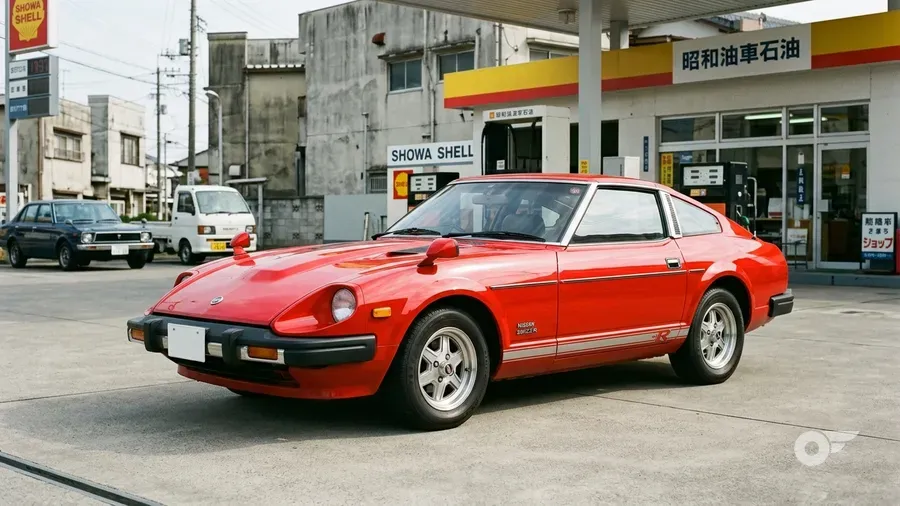
Kazumasu Takagi's team signed off the Z31 in 1982 and gave the Z the shape it is remembered for, badly by enthusiasts and widely by everyone else. Everything about it is wedge: a flat bonnet, a low nose with pop-up lamps, a hard shoulder line and a fastback tail. The drag coefficient came out at 0.30, a real number in 1983 and a long way past the 280ZX's 0.385. Nissan then spent six years unpicking it. The 1986 cars gained side skirts, flared fenders and 16-inch wheels on the turbo, lost the off-centre bonnet scoop, and had much of the black plastic painted body colour. The 1987 restyle went further: rounded aerodynamic bumpers, fog lamps set inside the air dam, replaceable-bulb headlamps in place of sealed beams, a narrow full-width tail light bar and an LED third brake lamp above the hatch. Inside is where the period shows hardest. The digital instrument cluster with its bar-graph tachometer, the seat-mounted Body Sonic speakers and the electronic climate control together make the most confidently 1980s cabin Nissan ever built.

Motorsport pedigree

The Z31's own record is modest and its engine's record is not, which is the honest way round to tell it. Paul Newman kept the Bob Sharp Racing relationship going into the V6 era, winning SCCA national championships in GT-1 at the Road Atlanta Runoffs in 1985 and 1986 in a 300ZX Turbo, as reported by the Los Angeles Times and UPI from those weekends. He also took the 300ZX's only Trans-Am win, at Lime Rock in 1986. Showroom stock racing brought the car wins through 1984 and 1985. The bigger story is the VG30ET. From 1985 Electramotive put it behind the driver in a Lola T810 and ran it as the Nissan GTP ZX-Turbo in IMSA GTP and the All Japan Sports Prototype Championship, badged as a Fairlady Z. By 1988 it was dominant, and the single-turbo, single-cam V6 was making upwards of 1,000 hp with a usable band from 4,000 to 9,000 rpm. The road car homologated none of it and started none of it. Its engine went sports-prototype racing and won.

In culture

The Z31 has almost no screen record and it would be dishonest to invent one. What it has instead is a shape that became shorthand. The 1984 wedge with pop-up lamps, a digital dash and a voice telling you the door is open is the 1980s Japanese sports car as most people picture it, and it got there by being everywhere: 270,144 American cars in six years, in every colour Nissan could mix. It is also the car that finished the Datsun to Nissan handover. The 1984 model year is technically the only Datsun 300ZX; from 1985 the Datsun name was off the badges even though the dealers were still called Datsun dealers, and Nissan spent heavily to make sure people noticed. One award this page will not borrow: Motor Trend's Import Car of the Year went to the 280ZX for 1979 and to the Z32 for 1990, and never to the Z31. Sitting between two decorated generations is a large part of why this one gets overlooked.

Owning One

Why collectors want it

For most of its life the Z31 was the Z you bought because you could not afford a better one, and that is still roughly its market position. It is worth understanding why that is changing.

The generation's connoisseur car was never sold in America. The Fairlady 200ZR of 1985 to 1988 dropped the V6 for the RB20DET, the twin-cam turbocharged six from the engine family that would go on to define the R32 GT-R, and it is the last inline-six Z-car ever built. Roughly 8,283 were made, Japan only, because Japanese displacement tax punished anything over two litres. Classic and Sports Car called it a glaring omission that Nissan never offered it elsewhere, and every one of them is now old enough to import into the United States.

Behind it sit the two American specials. The 1984 50th Anniversary Edition marked Nissan's half-century: 5,148 US cars and 300 Canadian. The 1988 Shiro Special is the one enthusiasts actually chase: 1,002 US cars and 75 Canadian, pearl white only, Recaros, viscous limited-slip differential, stiffer everything, and no options at all.

Which one to look for

The best Z31 was never sold outside Japan. The Fairlady 200ZR, built from 1985 to 1988, replaced the V6 with the RB20DET, a twin-cam turbocharged straight six making 178 bhp at 6,400 rpm and 167 lb-ft at 3,600, and it is the last inline-six Z-car. Roughly 8,283 were built in two forms: the 200ZR-I with a fixed slicktop roof, wind-up windows and a manual gearbox only, and the better-equipped 200ZR-II with T-tops. Both had the R200 limited-slip differential as standard. In America the two to know are both specials. The 1984 50th Anniversary Edition marked Nissan's half-century: 5,148 US cars and 300 Canadian, turbo, two-seat, Light Pewter over Thunder Black, with a digital dash reading average economy, g-force and compass, adjustable shocks, Body Sonic seats and 16-inch wheels. The 1988 Shiro Special is the driver's pick: 1,002 US cars and 75 Canadian, pearl white only, Recaro seats, stiffer springs and bars, fixed-rate suspension, a viscous limited-slip differential and a front lip. It had no options at all, so every Shiro is identical, which is a rare and useful thing in a car this heavily optioned.

300ZX · 1983–1989

The naturally aspirated volume car: VG30E 3.0 SOHC V6, 160 hp for 1984 to 1987 and 165 hp from 1988. Two-seat or 2+2, coupé or T-top.

300ZX Turbo · 1983–1989

VG30ET 3.0 turbo V6, 200 hp for 1984 to 1987 and 205 hp from 1988. Three-way electronically adjustable dampers, and a clutch-type limited-slip differential on cars built from April 1987.

50th Anniversary Edition · 1984

Turbo two-seater marking Nissan's half-century, in Light Pewter over Thunder Black. Digital dash with average economy, g-force and compass readouts, electronically adjustable shocks, Body Sonic seats, embroidered leather, 16-inch wheels and flared fenders.

Fairlady 200Z / 200ZS / 200ZG · 1983–1989

The Japanese entry cars, using the VG20ET 2.0 turbo V6 rated at 170 PS. Built to sit under Japan's displacement tax threshold rather than to be quick.

Fairlady 200ZR · 1985–1988

The connoisseur's Z31 and the last inline-six Z-car. RB20DET 2.0 twin-cam turbo six, 178 bhp at 6,400 rpm and 167 lb-ft at 3,600, with higher compression and lower boost than its rivals. R200 limited-slip differential standard.

Fairlady 300ZR · 1986–1989

Japan's naturally aspirated flagship, using the VG30DE 3.0 twin-cam V6 rated at 190 PS. The only Z31 with four camshafts and no turbocharger.

Shiro Special · 1988

Pearl white only, and built to be driven: Recaro seats, stiffer springs and anti-roll bars, fixed-rate suspension in place of the adjustable dampers, a viscous limited-slip differential, analogue gauges and a front lower lip.

What owning one is like

The mechanical picture is better than the Z31's reputation and the electrical picture is worse. The VG30E and VG30ET are unstressed single-cam V6s with a long service life, the turbo runs modest boost, and from 1988 the lower-inertia T25 is easier on itself than the T3 before it. Neither engine has a signature failure that defines ownership, which is not something you can say about most turbocharged cars of this age. The electronics do define it. This car shipped with three-way adjustable dampers, a digital instrument cluster, electronic climate control, Body Sonic seat speakers and a voice-warning box that muted the radio to talk to you, and all of it is now forty years old with no factory supply behind it. Individually none of it stops the car. Collectively, a Z31 with everything working is a materially better car than one with half of it dark, and that gap is where the value sits. Body-wise it is a Japanese car of its era: check the floors, the hatch surround and the battery tray, and check the T-tops for shrunken seals and blocked drains, because water that gets past them ends up in the structure. On a JDM 200ZR, add the RB20DET's timing belt and treat it as due until proven otherwise.

Upkeep & parts

Running one is cheap and finding parts for it is a two-tier problem. The VG30 V6 is among the most widely fitted engines Nissan ever made, shared across the Maxima, the pickups and the Pathfinder for years, so filters, gaskets, sensors, water pumps and injectors are commodity items. Suspension and brake wear parts are the same story, and any competent independent shop can work on the car.

Model-specific trim is where it gets slow. Bumpers, lamps, the digital cluster, the Body Sonic seats and the voice-warning box are Z31-only, were never supported for long, and are now a used-parts hunt. The 1987 to 1989 cars are worst served, because the restyled lamps and bumpers fit nothing else.

Club and forum coverage is genuinely good and mostly free. The Z Car Club Association covers North America and runs the annual ZCON convention, the Z Club of Great Britain keeps a Z31 section alongside the rest of the line, and Carl Beck's Z Car Home Page holds the Nissan FAST System production data that tells you what your car should have left the factory as. For a JDM 200ZR, expect to buy some parts from Japan.

Country of origin
Japan
Class
Sports
Production years
1983–1989
Units built
329,900
Model
Z-Car
Nickname
No nickname ("Shiro Special" names the 1988 pearl-white edition specifically, not the generation)
Body
Coupe, Hatchback
Layout
Front-engine, RWD
Engine
2.0L VG20ET turbo V6 (Japan, 200Z/200ZS/200ZG), 2.0L RB20DET turbo DOHC I6 (Japan, 200ZR), 3.0L VG30E V6 (300ZX), 3.0L VG30ET turbo V6 (300ZX Turbo), 3.0L VG30DE DOHC V6 (Japan, 300ZR)
Transmission
5-speed FS5W71C manual, 5-speed FS5R90A manual, 5-speed FS5R30A manual, 4-speed Jatco E4N71B automatic
Designer
Kazumasu Takagi