Octane Files
Explore CarsLancia Aurelia B20

Lancia Aurelia B20

Overview

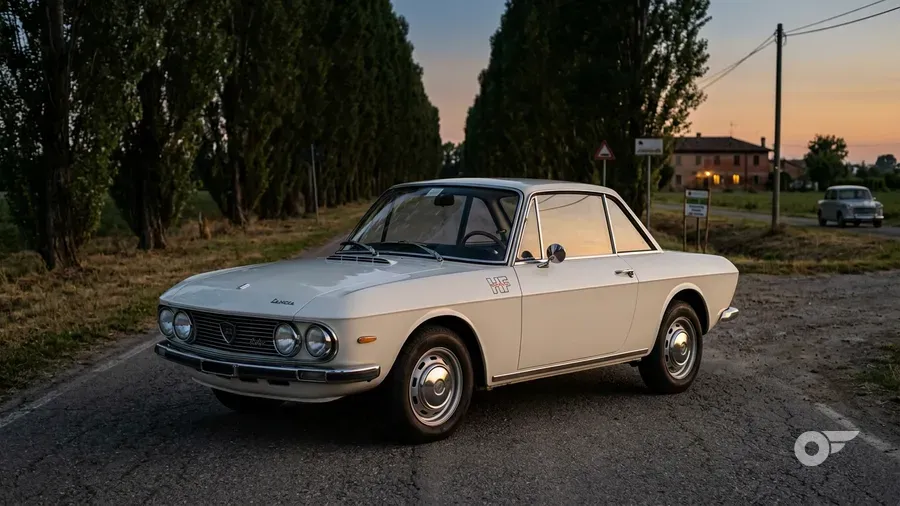
Lancia had already put the world's first production V6 into the Aurelia saloon when Gianni Lancia asked for a two-door version of it. What arrived at the Turin show in April 1951 was a fastback on a shortened wheelbase, with two proper seats, two occasional ones, and the letters GT on the tail. No production car had worn them before. Everything a grand tourer is now expected to do, this one was doing first: cross a country quickly, carry two couples and their luggage, and then embarrass sports cars on the road home. Within a month Giovanni Bracco and Umberto Maglioli finished second overall in the Mille Miglia on 1,991cc, behind Villoresi's 4.1-litre Ferrari and ahead of everything else in Italy. Underneath sat Francesco De Virgilio's 60-degree alloy V6, developed under Vittorio Jano, a rear transaxle carrying clutch, gearbox, differential and the rear brakes in one aluminium case, and the sliding-pillar front suspension Lancia had used since the Lambda. Only 3,871 were built across six series in seven years, and the shape barely moved in that time. That is usually a sign the first attempt was right.

Distinctions

The defining attributes and collector status that make this car garage-worthy.

Octane Files Select
Renowned for its history, engineering, or cultural weight.

Collectibility scorecard

Rated 1 to 10 on the traits that matter for owning, driving, and holding on to a car like this.

Desirability
8/10
Rarity
8/10
Driving thrill
7/10
Investment trajectory
6/10
Usability
6/10
Ease of restoration
3/10
Cultural impact
7/10
Electronic dependence
Fully analogHeavily electronic

A 1 on this scale, and there is nothing arguable about it. Fuelling is by Weber carburettors, ignition is coil and distributor, and the 12-volt system's entire job is sparks, lights and instrument needles. Everything else is a mechanical connection you can trace with your hands: a rod linkage running from the column lever back along the car to the transaxle, a worm-and-sector steering box, hydraulic drums with the rear pair mounted inboard on the gearbox casing. Nothing sits between an input and what the car does with it, which is the appeal, and also why a tired one feels vague.

Market data

Demand tier, price trend, and typical values by condition. Our own assessment, not a quoted valuation.

Demand tier
EntrySolidHighBlue-chip

Strong, sustained collector demand. Good examples never wait long for a buyer.

Value trajectory
AppreciatingStableCooling

Values are holding steady. What you pay today is what it's worth tomorrow.

Price by condition
Driver
$55k
Excellent
$110k
Concours
$175k

Sits just under the blue chips and has done for years. The 2.5-litre Series 4 to 6 cars are the traded volume: two 1958 Series VI coupes made $112,000 at Broad Arrow's Amelia sale in March 2025 and $61,600 at Monterey that August, a spread driven by condition and history rather than a moving market. A Series 1 made $168,000 at Gooding against a $200,000 to $300,000 estimate. Competition provenance and historic event eligibility are what move money here, not series numbers alone.

Values as of August 2026.

Buyer's guide

What anyone seriously considering this car should know first.

Why it's worth it
Second overall at the 1951 Mille Miglia on 1,991cc, beaten only by a 4.1-litre Ferrari
Callout
The first production car to carry the letters GT
What to watch for
Identify the car before you inspect it. Six series in seven years means parts, brakes, transaxles and even the drive side differ between cars that look identical, and a chassis number prefixed B20S tells you it is one of the left-hand-drive cars built from Series 4 onward. Then go under it. The shell is unitary, so rot in the footwells, bulkhead, inner and outer wheelarches, sills, rear suspension mountings, rear wings and the lower edge of the bootlid is structural work, and it is where B20 restoration budgets die. Lift carpets, check the jacking points, and be suspicious of fresh underseal. On the engine, the all-alloy V6 can suffer wet-liner sinkage, so look for a weeping head gasket, an overheating history and heavy breathing, and ask what year the internals came from. Brake judder is common and usually only a shoe-to-drum fit problem. Paperwork matters more here than on most cars of the era: documented history, matching numbers and a clean identity are what separate a car that is welcome on the Mille Miglia Storica from one that merely looks the part.

The Story

Driving character

The B20 makes sense within about a mile, and none of that mile is about outright speed. Around 12 seconds to 60mph in a 2.5-litre car reads slowly until you notice the V6 does its work between 2,000 and 4,000rpm and pulls a tall gear up a mountain road without being asked to shout about it. The engine only gets vocal under load. The column shift looks like a compromise and is not: the linkage runs the length of the car to the transaxle, yet the movement across the gate is short and unusually smooth, which is why owners still argue about whether the period Nardi floor conversion improves anything. The steering is worm-and-sector and light enough to guide on fingertips. The sliding-pillar front end gives a flat, quiet ride that feels a decade later than it is. Early trailing-arm cars want respect at the limit and the de Dion cars from Series 4 tie the back down better, but neither is nervous. This is a car built to hold a high average all day, and it still does exactly that.

Design

Gianni Lancia went outside the factory for the body and asked Felice Mario Boano at Ghia, whose answer was a fastback 2+2 on a shortened saloon floorpan with almost nothing applied to it. No fins, no chrome spears, no scoops. There is a small vertical Lancia shield, a low nose, a roofline that runs unbroken into the tail, and pillars slim enough to make the cabin feel like glass. Boano did not have the capacity to build it, so the earliest bodies came from Viotti's works before production moved to Pinin Farina, which is why auction catalogues credit the styling to Pininfarina while the marque club credits Boano. Both firms have a real claim on the car; only one of them drew it. Across seven years the shape changed remarkably little, gaining quarter-lights and more sound deadening by the sixth series as Lancia pushed the car towards comfort. The proportion is the achievement, and it is why almost every Italian coupe of the following decade looks like it is arguing with this one.

Motorsport pedigree

For a two-litre road coupe the record is close to absurd. Bracco and Maglioli took second overall at the 1951 Mille Miglia against 4.1-litre Ferraris and won the class. At Le Mans that June, Lurani and Bracco brought a B20 home 12th overall and first in the 2.0-litre class, having covered nearly 2,000 miles on one set of tyres before driving the car back to Turin. The same year it won the Coppa delle Dolomiti, the Pescara 6 Hours and the Coppa delle Alpi outright. In 1952 Scuderia Lancia finished 6th and 8th at Le Mans with Valenzano and Bonetto and took the class again, and Felice Bonetto won the Targa Florio outright, with Aurelias filling the first three places. A B20 won the Liege-Rome-Liege in 1953 and swept the Coppa della Toscana 1-2-3. Then in 1954 Louis Chiron, at 54, won the Monte Carlo Rally outright alongside Ciro Basadonna, Lancia's first overall victory on the Monte. The works cars were lightly modified versions of the showroom car, which is the whole point.

In culture

The B20's biggest cultural mark is a piece of language. Every GT badge since 1951, on cars good and appalling, traces back to this one, and the idea of a fast car you could genuinely travel in was settled here rather than argued into existence later. Beyond that its fame is the connoisseur's kind. Herge put a B20 into The Calculus Affair in 1956, drawn accurately and driven by Arturo Benedetto Giovanni Giuseppe Pietro Archangelo Alfredo Cartoffoli da Milano, who gives Tintin and Haddock a lift and chases a Chrysler New Yorker through the mountains in what is still one of the best car sequences in European comics. Juan Manuel Fangio and Mike Hawthorn both bought one, which tells you what working drivers made of it. Anyone arriving expecting the Aurelia from Il Sorpasso is thinking of the open B24, a different body on the same mechanicals. Lately the B20 has stayed visible largely through Thornley Kelham's Fuorilegge restomods, an odd route back into view for a landmark, but it has worked.

Rivals

Cars from other manufacturers that competed for the same buyers when new.
Owning One

Why collectors want it

This is the car that named a category, and the market has never really forgotten it. The B20 is bought by people who have already owned the obvious things and want the car that made them possible, which keeps values firm without ever making the Aurelia fashionable. Rarity helps: 3,871 in seven years, spread across six series, and a survival rate hurt by the fact that a unitary Italian bodyshell of the early 1950s rusted like one. The hierarchy inside the generation is clear and it is about competition. Series 1 cars, 500 of them and right-hand drive only, carry the racing years on their backs and clear historic event eligibility without an argument, so they sit at the top. The 2.5-litre Series 3 is the enthusiast's choice, with the most power of any B20 in the lightest of the big-engined shells. The later Series 4 to 6 cars are the usable ones and the affordable ones, which is the generation's quiet strength: the cheapest B20 you can buy is still the car that invented the grand tourer, and it will still cross France in a day.

Which one to look for

Rank them by what you want from the car. The Series 1 is the collector's one: 500 built, right-hand drive only, around 1,070kg, 75hp, and the version that was on the road while the results were being set, which is why it clears historic event eligibility without discussion. Series 2 added compression for 80hp across 731 cars. The Series 3 of 1953 is the driver's pick, 720 cars, the first with the 2,451cc V6 at 118hp and still on the lighter early shell before the weight arrived. Series 4 is the biggest run at 1,000 cars, brings the de Dion rear end and the first left-hand-drive Aurelias (255 of them, chassis prefix B20S), and is the sensible choice for covering distance. Series 5 is the scarcest at 300 cars, with a stronger split-case transaxle and slightly less power. Series 6, 620 cars, is the most refined, the heaviest and usually the cheapest. Above all of them sit the works-prepared lightweights that ran the Mille Miglia and the Targa Florio, and those are effectively museum property now.

Series 1 · 1951–1952

The launch car and the lightest B20 at around 1,070kg, with the 1,991cc V6 at 75hp and semi-trailing arm rear suspension. Right-hand drive only. This is the version that was racing while the results were being set, which is why it leads the market and clears historic event eligibility without argument.

Series 2 · 1952–1953

Same 1,991cc V6, raised compression for 80hp, and detail changes through the body and cabin. Still right-hand drive only and still on trailing arms. The last of the small-engined cars and the cheapest way into a two-litre B20.

Series 3 · 1953

The 2,451cc V6 arrives at 118hp, the most power any B20 made, in a shell that had not yet gained the later cars' weight. Top speed climbs to around 185km/h. The driver's choice of the six and the value sweet spot.

Series 4 · 1954–1955

De Dion rear suspension replaces the trailing arms, which settles the back end at speed, and left-hand drive appears for the first time on chassis prefixed B20S. Still 118hp. The biggest production run and the one to have if you plan to cover distance.

Series 5 · 1956–1957

A stronger split-case transaxle and a slightly detuned engine, around 110hp, as Lancia pushed the car towards comfort. The scarcest of the six series by a wide margin, and the point where the B20 stops being a competition car with seats.

Series 6 · 1957–1958

The last and most refined B20, with around 112hp, more torque, added sound deadening and front quarter-lights. Also the heaviest. Usually the cheapest series to buy and the easiest to use, which makes it the sensible first Aurelia.

What owning one is like

Everything expensive about a B20 is structural, and on this car the body is the structure. The shell is unitary, so corrosion in the footwells, bulkhead, inner and outer wheelarches, sills, rear suspension mountings, rear wings and the bottom edge of the bootlid is not cosmetic. Owners learn to buy the best shell they can find and negotiate on the mechanicals instead. The all-alloy V6 is long-lived but can suffer liner sinkage, and because Lancia altered details constantly across six series, plenty of engines have been rebuilt with parts from the wrong year, which is worth knowing before you chase a fault. Brake judder is the classic Aurelia grumble and usually comes down to shoe-to-drum fit. The transaxle is strong, particularly the split-case unit from Series 5, but anything inside it is specialist work because the clutch, gearbox, differential and rear brakes all share the casing. None of this is mysterious to the people who know these cars, and there are more of them around than the production figure suggests.

Upkeep & parts

For a 1950s Italian car built in fewer than 4,000 examples, the support is genuinely good. Omicron Engineering in the UK carries Aurelia parts and does full restorations and competition preparation; Cavalitto in Turin holds much of what Omicron does not. Centro Aurelia, launched in 2025 for the model's 75th anniversary, has put Paul Mayo's workshop manual online alongside factory parts catalogues, instruction books and homologation papers, which removes the single biggest obstacle to running one of these sensibly. The Lancia Motor Club in the UK and the American Lancia Club, going since 1956, are both active and both publish. Budget in the right order: routine servicing is unremarkable, an engine or transaxle rebuild is a known specialist cost, and bodywork on a rotten shell will pass the value of the car without much effort. Genuinely series-specific parts take patience to find, so establish what a car actually needs before you buy rather than afterwards.

Country of origin
Italy
Class
Grand Tourer
Production years
1951–1958
Units built
3,871
Model
Aurelia
Nickname
No nickname ("Fuorilegge" names Thornley Kelham's modern restomod specifically, not the generation)
Body
Coupe
Layout
Front-engine, RWD
Engine
1,991cc 60-degree V6 (75hp, 1st series; 80hp, 2nd series), 2,451cc 60-degree V6 (118hp, 3rd and 4th series; 110-112hp, 5th and 6th series)
Transmission
4-speed manual in a rear transaxle, column shift (Nardi floor-shift conversion a period option)
Designer
Felice Mario Boano (Ghia), bodies built by Pinin Farina