Octane Files
Browse CarsAlfa Romeo Spider Series 4

Alfa Romeo Spider Series 4

Overview

Long-running cars usually end badly, worn out and unloved. The Spider did not. In 1990 Pininfarina, who had drawn and built every one since 1966, took the body back and undid a decade of bolted-on plastic. Body-colour bumper fascias replaced the black rubber, the sills were folded into the sheet metal instead of tacked over it, the 1983 ducktail spoiler gave way to a gentle recurve across the whole rear shell, full-width taillights arrived in the spirit of the 164 flagship, and the inverted triangle grille came back to the nose for the first time since the Kamm-tail cars. Underneath sat Bosch Motronic engine management with onboard diagnostics and an electric cooling fan, and from 1991 American cars added power steering and a driver's airbag. Alfa built 21,407 of them, 18,456 with the 2.0 and 2,951 with a 1.6 for the Italian market, and the last car left Pininfarina's San Giorgio Canavese plant in April 1993. That made it the final rear-wheel-drive Alfa Romeo until the 8C Competizione of 2007. The 190 cars held back for North America were sold as 1994 Commemorative Editions, and a twenty-seven-year, 124,104-car run stopped there.

Distinctions

The defining attributes and collector status that make this car garage-worthy.

Octane Files Select
Renowned for its history, engineering, or cultural weight.

Collectibility scorecard

Rated 1 to 10 on the traits that matter for owning, driving, and holding on to a car like this.

Desirability
6/10
Rarity
4/10
Driving thrill
6/10
Investment trajectory
5/10
Usability
8/10
Ease of restoration
6/10
Cultural impact
5/10
Electronic dependence
Fully analogHeavily electronic

Series 3 cars already had an injection computer. The Series 4 is where one box took over the whole engine: Bosch Motronic ML4.1 runs fuel and ignition together and adds onboard diagnostics, which the L-Jetronic system it replaced did not, and an electric cooling fan came with it. American cars from 1991 added a driver's airbag, electric mirrors and hydraulic power steering, which is assisted rather than electronic. Everything else stays mechanical: the intake cam variator is moved by engine oil pressure, the throttle is a cable, and there is no traction or stability control anywhere on the car. A 3 is the honest position. It is the most electronic Spider ever built and still a long way from a car that thinks for you.

Market data

Demand tier, price trend, and typical values by condition, based on recent sales data.

Demand tier
EntrySolidHighBlue-chip

A dependable market. Well-kept cars hold their value and find ready buyers.

Value trajectory
AppreciatingStableCooling

Values are holding steady. What you pay today is what it's worth tomorrow.

Price by condition
Driver
$10k
Excellent
$18k
Concours
$28k

Series 4 cars sit at the affordable end of a market its earliest examples left long ago. Tracked sales average $16,128 across the series, with the low end around $4,250 for a needy 1991 car, Hagerty putting concours examples near $27,000 and exceptional cars above $45,000, and UK guide ranges running from roughly 5,000 to 25,000 pounds. The market is unusually liquid for a cheap classic: of 301 tracked auction appearances, 242 sold, an 80 percent sell-through that says these cars find buyers rather than sit. The Commemorative Edition is the one part of the series that behaves like a collectible in its own right, with a documented $64,000 result in July 2025. Values have been flat rather than rising, which is why the trajectory is stable, but the floor has firmed as the supply of unrusted cars shrinks. The band below describes the volume car, a base or Veloce 2.0 with the manual gearbox, and deliberately excludes the Commemorative Edition.

Values as of August 2026.

Buyer's guide

What anyone seriously considering this car should know first.

Why it's worth it
The final form of the 27-year Spider, and the only one Alfa built to be lived with
Callout
The last rear-wheel-drive Alfa Romeo until the 8C Competizione of 2007
What to watch for
Rust still decides everything, and the Series 4 makes it harder to see. The plastic sill covers that tidied up the styling also hide the sills, so you cannot judge them by eye. Drive several cars and learn what normal scuttle shake feels like, because one that shivers more than its peers is usually telling you what is happening underneath. Then check the front crossmember beneath the radiator, the chassis legs running back from the engine bay, the floors and the spare wheel well. Alfa improved the rustproofing for this series and it shows, but improved is not immune. Mechanically the twin cam is the least of your worries: a light oil weep is normal, coolant in the oil is not, and corroded alloy castings are the expensive ending to a long story about tired coolant and an old radiator. Try second and third on the way up and reverse on the way back, because the synchros wear in that order. Later differentials can want attention around 60,000 miles. Work the hood, which should seal to the screen rail and the door glass and fold flat behind the seats. On a Commemorative Edition, the numbered dash plaque and the original certificate and portfolio are what separate a real one from a badged one.

The Story

Driving character

Nothing about the Series 4 is fast and everything about it is pleasant, which turns out to be the better trick. The 2.0 twin cam makes 120 horsepower in American tune and takes around ten seconds to reach 60mph, and yet the engine is still the reason to be there: all-alloy, revvy, hard-edged at the top, and fitted with the oil-pressure intake cam variator Alfa had been building since 1980, which keeps it civil at idle and lets it sharpen up past 3,000rpm. The gearbox still asks for the old ritual, an unhurried beat on the way into second, and every owner learns it inside a week. What separates this car from the ones before it is the steering. American cars got hydraulic assistance in 1991 through a new four-spoke airbag wheel, and it is unusually well judged, light without going numb, so the Spider works in traffic instead of merely surviving it. The chassis is the 1966 idea untouched, wishbones at the front and a coil-sprung live axle behind, so the car leans, shimmies over broken surfaces and tells you everything. Skip the automatic. With the manual, the top down and the revs up, this is the Spider you can drive to work.

Design

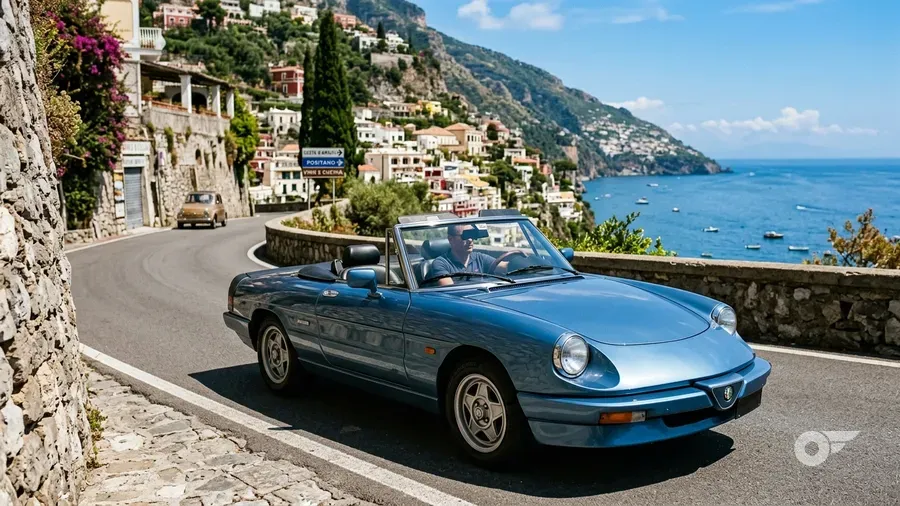
This is a restyle that worked by removing things, which is rare. Pininfarina's 1990 revision deleted the black rubber spoiler under the front bumper and the ducktail on the boot lid, replacing the latter with a gentle recurve across the whole rear shell so the tail reads as one surface again. Bumpers became full-width body-colour fascias with the Alfa shield set into the front one. The sills stopped being bolt-on covers and became part of the flank. The taillights went full width in the manner of the 164 saloon that was then the company's flagship, and the inverted triangle grille returned to the nose for the first time since the Kamm-tail cars. Underneath all of it is still the 1970 shape, and under that the 1966 one, with the scalloped flanks and the low shield nose intact after twenty-four years of revisions. Every car was built at Pininfarina's San Giorgio Canavese plant in left-hand drive only, which is why a Series 4 looks identical in every market it was sold in. Collectors argue about whether the boat tail or this car is the better looking Spider. Both arguments are honest ones.

Motorsport pedigree

There is no racing record here, and pretending otherwise would be a disservice. The Spider was never Alfa Romeo's competition car in any of its four series. That job belonged to the closed 105-series GTA, which Autodelta turned into the dominant touring car of the late sixties. By the time the Series 4 arrived the company's competition department had moved somewhere else entirely: while the last Spiders were coming down the line at San Giorgio Canavese, Alfa Corse was campaigning the four-wheel-drive 155 V6 TI, and Nicola Larini took the 1993 Deutsche Tourenwagen Meisterschaft title with it in the car's first season. Nobody at Alfa was going to go racing with a twenty-seven-year-old roadster. What the Spider inherited instead is the family hardware, the twin cam architecture and the all-synchro five-speed and the suspension thinking that made the coupes effective, which is why Spiders have spent decades as friendly club and vintage rally cars. The Series 4 is the least likely of the four to be used that way, because it is the one people keep original.

In culture

The Series 4 holds a strange cultural position: it is the Spider most Americans actually saw new, and the one with the least to say for itself on screen. The Graduate belongs to the boat tail, and even the Graduate trim name, which Alfa had put on cheap American Spiders since 1985, was retired just as this car arrived. What the Series 4 carries instead is an ending. Alfa's American sales had collapsed against the Mazda MX-5, which sold 51,658 cars in the United States in its first model year alone, and after 1995 the company withdrew from the country altogether. That made the Series 4 the last open Alfa Romeo an American could buy new for two decades, until the 4C Spider of 2015. For a generation of American enthusiasts it is therefore not a film car and not a poster car but a memory of a dealership that closed, the small convertible still sitting on the lot when the Alfa sign came down. That is a quieter kind of fame, and it is a large part of why these cars are being found and fussed over now.

Rivals

Cars from other manufacturers that competed for the same buyers when new.
Owning One

Why collectors want it

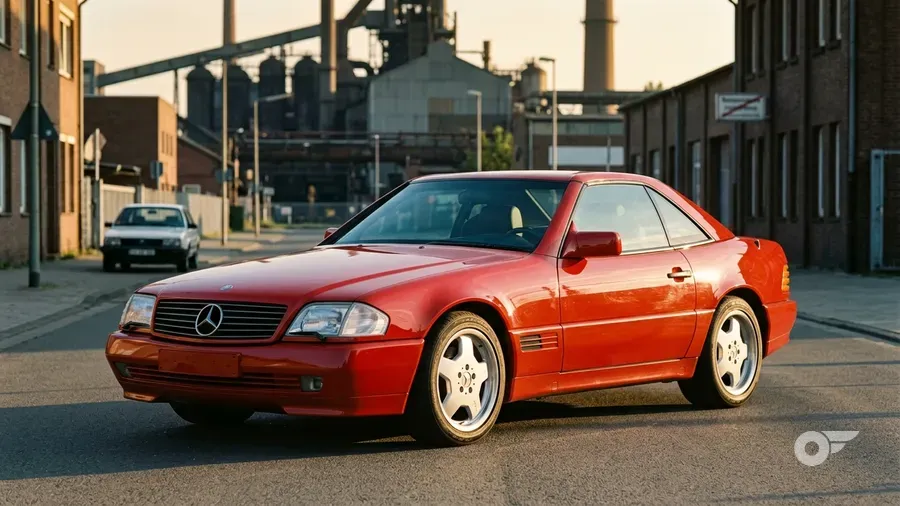
The Series 4 is the cheap way into a car whose earliest examples have gone somewhere else entirely. Boat-tail Series 1 cars trade as design objects and the best have passed $50,000, while tracked Series 4 sales average $16,128, which buys a Pininfarina-bodied twin cam roadster with five gears and a disc brake at every corner. That is the argument, and it holds up. It held up when the car was new too: a Spider Veloce cost a fraction of the Mercedes SL that occupied the same daydream, which is why the R129 belongs on the rivals list as the car the Spider buyer looked at and could not have. The hierarchy inside the series is short and clear. The 190 Commemorative Editions sit alone at the top, one reaching $64,000 in July 2025, because they are the documented last cars of a twenty-seven-year line and the numbers on their dash plaques make them countable in a way no other Spider is. Below them a sorted Veloce with the manual gearbox is the one to own, with Hagerty putting concours cars near $27,000 and exceptional examples above $45,000. What makes the Series 4 worth buying rather than merely worth affording is that it is the version Alfa finally got right.

Which one to look for

Two cars carried the series in North America: the base Spider and the Spider Veloce, the Veloce adding leather, 15 inch alloys and standard air conditioning over the base car's cloth and steel wheels. Both use the same 1962cc twin cam, so the choice is trim rather than performance. Europe also got a 1570cc car, 2,951 of them built between 1990 and 1992 for Italy's engine-size tax bands, against 18,456 of the 2.0. A three-speed automatic joined the American options in 1992 and is the one specification to walk past, because three ratios and 120 horsepower do not go together. Top of the range and top of the market is the Commemorative Edition, 190 cars built in 1993 and sold as 1994 models, with a numbered dashboard plaque, CE script on the tail, gold wheel centre caps, burl wood trim, and a leather portfolio and numbered keychain to prove it. Britain is its own case, because Alfa never built a factory right-hand-drive Spider at all. UK Series 4 cars were sold left-hand drive with a hardtop as standard, and any right-hooker you find is a conversion. Buy a manual, and buy the tidiest one you can find.

Commemorative Edition · 1994

The North American send-off: a numbered dashboard plaque, nose badge, CE script on the tail, gold wheel centre caps and burl wood trim, delivered with a certificate of authenticity, a leather portfolio and a numbered keychain. Mechanically a standard 2.0 Veloce, and the most valuable Series 4 by a wide margin.

Spider 1600 · 1990-1992

The European entry car, using the 1570cc twin cam rated at 109PS instead of the two-litre. It existed for Italy's engine-size tax bands rather than for any driving reason, and it is the rarer of the two Series 4 engines by a factor of six.

Spider Veloce · 1991-1994

The upper of the two North American cars, adding leather seats, 15 inch alloy wheels and standard air conditioning over the base Spider's cloth trim and steel wheels. Same 1962cc twin cam and same five-speed, so the choice is equipment rather than pace, and it is the specification most surviving US cars carry.

What owning one is like

A Series 4 is the easiest Spider to live with and it still asks for the same one thing, which is to be kept dry. The body is the structure, so corrosion in the sills, floors, front crossmember and spare wheel well is a bill rather than a job, and the plastic sill covers mean you find out about it later than you would on an older car. Everything else is comparatively gentle. The twin cam seeps a little oil as a matter of character and has done since 1966. Second gear buzzes on a hurried shift on any 105-series gearbox, healthy or not. Cooling systems left alone eat alloy, so a car with fresh coolant and a recent radiator is worth paying for. The Motronic system is the most reliable engine management the Spider ever had, but it is thirty-five years old now, and the classic symptom of an ageing example is electrical: a lazy earth producing a flickering warning light or an intermittent no-start that three specialists cannot reproduce. Hoods, seat bolsters and dash plastics wear, and all of them are replaceable. What owners report is a car that starts, drives and charms every weekend, provided the rust was somebody else's problem first.

Upkeep & parts

This is the friendliest Italian classic to keep on the road, and the Series 4 is the friendliest version of it. Alfa built 124,104 Spiders across twenty-seven years, so mechanical parts, service items, rubber and full rust repair panels remain in steady supply through specialists in North America and Europe, and the engine is a simple, exhaustively documented twin cam any competent independent can service. Budget for the predictable: a clutch, an exhaust, a hood every decade or so, a cooling system refresh, and a differential if the car has done serious miles. Rust repair is the only open-ended cost, which is why money spent buying a dry car beats money spent fixing a cheap one every time. The Series 4 has one wrinkle the older cars do not. Its model-specific trim, the body-colour bumper fascias and the full-width taillights, is getting harder to find than the mechanical parts, so a complete original car is worth a premium over a tidy one with pieces missing. The club scene carries the rest: the Alfa Romeo Owners Club in the US, the AROC UK 105/115 register and the AlfaBB forum mean nobody has to diagnose a Spider alone.

Country of origin
Italy
Class
Sports
Production years
1990–1994
Units built
~21,407
Model
Spider
Nickname
No nickname ("Duetto" names the 1966-67 Series 1 boat-tail specifically, not the Series 4)
Body
Spider
Layout
Front-engine, RWD
Engine
1962cc twin cam I4 with Bosch Motronic injection and variable intake cam timing (126PS European, 120hp US), 1570cc twin cam I4 (109PS, European market 1990-1992)
Transmission
5-speed manual, 3-speed automatic (optional, North America, from 1992)
Designer
Pininfarina