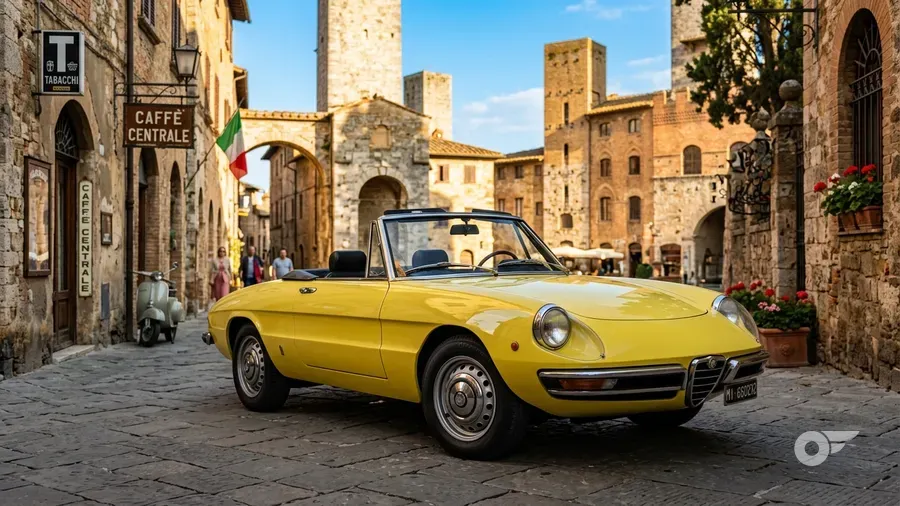
Alfa Romeo Spider Series 1
Italy·Sports·1966–1969

The defining attributes and collector status that make this car garage-worthy.

Rated 1 to 10 on the traits that matter for owning, driving, and holding on to a car like this.
Demand tier, price trend, and typical values by condition, based on recent sales data.
Values as of August 2026.
What anyone seriously considering this car should know first.
Cars from the same manufacturer family, like platform siblings or shared-era relatives.
Cars from other manufacturers that competed for the same buyers when new.
The first Kamm-tail Spider and the connoisseur's pick of the series. Chrome bumpers, the pinched nose, the pre-crash-bumper cabin, and the 1779cc twin cam at 124 PS. US cars carried SPICA mechanical injection from model year 1971.
The volume Spider and the one most people mean. 1962cc twin cam at 132 PS, SPICA-injected for America as the Iniezione, with the rear anti-roll bar that cured the early car's understeer. From 1980 the US cars carried Alfa's variator, the first variable valve timing in a production car.
Launched at the 1978 Long Beach Grand Prix to mark Lauda joining the Brabham Alfa Romeo Formula One team. Brabham red, white and blue, a three-piece fiberglass rear spoiler wrapping onto the rear quarters, special side badging and a numbered dashboard plaque, over standard 2000 Spider Veloce America mechanicals. Chassis 001 was driven on the circuit by Lauda himself.
The entry Series 2 Spider, 1290cc twin cam at 89 PS, sold without headlamp fairings and with simpler trim. Light, quick-witted and priced below its ability. Gained rear jump seats in 1974.
The 1570cc twin cam back in Junior specification after the Duetto era, at 110 PS, visually identical to the 1300 Junior. A European-market middle path and arguably the best-balanced engine in the range.