Overview
No other car got its name the way this one did. Bertone sent two white concept coupes to Expo 67, the World's Fair in Montreal, as part of Italy's showcase. Alfa Romeo displayed them without a model name, so the public supplied one, and it stuck. By the time the production car appeared at the 1970 Geneva show, the shape had barely changed but the substance had: in place of the concept's 1.6-litre Giulia four sat a 2,593cc quad-cam V8 derived from the Tipo 33 racing program, fed by SPICA mechanical injection and rated around 200hp. The price was the problem. In Britain a Montreal cost more than a Jaguar E-Type or a Porsche 911, and sat within a few hundred pounds of a Ferrari Dino. Then the 1973 fuel crisis emptied the order books for thirsty V8 coupes, and the car faded from the price lists in 1977 after 3,917 were built by Bertone's count. The finishing touch of irony is in the name: the Montreal was never officially sold in Montreal, or anywhere else in North America.
Distinctions
The defining attributes and collector status that make this car garage-worthy.
Collectibility scorecard
Rated 1 to 10 on the traits that matter for owning, driving, and holding on to a car like this.
The injection is mechanical, not electronic: SPICA's pump meters fuel entirely by mechanical means, and there is no engine computer anywhere on the car. The one electronic system is the factory-fitted Bosch electronic ignition. Everything else, from the pneumatically operated headlamp grilles to the throttle linkage and servo-assisted brakes, works by mechanical, hydraulic or pneumatic action, which places the Montreal one step above fully analog.
Market data
Demand tier, price trend, and typical values by condition. Our own assessment, not a quoted valuation.
Strong, sustained collector demand. Good examples never wait long for a buyer.
Values are climbing. The market wants more of these than exist.
Values stagnated for decades and have moved decisively as Gandini's designs are reassessed. Verified 2025 to 2026 results run from the low $40,000s equivalent for drivers (a 38,750 euro sale in Athens, a 42,328 pound sale at Historics) to $69,750 to $95,200 for strong cars at Bring a Trailer, Gooding and Broad Arrow, with exceptional low-mileage examples asking well into six figures. Right-hand drive (180 built) and unconverted SPICA cars carry premiums. Still modest money next to the mid-engined Italians it shared show stands with, which is the appreciation case.
Values as of July 2026.
Buyer's guide
What anyone seriously considering this car should know first.
The Story
Driving character
The engine makes the car. It pulls to a 6,500rpm power peak through a tachometer marked to 9,000, and its flexibility startled period road testers. Autocar's 1972 test found the car would step away from rest in fourth gear and keep pulling to 120mph, and the testers admitted they changed gear too often simply because the V8 never asked for it. They also noted how little noise reached the cabin as speed rose, which reads as refinement or a small tragedy depending on your taste. The chassis is Giulia GTV underneath: double wishbones up front, a well-located live axle behind, and manners soft by exotic-car standards. There is body roll, there is nose dive under hard braking, and bumpy corners set the rear axle pattering. Driven with sympathy rather than aggression it flows down a road on an even keel, and period testers called it a car you grow into rather than one that grabs you on the first drive. The ZF five-speed and the limited-slip differential do their work without drama, and the twin-cowl dash puts the essentials dead ahead like a fighter cockpit.
Design
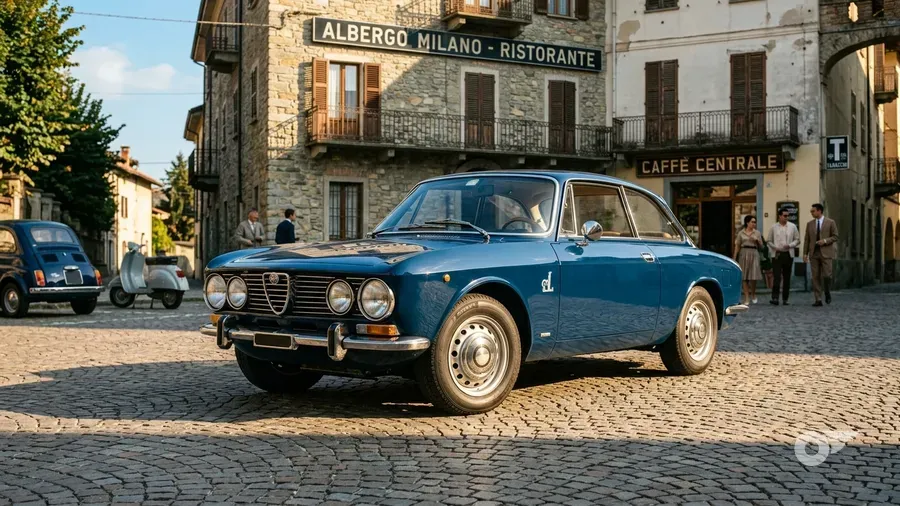
The Montreal sits exactly between the Miura and the Countach in Marcello Gandini's run at Bertone, and you can read both in the metal. The upswept side glass recalls the Miura, the slatted C-pillar vents descend from the Canguro concept, and the partly covered headlamps develop an idea Gandini had tried on a one-off Bertone Porsche 911 roadster shown in 1966. Those grilles retract pneumatically when the lamps switch on, a compromise with headlight-height regulations turned into the car's defining gesture. The NACA duct on the bonnet is a dummy that feeds nothing: its job is to disguise the power bulge. The slats behind the doors carry the cabin vents and otherwise serve pure theatre. Trim is stainless steel rather than chrome, the turbine-style wheels are magnesium Campagnolos, and the only model script on the entire car sits on the ashtray, which tells you how confident Bertone was in the shape. Inside, twin dash cowls house the tachometer and speedometer with the minor gauges arced inside them. The production car stayed remarkably faithful to the 1967 concept, which almost never happens, and is most of why the design still lands.
Motorsport pedigree
The racing pedigree runs upstream rather than down. The Montreal never had a works competition career, but its engine is a detuned version of the Carlo Chiti quad-cam V8 that powered the Tipo 33 sports prototypes and the 33 Stradale, which is more provenance than most road cars can claim. The one serious attempt to send the coupe itself racing came from Autodelta, Alfa's competition arm, which built a Group 4 Montreal in late 1972 and launched it at the London Racing Car Show in January 1973. Bored out to 2,997cc and producing around 370hp at 9,000rpm, it went to Alfa Romeo Germany and contested the DRM series for GT cars with Dieter Gleich as principal driver. Without further development it was outpaced almost immediately, and a parallel privateer effort in the United States fared no better. The program was brief and unsuccessful, but it showed what the engine could give when wound back toward racing tune, and the surviving Group 4 car remains the model's competition footnote made real.
In culture
The Montreal's origin story is its cultural moment. Expo 67 drew 55 million visitors in a single summer, and the unnamed Bertone coupe became one of the fair's souvenirs to the wider world: the public called it the Montreal until Alfa Romeo gave in and made the name official. The sequel is the car's best-known piece of trivia, because Alfa never submitted it for North American emissions approval, and the car named for a Canadian city was never officially sold in Canada or the United States. After that the Montreal spent decades as connoisseur's knowledge rather than public property, the sort of car magazines file under forgotten and enthusiasts deploy to win conversations. Its profile has climbed as Gandini's reputation has been reassessed, helped along by a turn through Jay Leno's garage on camera and a steady presence at concours and Italian-car gatherings. One of the two white Expo concept cars stands in the Alfa Romeo museum at Arese, which is as close as the story comes to a monument, and the road car remains the rare exotic that most onlookers cannot name.
Related cars
Cars from the same manufacturer family, like platform siblings or shared-era relatives.
Rivals
Cars from other manufacturers that competed for the same buyers when new.
Owning One
Why collectors want it
The Montreal is the accessible way into a real Gandini exotic, and the market has begun to notice. This is the same hand that drew the Miura before it and the Countach after, working at the height of Bertone's influence, and the car wears the family signatures to prove it. Under the bonnet is an engine no other road car received: a quad-cam, dry-sump V8 bred from the Tipo 33 sports prototype, detuned so far from racing spec that it lives an unstressed life at road speeds. For decades the car sat in the shadows, priced on its reputation for complexity rather than its substance, and cheap Montreals were driven into the ground or broken for parts, thinning the survivor pool. That long neglect is today's opportunity. Fewer than 4,000 were built, just 180 of them right-hand drive, and good ones now change hands for money that finally reflects the design pedigree. The hierarchy within the model is simple, because there is only one specification: condition and originality are everything, and an unmolested car with its injection system intact and working is the one collectors argue over.
Which one to look for
There is one Montreal. Alfa Romeo never offered another engine, another body or a trim ladder, and almost nothing changed across seven years of production, so variant hunting takes a different form here. Right-hand drive is the closest thing to a factory rarity: 180 cars out of a total run under 4,000, built for Britain and other RHD markets. Options were few and are worth finding now, chiefly air conditioning, electric windows and leather upholstery, the last supplied only to special order in place of the standard velour and Texalfa trim. Early cars, roughly the first hundred, left the factory without the front spoiler later added to cure high-speed lift, though most were retrofitted during service, so an unspoilered nose is a curiosity rather than a value driver. The grail is not a variant but a state: an unrestored or correctly restored car with the SPICA injection intact, documented specialist history and honest bodywork. The two white Expo 67 concepts survive with the factory, one on display in the Alfa Romeo museum at Arese.
What owning one is like
A Montreal rewards the owner who understands what it is: a Giulia GTV chassis carrying a miniature racing engine. The chassis half of that sentence is easy, since suspension, brakes, axle and steering are shared 105-series hardware, well understood and well supported. The engine half is where the commitment lives. The V8 exists in no other car, so major engine parts are scarce and rebuilds are specialist work priced accordingly. The SPICA mechanical injection has a reputation that outruns reality: neglected or fiddled with by the uninitiated it runs poorly, but set up by someone who knows the system it is dependable, and that knowledge is alive and shared in the owner community. The dry-sump lubrication adds lines and a tank to keep in good order. Bodywork asks the usual Italian-coupe questions, because the shell was only partly zinc coated when new, so floors, sills and arches want regular inspection and hidden rust costs more than mechanical wear ever will. The pneumatic headlamp grilles can grow lazy with age. None of this is a reason to walk away. It is a reason to buy the best-sorted car available and keep it that way.
Upkeep & parts
Ownership splits neatly in two. Everything below the engine draws on the vast 105-series Giulia parts ecosystem, so brakes, suspension, driveline and much of the running hardware are obtainable and affordable through the usual Alfa specialists. The engine is the budget item: set aside real money for injection-pump servicing by a SPICA specialist, and treat a documented recent engine rebuild in a car's history as something worth paying extra for up front. The support network is unusually good for so rare a car. Bruce Taylor's two Montreal reference books and his companion website amount to a model-specific archive covering maintenance, originality and production records, and owners treat them as required reading. The Alfa Romeo Owners Club in the US maintains a digital library of factory manuals plus a network of technical advisors, and the Montreal section of the AlfaBB forum holds years of searchable troubleshooting. Values now justify proper care, which was not true for most of the car's life, so the population of well-sorted examples is growing rather than shrinking. Budget honestly for the V8, lean on the community, and the rest is ordinary vintage Alfa upkeep.