Octane Files
Explore CarsPorsche 912 1st Gen

Porsche 912 1st Gen

Overview

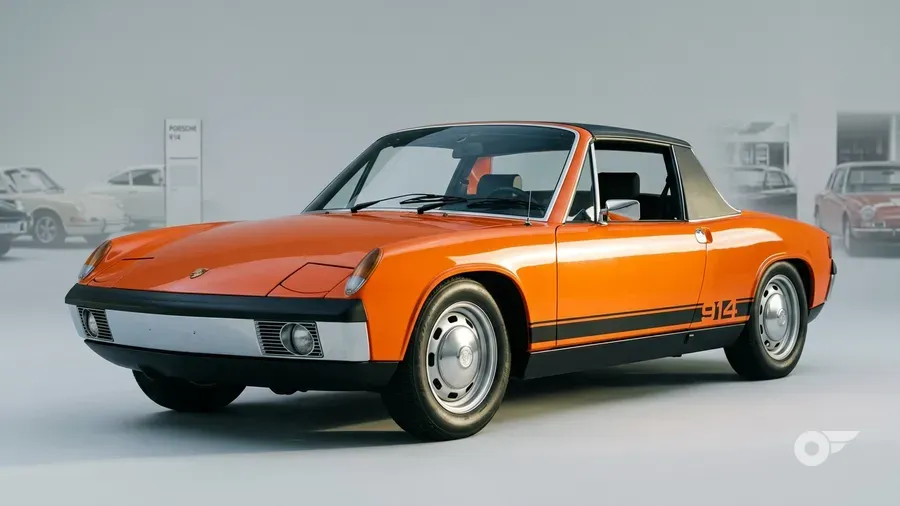
The 912 exists because Porsche had a problem in 1965. The 356 was finished, the 911 that replaced it cost considerably more, and a large part of the customer base could not follow the company upmarket in a single step. So Porsche put the 356 SC's pushrod flat four into the new 911 body and sold it at 4,700 dollars, and for the next few years the cheap four-cylinder car was the volume seller, substantially outselling the six. That is the whole point of the 912 and it is what makes its position unusual: it was not a lesser 911, it was the car keeping the lights on while the 911 found its market. Around 30,745 were built between April 1965 and July 1969 by Porsche's own count, coupes and, from the end of 1966, Targas. The engine gives away 40 or so horsepower to a 911, which the car partly hands back in balance, because a light flat four moves the mass forward and the 912 turns in more honestly than any early six. It was dropped in 1969 when the 914 arrived to take the entry-level job.

Distinctions

The defining attributes and collector status that make this car garage-worthy.

Octane Files Select
Renowned for its history, engineering, or cultural weight.

Collectibility scorecard

Rated 1 to 10 on the traits that matter for owning, driving, and holding on to a car like this.

Desirability
7/10
Rarity
6/10
Driving thrill
6/10
Investment trajectory
7/10
Usability
7/10
Ease of restoration
6/10
Cultural impact
5/10
Electronic dependence
Fully analogHeavily electronic

Fully mechanical, with nothing between the driver and the machinery. Fuel is supplied by twin Solex carburettors, spark by a distributor and breaker points, and there is no engine management, no fuel injection and no sensor of any kind beyond the temperature and fuel senders. The throttle runs on rods and cables, the clutch is cable operated, and the brakes are unassisted discs. There is no power steering, no ABS and no electrically assisted anything except the wipers, the heater blower on later cars and the lights. Owners commonly fit an electronic ignition module inside the distributor, which is the single most modern part on most surviving cars.

Market data

Demand tier, price trend, and typical values by condition. Our own assessment, not a quoted valuation.

Demand tier
EntrySolidHighBlue-chip

A dependable market. Well-kept cars hold their value and find ready buyers.

Value trajectory
AppreciatingStableCooling

Values are climbing. The market wants more of these than exist.

Price by condition
Driver
$30k
Excellent
$55k
Concours
$90k

Solid and climbing steadily rather than spiking. classic.com's short-wheelbase 912 average is $51,395, which is a long way from where these cars sat a decade ago and still a fraction of the equivalent 911 T. The driver of the market is scarcity of unmolested cars: enormous numbers were converted to six-cylinder power or broken for parts when they were cheap, so original four-cylinder cars with matching numbers are far less common than the 30,745 production figure suggests. Targas and long-wheelbase 1969 cars remain the value end. The band below describes a coupe in original specification.

Values as of August 2026.

Buyer's guide

What anyone seriously considering this car should know first.

Why it's worth it
The 911 body with the 356 engine, built so that 356 owners could stay Porsche owners
Callout
For its first years Porsche's cheapest car outsold the 911 it was based on
What to watch for
The first thing to establish is whether the car is still a 912. Thousands were used as cheap donors for 911 engine conversions and backdate projects, so check that the engine number matches the paperwork and that the engine bay has not been cut or reinforced for a six. A converted car is not worthless, but it should not be priced as an original. After that it is the same inspection as any 1960s Porsche, which means rust. Look at the front suspension pan, the battery boxes on either side of the front luggage compartment, the closing panels below the windscreen, the door bottoms, the longitudinals and the area under the fuel tank. Bodies were not galvanised until 1976, so a car with no rust history is unusual rather than normal. Mechanically the pushrod four is the easy part of the deal, being essentially 356 SC hardware, but check for the reason a cheap 912 is cheap: worn valve guides showing as oil smoke, and Solex carburettors that have been swapped for Webers and never set up properly. Paperwork on a four-cylinder car is now worth real money.

The Story

Driving character

The 912 does something the early 911 does not, and it is not about speed. The pushrod flat four is 40-odd horsepower down, so the car is genuinely slow by modern standards, taking 13.5 seconds to 100 km/h and running out of breath at 183 km/h. What it gains is balance. The four is much lighter than the six and sits lower, so less mass hangs behind the rear axle and the car turns in cleanly and stays neutral where an early 911 asks you to think about what the tail is doing. The steering is unassisted and delicate, the brakes are discs from the start and entirely adequate for the performance, and the whole car feels lighter and more willing to be thrown around than the numbers suggest. The engine note is flat-four thrum rather than flat-six wail, closer to a 356 than to a 911, and it is happiest between 4,000 and 5,500 rpm, which is where the four-speed's gaps become annoying and the optional five-speed earns its premium. It is a car you drive quickly by carrying speed, which is precisely the 356 lesson in a newer body.

Design

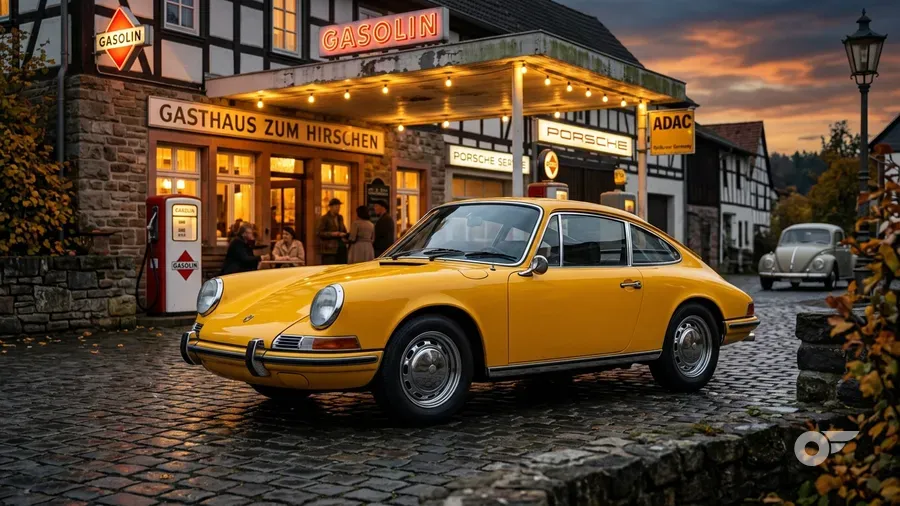
There is no separate 912 design story, and that is the trick. The car wears Ferdinand Alexander Porsche's 911 body with almost no changes: the same long bonnet, the same rising rear haunches, the same thin pillars and enormous glass area. From ten feet away nobody can tell, which was the entire commercial point. The differences are inside and behind. The 912 got the simpler three-dial instrument binnacle rather than the 911's five, so the dash is cleaner and, to some eyes, better resolved, though a five-dial cluster was available as an option. Trim was plainer, with less brightwork and simpler seats and door cards. At the back, the engine lid grille sits over a flat four rather than a six, and the exhaust arrangement differs. Fuchs forged alloy wheels, which arrived on the 911 S in 1967, became the wheel of choice on 912s too and now define how most restored cars look. The long-hood proportion is the point and the 912 owns it as completely as the 911 does.

Motorsport pedigree

The 912's competition record is thin by design and genuinely interesting for one result. Porsche had a purpose-built racing programme for outright results and a 911 for rallying, so the four-cylinder car was never given a works effort of its own. It did get one significant works loan: the Polish driver Sobieslaw Zasada took a factory-supplied 912 to the 1967 European Rally Championship title, which remains the car's headline achievement and says a great deal about how well a light, balanced, unbreakable Porsche suited long-distance rallying even without much power. Beyond that, the 912 spent its competition life at club level, where its combination of low weight, cheap running costs and honest handling made it a natural for autocross, hillclimbs and regional racing on both sides of the Atlantic. It still does that job today in vintage and historic classes, where a 912 is often the cheapest way to get an air-cooled Porsche onto a grid. The absence of a factory programme is not a gap; it is what the car was for.

In culture

The 912's cultural life is really the story of what a Porsche cost. It was the car that put the badge within reach of teachers, engineers and enthusiasts who could not stretch to a 911, and it carried the label poor man's Porsche from almost the moment it launched, a tag the specialist press and Hagerty still reach for. For decades that framing did real damage: the 912 was the Porsche you apologised for, and the cheapest way to a 911 shell, which is why so many were broken up for conversions. That has flipped completely. Owners now use the same phrase with pride, and the 912 has become the entry point into early air-cooled Porsche ownership for people who care more about driving the car than about the number on the engine lid. Its on-screen footprint is small compared with the 911's, which suits it; the 912 was always the quieter car in the driveway. What it has instead is a reputation among people who have driven both, which is a more durable kind of fame.

Owning One

Why collectors want it

The 912 has spent most of its life being valued as a 911 with something missing, and that is finally over. The argument in its favour is simple: it is a real early Porsche with the correct long-hood body, the same interior, the same doors and glass and Fuchs wheels, built in far smaller numbers than the 911 F-Series, and it costs a fraction of one. classic.com's average for a short-wheelbase 912 sits at $51,395, against six-figure money for the equivalent 911 T. Within the range the hierarchy is clear enough. Early short-wheelbase 1965 and 1966 cars, particularly with the five-speed gearbox, are the ones enthusiasts chase; the 1969 long-wheelbase cars are the best to drive and the most usable; Targas trade below coupes, as they do across the early 911 range, and the soft-window Targa of 1967 is the rarity. What has changed the market is that people stopped buying 912s to convert into 911s. A numbers-matching, unmolested four-cylinder car is now worth more as itself, which was not true a decade ago.

Which one to look for

Two decisions matter, and neither is about trim level. The first is wheelbase. Cars from 1965 to 1968 are short-wheelbase and feel the more alert and the more nervous; the 1969 cars use the longer wheelbase introduced across the range for that year, which calms the tail and makes them the better road car. The second is the gearbox: four-speed was standard and the five-speed was optional, and it makes a real difference to a 90 PS car that needs its revs kept up, so a five-speed commands a premium. On body style, the coupe outsold the Targa by roughly twelve to one, so the roughly 2,500 Targas are the rare ones, and inside that group the 1967 soft-window cars with the plastic rear screen are rarer still; the hard-window Targa arrived in January 1968. One car is outside this generation but worth knowing about: the 912E of 1975 to 1976, a US-only revival with the 914's two-litre Volkswagen four and Bosch fuel injection, of which just over 2,000 were built. It shares a name and nothing else.

912 Coupe (long wheelbase) · 1969

The final year, on the longer wheelbase adopted across the range for 1969. The extra 57mm calms the tail and makes this the best 912 to cover distance in. Production ended in July 1969 when the 914 took over the entry-level job.

912 Coupe (short wheelbase) · 1965–1968

The original car and the one most people picture: 911 long-hood body, 1.6-litre pushrod flat four from the 356 SC, four-speed standard with a five-speed on the options list. Alert, light on its nose and slightly nervous at the back, in the way every short-wheelbase early Porsche is.

912 Targa (hard window) · 1968–1969

From January 1968 the Targa gained a fixed glass rear screen, which made the car quieter, drier and far more usable. Values sit below the equivalent coupe, as they do across the early 911 range.

912 Targa (soft window) · 1967

Launched in December 1966 for the 1967 model year with a folding plastic rear window behind the stainless roll-over hoop. The rarest body style in the range and the one Targa collectors chase.
What owning one is like

A 912 asks less of an owner than almost anything else wearing this badge. The pushrod flat four is the same basic unit that ran in the 356 SC and it is genuinely durable, cheap to rebuild relative to any Porsche six, and simple enough that a competent home mechanic can do valve clearances and carburettor balancing on a Saturday. What it does ask for is discipline about rust, because these bodies were not galvanised and water finds the front suspension pan, the battery boxes, the screen surrounds and the longitudinals. Catch it early and it is bodywork; leave it and it is structural. Solex carburettors are the other running theme: they work well when correctly set and badly when not, and a great many cars have been fitted with Webers by owners who lost patience. Oil consumption creeping up usually means valve guides rather than anything dramatic. Heating is 1960s air-cooled heating, which is to say it depends on the heat exchangers being intact and the flaps working. None of this is expensive by the standards of the marque, which is exactly why people buy them.

Upkeep & parts

Parts support is excellent and cheaper than for any other early Porsche, because so much of the 912 is shared in two directions. The body, glass, interior, brakes and suspension are 911 items and available from the whole early-911 supply chain, including Porsche Classic's own re-manufactured parts and specialists like Stoddard and Pelican. The engine is 356 hardware, so the 356 trade covers it, and pistons, barrels, valve gear and carburettor parts are all obtainable. The Porsche Club of America runs technical resources and regional events, and the 912 has its own dedicated owner communities online where the specific quirks of the four-cylinder cars get argued out. Budget the way you would for any air-cooled Porsche: mechanical work is affordable, bodywork is not. A proper rust repair to the pan and longitudinals costs more than many cars are worth in driver condition, which is why buying the best body you can find and living with worn mechanicals is nearly always the cheaper route.

Country of origin
Germany
Class
Sports
Production years
1965–1969
Units built
~30,745
Model
912
Nickname
Poor Man's Porsche
Body
Coupe, Targa
Layout
Rear-engine, RWD
Engine
1.6-litre Type 616/36 air-cooled pushrod flat four, 90 PS (rated 102 SAE hp at 5,800 rpm in US market material)
Transmission
4-speed manual, 5-speed manual (optional)
Designer
Ferdinand Alexander Porsche (911 body, carried over)