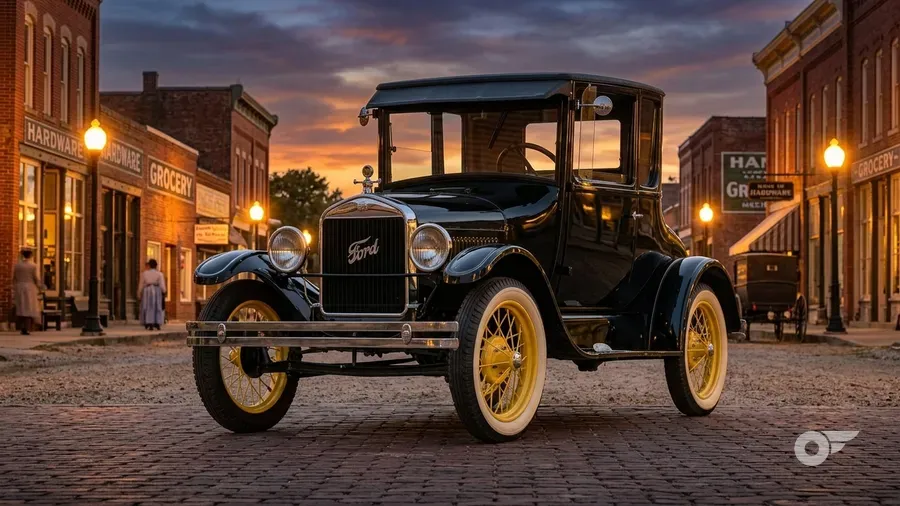
Ford Model T
USA·Vintage·1908–1927

The defining attributes and collector status that make this car garage-worthy.


Rated 1 to 10 on the traits that matter for owning, driving, and holding on to a car like this.
Demand tier, price trend, and typical values by condition. Our own assessment, not a quoted valuation.
Values as of August 2026.
What anyone seriously considering this car should know first.
Cars from the same manufacturer family, like platform siblings or shared-era relatives.
Cars from other manufacturers that competed for the same buyers when new.
A 1931-only DeLuxe body: four doors, wind-up windows and a folding top, with leather trim and walnut-grained interior wood. The rarest regular-production Model A and the one that heads most want lists.
An open car with wind-up windows, a proper padded top and a rumble seat as standard: the roadster for people who wanted weather protection without buying a sedan. Introduced in March 1929.
The four-seat open car in DeLuxe trim, and one of the genuinely scarce Model A bodies. Overlooked next to the roadsters, which is part of the appeal.
The 1930 restyle brought a DeLuxe line, and the DeLuxe Roadster is its most wanted member: brighter trim, better interior materials, and a good deal rarer than the Standard car it sits beside.
The four-door family car, and the most complicated part of the Model A range to keep straight. Ford sold Leatherback and Steelback versions in 1928 and 1929, then dropped both for 1930 in favour of two-window and three-window Standard and DeLuxe cars, plus the Town Sedan.
A coupe with a fabric-covered roof insert and landau irons on the rear quarters, giving the closed body a hint of the cabriolet. Popular when new and often confused with the Standard Coupe today.
The Tudor's proposition with a shorter roof and a rumble seat behind. Business, Special and DeLuxe coupes ran alongside it at various points, but the Standard is the volume car of the coupe family.
The four-seat open car: no side glass, a folding top and doors cut low. The touring body in the Model T sense, and the one that looks most like the 1920s from twenty feet away.
Two seats, a folding top, side curtains rather than windows, and the lightest body Ford offered on the chassis. The enthusiast's Model A and, since roughly 1945, the single most modified body in American hot rodding.
The default Model A and the one most owners start with. Two doors, a fixed steel roof and room for four, sold in every one of the four model years. Cheap when new, cheap now, and the body that sets the floor of the market.
Ford's wood-bodied wagon, added for 1929 and built in tiny numbers next to everything else. The ancestor of every American woodie, and the body with the highest restoration cost in the range because the structure is the bodywork.
A chauffeur-driven body with an open front compartment and an enclosed rear, listed at up to $1,400 when a roadster cost $385. Ordering one on a Ford chassis was always a slightly odd thing to do, which is exactly why so few exist.
Introduced with the 1930 restyle and the prettiest closed body Ford put on the Model A chassis: a close-coupled two-door with a sharply sloped rear roofline. Sits above the Tudor in both looks and money.