Octane Files
Explore CarsBugatti Type 57

Bugatti Type 57

Overview

By 1934 Ettore Bugatti had spent a decade winning races with straight-eight engines and building the outsized Royale for customers who never fully materialized. The Type 57 was neither of those things. It was an entirely new grand tourer, and for the first time the design brief belonged to his son, Jean Bugatti, not yet twenty-five. Jean reworked his father's twin-cam architecture around the supercharged straight-eight the factory had built for the Type 59 Grand Prix car, wrapped it in bodies of his own drawing, Ventoux coupe, Galibier saloon, Stelvio cabriolet, and set it on a chassis descended from the Type 49. The result outsold every prior Bugatti: 710 built between 1934 and 1940, more than any single model the marque had made. Within that run sat a hierarchy few manufacturers have matched before or since, from everyday Ventoux coupes to the lowered 57S sports chassis, the supercharged 57SC, and finally the Atlantic, four coupes with a riveted spine borrowed from an aircraft-alloy show car. A works-built Tank version won Le Mans twice. Then, weeks after the second win, Jean died testing that same car on the public road outside Molsheim. He was thirty. The factory never fully recovered its prewar footing, and the Type 57 remains its defining achievement.

Distinctions

The defining attributes and collector status that make this car garage-worthy.

Legend
A car that transcended the hobby, known far beyond the people who drive them.
Poster Car
The car on the bedroom wall, the one people dreamed about before they could drive.
Octane Files Select
Renowned for its history, engineering, or cultural weight.

Collectibility scorecard

Rated 1 to 10 on the traits that matter for owning, driving, and holding on to a car like this.

Desirability
9/10
Rarity
9/10
Driving thrill
6/10
Investment trajectory
6/10
Usability
4/10
Ease of restoration
3/10
Cultural impact
8/10
Electronic dependence
Fully analogHeavily electronic

Fully mechanical: magneto ignition, mechanical fuel pump and carburettors, and no electronic component of any kind anywhere in the car. Braking is cable-operated on pre-1938 cars and Bugatti-Lockheed hydraulic (still non-electronic) from 1938 on; the only change across the run is which mechanical system does the stopping.

Market data

Demand tier, price trend, and typical values by condition. Our own assessment, not a quoted valuation.

Demand tier
EntrySolidHighBlue-chip

The proven elite. Values are established, liquid, and defended at every auction.

Value trajectory
AppreciatingStableCooling

Values are holding steady. What you pay today is what it's worth tomorrow.

Price by condition
Driver
$200k
Excellent
$450k
Concours
$750k

Base cars (Ventoux, Galibier, Stelvio) have sold for $179,200 to $759,000 at public auction between 2021 and 2026, with most sorted examples landing in the $400,000–$550,000 band; halo variants (S, SC, Atalante, Atlantic) are excluded from this band and trade in the seven and eight figure range. Hagerty has singled out the Type 57, especially the Atlantic, as a rare prewar model attracting collectors in their twenties and thirties even as the broader prewar market cools, which supports a stable rather than cooling call for the generation as a whole.

Values as of July 2026.

Buyer's guide

What anyone seriously considering this car should know first.

Why it's worth it
The car that turned Bugatti's engineering house into a design house, with Jean Bugatti drawing every closed body in the range
Callout
The Le Mans-winning Tank was the car Jean Bugatti was testing when he died, weeks after its second win in 1939
What to watch for
Buy the paperwork before you buy the car. Bugatti's own prewar records are famously incomplete, and the Type 57's eighty-year history includes bodies swapped between chassis, engines rebuilt with mismatched numbers, and, at the S and SC end of the range, cars later upgraded to a specification they never left the factory with. The Bugatti Trust and specialist historians such as Pierre-Yves Laugier have done the work of untangling individual chassis, chassis 57156's Galibier body was moved to a second chassis in 1936, which is normal Bugatti history rather than a red flag, but it means the chassis card matters more than the badge on the boot. Mechanically, know your year: cars built before 1938 stopped on cable-operated drums that period road tests already complained about, while 1938-on cars got Lockheed-design hydraulics that Ettore himself resisted adopting. Either is manageable if it works as designed. Check the thermostatically controlled shutters ahead of the radiator, they seize with age and are a simple wax refill rather than a real fault, and have the carburation gone through by someone who knows the type, since old fuel and tired needle valves are the most common reason a sound car runs badly.

The Story

Driving character

A Type 57 asks to be driven with intention rather than instinct, and it rewards exactly that. The twin-cam straight-eight, still using the spur-gear cam drive Jean Bugatti specified instead of his father's bevel gears for quiet running, spins with a mechanical thoroughness that no eight-cylinder since has quite matched, smooth from idle to the top of its range and audibly busy doing it. The four-speed gearbox has no synchromesh, so changing gear properly means matching engine speed on the way down and being deliberate on the way up, a skill every owner eventually earns and few forget once they have it. Steering is heavy at parking speeds and settles into something genuinely communicative once moving, helped on 57S-based cars by suspension that was nearly independent up front, radical for 1936. On the base cars, ninety-five miles an hour is a real and satisfying number rather than a claim; on a supercharged SC, the same road feels considerably shorter. Braking asks for planning on early cable-drum cars and rewards confidence once hydraulics arrive in 1938. None of it feels vintage for its own sake. It feels like an engineer's answer to what a fast touring car should do, arrived at decades before anyone else caught up.

Design

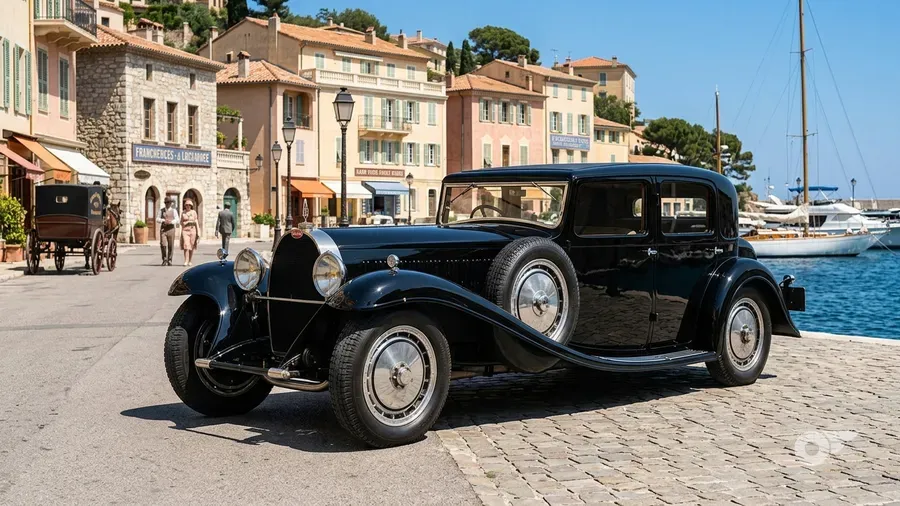
Every closed body on the standard Type 57, the Ventoux coupe and Galibier saloon built in-house at Molsheim, and the Gangloff-built Stelvio cabriolet, came from Jean Bugatti's own drawing board, and the family fingerprint runs deeper than the sheet metal. The horseshoe radiator shell is a shrunken echo of the one his father put on the Royale, carried down in scale but not in intent, it still announces the car before anything else does. Thermostatically controlled shutters flank the engine bay, a functional detail Jean turned into a styling one. The Atlantic is where the design story sharpens into something else entirely: its riveted dorsal seam began as an engineering necessity on the 1935 Aerolithe show car, whose Elektron magnesium-alloy body panels could not be welded and so were joined by external rivets borrowed from aircraft practice. When the four production Atlantics switched to conventional aluminium, which could have been welded invisibly, Jean kept the seam anyway, because by then it had become the car's signature rather than its workaround. Alloy wheels, patented by the factory a decade earlier on the Type 35, carried the racing pedigree through to the road car. Nothing on a Type 57 is ornamental without also being explainable.

Motorsport pedigree

Ettore Bugatti had officially stepped back from factory racing by the mid-1930s, but the Type 57 gave the marque one last works effort worth the name. The 57G, a streamlined two-seater built on the shortened 57S chassis and nicknamed the Tank for its low, enclosed bodywork, won the 1936 French Grand Prix outright. The following year a Tank driven by Jean-Pierre Wimille and Robert Benoist won the 24 Hours of Le Mans, covering 3,288 kilometres, seven laps clear of the second-place Delahaye. Bugatti returned in 1939 with an updated 57C-based Tank, and Wimille, partnered this time by Pierre Veyron, won again, 3,354 kilometres at an average of 139 km/h, a result that stood as the marque's last great prewar success before the factory's occupation. Only three Tanks were built. The 1937 Le Mans winner, chassis 57335, is the sole survivor and lives at the Simeone Foundation museum in Philadelphia. The racing story ends in tragedy rather than triumph: weeks after the 1939 Le Mans win, Jean Bugatti died testing that same car on the public road between Molsheim and Strasbourg, swerving to avoid a cyclist. He was thirty years old.

In culture

The Type 57's cultural weight rests less on screen appearances than on the story of the family that built it. Ettore Bugatti came from a dynasty of artists, his father Carlo designed furniture now in museum collections and his brother Rembrandt sculpted animals in bronze, and Jean's willingness to treat a car body the way his relatives treated furniture and sculpture is part of why the Atlantic still reads as art rather than transport. Jean's death in 1939, at the wheel of the car that had just won Le Mans, closed the family chapter on Molsheim two years before the war closed the factory itself. Modern Bugatti has leaned into that history rather than away from it: in 2019, for the marque's 110th anniversary, the company unveiled La Voiture Noire, a one-off styling tribute to the missing second Atlantic, chassis 57453, unseen since the war, and sold it for a reported nineteen million dollars. The surviving Atlantics have since crossed into the art world in their own right, exhibited at the Guggenheim Bilbao and taking Best of Show at Pebble Beach twice. Few cars have made the jump from garage to gallery this convincingly.

Rivals

Cars from other manufacturers that competed for the same buyers when new.

Owning One

Why collectors want it

The Type 57 is where prewar Bugatti ownership becomes genuinely layered, and that layering is exactly why it holds the top of its market. At the accessible end sit the catalogue-bodied cars, the Ventoux coupe, Galibier saloon and Gangloff-built Stelvio cabriolet, honest twin-cam grand tourers that a serious collector can still buy for the price of a well-optioned new supercar. Above them the lowered 57S sports chassis, its supercharged 57SC sibling, and the seventeen-off Atalante coupe occupy seven-figure territory earned by genuine scarcity rather than marketing. At the summit sits the Atlantic: four coupes built, three known to survive, one missing since the war and valued by specialists in nine figures should it ever surface. That range gives the Type 57 something rarer than desirability, it gives it an entry point. Hagerty has flagged it specifically as a gateway into prewar collecting for buyers in their twenties and thirties, drawn less by nostalgia than by the Atlantic's design and the model's genuine motorsport record, two Le Mans wins among them. Few prewar cars offer both a driveable, ownable base car and a halo variant that regularly resets what a car can be worth.

Which one to look for

Rank matters here more than most Bugattis. The Atlantic is the grail, four built, three survivors, a car most buyers will never own but every buyer should know about. Below it the 57SC and 57S share the lowered sports chassis and near-independent front end; only two SCs left the factory as such, though many S cars were later fitted with the supercharger customers wanted, so factory SC and S converted to SC specification are two different things worth distinguishing on paperwork alone. The Atalante, seventeen built on the same 57S chassis, is the most attainable of the true sports coupes. For everyone else, the catalogue bodies are where real ownership happens: the Ventoux coupe is the most common and the easiest to live with, the four-door Galibier suits a buyer who wants to use the car, and the Gangloff-built Stelvio cabriolet splits the difference with open-air touring. None of the closed cars are lesser Bugattis, they are simply the ones you can actually find, insure and drive without needing a second mortgage or a place in a museum queue.

Atalante · 1935–1940

A two-door coupe on the shortened, lowered 57S sports chassis, sharing its silhouette with the Atlantic but without the riveted dorsal seam and with a single-piece windscreen. The most attainable of the true sports coupes.

Galibier · 1934–1940

The four-door pillarless saloon, built in-house at Molsheim to Jean Bugatti's design. The practical, family-usable end of the range, and the body most likely to have covered real touring mileage in period.

Stelvio · 1934–1940

A four-seat cabriolet built by coachbuilder Gangloff of Colmar to Jean Bugatti's plans, named after the Alpine pass. Splits the difference between the closed Ventoux and open-air touring.

Type 57G Tank · 1936–1939

The streamlined works racer built on the shortened 57S chassis for Grand Prix and endurance competition, nicknamed for its low, fully enclosed bodywork. Won the 1936 French Grand Prix and the 1937 and 1939 24 Hours of Le Mans; never sold to customers.

Type 57S · 1936–1938

The lowered 'Surbaisse' sports chassis: the rear axle passes through the frame rather than under it, lubrication went dry-sump to clear the lower hood line, and the front end is nearly independent. Widely considered the ultimate road-going prewar Bugatti chassis.

Type 57SC · 1936–1940

The supercharged evolution of the 57S, with a Roots-type blower lifting output from around 170hp to roughly 200hp and top speed from about 125mph to 135mph. Distinguished by a V-shaped dip at the base of the radiator and mesh side grilles.

Type 57SC Atlantic · 1936–1938

The ultra-low coupe derived from the 1935 Aerolithe show car, with a riveted dorsal seam running the length of the body, a styling signature kept even after production cars switched from unweldable Elektron alloy to conventional aluminium. Named for Jean Bugatti's friend, aviator Jean Mermoz, lost over the South Atlantic.

Ventoux · 1934–1940

The two-door, four-seat closed coupe, designed in-house by Jean Bugatti and named after the Mont Ventoux climb. The most numerous body on the standard chassis and the easiest Type 57 to find, insure and drive day to day.

What owning one is like

What owning a Type 57 asks of you is patience with a car that predates most of what modern drivers take for granted, stated plainly rather than as a warning. The non-synchromesh gearbox punishes a rushed shift with a crunch rather than a click, and learning to double-declutch a downshift is simply part of owning one, not a defect to fix. Pre-1938 cars stop on cable-operated drum brakes that were criticized when new and need a sympathetic, well-maintained setup to be genuinely safe at speed; cars from 1938 on got Bugatti-Lockheed hydraulics that solve the problem outright. The thermostatically controlled radiator shutters seize with age, a wax top-up rather than a rebuild. Fuel system niggles, sticking needle valves, blocked jets, dirty petrol fouling the carburettors, are the most common reason an otherwise sound car runs poorly, and they are the first thing any prepurchase inspection should chase down. Because so few cars exist and so many have unique histories, bodies swapped, engines rebuilt, chassis renumbered, the biggest variable is not mechanical at all: it is how faithfully a given car matches its own documented past, and that takes a specialist eye to confirm, not a service manual.

Upkeep & parts

Parts support for a Type 57 is nothing like a postwar car's, but it is better than the car's rarity would suggest. A small, deeply knowledgeable network of prewar specialists, in the UK, the US and France, still fabricates or sources everything from gearbox internals to the specific fiber-and-steel camshaft gears Jean Bugatti designed for quiet running, and most routine mechanical work is a solved problem for anyone with the right contacts. The bottleneck is bodywork and trim: coachbuilt panels from Gangloff, Vanvooren or the Molsheim works itself were never mass-produced, so replacing anything beyond mechanical parts usually means hand fabrication rather than a catalogue order. The Bugatti Owners' Club, based at Prescott in the UK, and the American Bugatti Club, which publishes the Pur Sang quarterly and maintains a North American register of surviving cars, are both genuinely active communities rather than nostalgic mailing lists, and the Bugatti Trust holds archival chassis records that matter enormously given how often cars were rebodied or rebuilt in period. Budget for specialist labour rather than parts costs: the components are largely available to those who know where to look, but almost nobody works on a Type 57 who has not spent years learning the type first.

Country of origin
France
Class
Grand Tourer
Production years
1934–1940
Units built
~710
Model
Type 57
Nickname
No nickname ("Tank" names the Type 57G racer specifically, not the generation)
Body
Sedan, Coupe, Convertible
Layout
Front-engine, RWD
Engine
3,257cc (3.3L) DOHC straight-8, naturally aspirated, 135hp (Type 57); 3,257cc DOHC straight-8 with Roots-type supercharger, 160hp (Type 57C); 3,257cc DOHC supercharged straight-8, up to 200hp (Type 57SC)
Transmission
4-speed manual, non-synchromesh
Designer
Jean Bugatti