Octane Files
Explore CarsBugatti Type 41

Bugatti Type 41

Overview

Ettore Bugatti built the Royale to answer an insult. When an English aristocrat told him her Rolls-Royce was better engineered than anything from Molsheim, he set out to build the largest, most expensive car anyone had attempted, planning twenty-five examples for the crowned heads of Europe. What he built instead was one of history's great commercial failures and one of its great engineering statements. The Type 41 rides on a 4.3-metre wheelbase under a 12.8-litre straight-eight so large that opening the bonnet took two mechanics, an engine originally blueprinted from an aircraft design Bugatti had drawn up for the French government. Six chassis were completed between 1927 and 1933, each carrying its own coachwork from outside houses like Kellner, Weinberger, Binder, and Park Ward, plus two bodies by Ettore's son Jean. The Great Depression gutted the market Bugatti had aimed at: no monarch ever bought one, Bugatti reportedly turned down King Zog of Albania over his table manners, and only a handful of the six ever found a paying customer at all. The surplus engines found a second life powering record-setting high-speed railcars for the French state railway. All six Royales survive today, scattered between museums and a handful of private collections, each one among the rarest cars in the world.

Distinctions

The defining attributes and collector status that make this car garage-worthy.

Legend
A car that transcended the hobby, known far beyond the people who drive them.
Octane Files Select
Renowned for its history, engineering, or cultural weight.

Collectibility scorecard

Rated 1 to 10 on the traits that matter for owning, driving, and holding on to a car like this.

Desirability
9/10
Rarity
10/10
Driving thrill
3/10
Investment trajectory
6/10
Usability
1/10
Ease of restoration
1/10
Cultural impact
8/10
Electronic dependence
Fully analogHeavily electronic

No fuel injection, no electronic ignition, no computer of any kind. Dual spark plugs per cylinder fire off a period magneto and distributor setup, the three-speed gearbox is a purely mechanical rear-mounted transaxle, and the brakes are cable-actuated drums with no power assistance whatsoever. Every input on a Royale, original or replica, is a direct mechanical linkage exactly as built in the late 1920s and early 1930s.

Market data

Demand tier, price trend, and typical values by condition. Our own assessment, not a quoted valuation.

Demand tier
EntrySolidHighBlue-chip

The proven elite. Values are established, liquid, and defended at every auction.

Value trajectory
AppreciatingStableCooling

Values are holding steady. What you pay today is what it's worth tomorrow.

Price by condition
Driver
$20M
Excellent
$30M
Concours
$50M

There is no volume Royale and no condition ladder, so read the band below as a spread across six unique cars rather than a driver to concours climb. Four of the six are effectively out of the market: two sit in the Cite de l'Automobile at Mulhouse, the Weinberger cabriolet has been in the Henry Ford Museum since it was donated in 1957, and Volkswagen has owned the Binder coupe de ville since 1999, when it paid a reported $20 million to give the revived marque its own heritage. The documented anchors are few and old. Christie's sold the Kellner car at the Royal Albert Hall in 1987 for 5.5 million pounds, about $9.7 million and a world record for any car at the time, and that same chassis went to Japan's Meitec Corporation in 1990 for a reported $15.7 million. The only recent movement is the Berline de Voyage, sold privately out of the Blackhawk Collection in March 2021; no figure was ever published, though the specialist press put it above the $22 million a Duesenberg SSJ made in 2018. The top of the band is therefore reasoned rather than observed, and a Royale changes hands about once a decade.

Values as of August 2026.

Buyer's guide

What anyone seriously considering this car should know first.

Why it's worth it
Built to out-snob Rolls-Royce, planned in a run of twenty-five, and never sold to a single member of the royalty it was named for
Callout
Ettore Bugatti turned down a sale to King Zog of Albania, saying the king's table manners were beyond belief
What to watch for
Nobody buys a Royale the way they buy a Corvette. Opportunities arise once a decade at most, usually by private treaty rather than public auction, and each transaction is really the sale of a documented artifact rather than a used car. The first thing to verify is which of the six chassis you're actually looking at and what has changed: several were rebodied more than once, chassis 41100 wore at least four different bodies across its life, and coachwork history matters as much as mechanical originality to value. Because the cars are so well known individually, provenance research is unusually thorough already; lean on it rather than reinvent it. Watch for replica confusion: exact reproductions of several bodies, including the Coupe Napoleon and the Esders Roadster, have been built by specialist restoration houses for museum display, and total clarity on which is which matters enormously. Mechanically, the engines have occasionally been modified from factory specification, most famously the Weinberger car's American owner fitting a four-carburettor intake in the 1940s; know whether what you're looking at is original or period-modified before any conversation about value begins. This is a car bought through relationships and specialist advisors, never through a listing.

The Story

Driving character

Contemporary road tests, including one Ettore Bugatti commissioned from The Autocar in 1926, found the Royale surprisingly close in feel to Bugatti's much smaller sports cars: quick steering and balanced weight distribution, nothing like the wallowing barge its size suggests. That balance came from deliberate engineering, with the gearbox mounted at the rear as a transaxle specifically to offset the mass of a straight-eight so large that two mechanics were needed to raise the bonnet. The engine itself does the opposite of what its size implies: peak power arrives at just 1,800rpm, and period owners described it as eerily smooth, the source of the old story that a standing coin wouldn't fall off the running engine. None of that makes it easy to drive. The brakes are cable-operated drums the size of dustbin lids, needing real leg strength and a driver who plans stops well in advance, and one owner's fuel-consumption notes from the 1950s recorded dramatically higher use in stop-start traffic than on the open road. This is a car that rewards long, open roads and punishes impatience: effortless at speed, demanding at a standstill, and entirely unlike anything else Bugatti built before or since.

Design

Every Royale carries its own coachwork, which makes design a six-way conversation rather than one story, but two elements are constant across all of them. The first is the elephant on the radiator cap, a dancing figure sculpted by Ettore's brother Rembrandt Bugatti, a serious artist who died in 1916; it's the only hood ornament ever used on a Bugatti. The second is the wheels: cast alloy discs 610mm across, made in one piece with the brake drums, unlike anything on a contemporary luxury chassis. Beyond that, the six bodies range widely. Jean Bugatti's Esders Roadster is the most daring, an open two-seater with dramatically flared wings and no headlamps at all, later rebodied by Binder into a formal coupe de ville for a different owner entirely. The Kellner coupe and Park Ward limousine sit at the more conservative, formal end, built for chauffeured use rather than for the owner to drive. Inside, every car shared the same period-correct materials regardless of body style: dashboard controls carved from whalebone and a steering wheel rim wrapped in walnut, details that read as excess until remembering this was a car aimed, quite literally, at royalty.

Motorsport pedigree

The Royale never raced and was never meant to; it's the one Bugatti model built with no competition intent whatsoever, a striking contrast to a marque that spent the 1920s winning Grands Prix and five straight Targa Florios with the Type 35. Its only brush with speed-record territory came sideways: when the Depression left Bugatti with a stock of unsold 12.7-litre engines, the factory adapted the design to power a new generation of high-speed railcars built for the French state railway from the mid-1930s onward. One of those railcars reached speeds close to 200km/h in record-setting test runs, powered by the same basic engine design that couldn't find six buyers as a car. Bugatti built 79 of the railcars for the SNCF, some of which stayed in regular service into the late 1950s, making the Royale's engine, if not the Royale itself, one of the most operationally successful things Bugatti ever built.

In culture

The Royale's cultural footprint outran its sales figures almost immediately, helped by a founding story too good not to repeat: Ettore Bugatti reportedly built it to answer an English lady who preferred her Rolls-Royce, then turned down King Zog of Albania as a customer over his table manners. It has shown up in fiction ever since, usually as shorthand for old-world extravagance. Jasper Fforde's The Eye of Zoltar gives its heroine a Royale as her vehicle of choice, Clive Cussler put one in The Wrecker, and Donald Stanwood's 1987 novel The Seventh Royale imagines a hunt for a mythical seventh example beyond the known six. E.F. Benson's Mapp and Lucia universe, continued by Guy Fraser-Sampson, has a maharajah's Royale driven into Lake Como by comic incompetence. In the real world, all six surviving cars were reunited on the lawn at the 1985 Pebble Beach Concours, a gathering unlikely to be repeated given where the cars live now, and a faithful replica of the Coupe Napoleon carried a Danish prince and his new bride away from their 2008 wedding. For a car almost nobody ever saw new, the Royale became better known after the fact than most cars that sold in the millions.

Rivals

Cars from other manufacturers that competed for the same buyers when new.
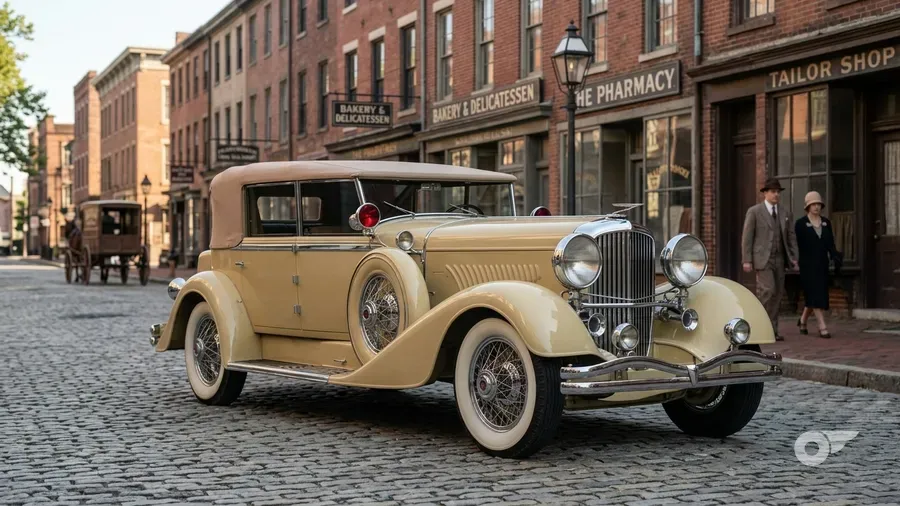
Duesenberg Model J

Duesenberg Model J

USA·Vintage·1928–1937

Rolls-Royce Phantom II

We haven’t profiled this car yet. Request to add

Owning One

Why collectors want it

There is no market for the Royale in any conventional sense, because there is no volume: six chassis exist, several still owned by museums or the modern Bugatti company itself, and a transaction happens perhaps once a decade. What collectibility means here is closer to owning a major artwork than a car. Each of the six carries its own coachwork and a documented ownership chain back to the 1930s, unusually intact for a pre-war car precisely because so few people have ever owned one. The Kellner-bodied car set a world record price when Christie's sold it for 5.5 million pounds in 1987, and the Binder coupe de ville reportedly changed hands for around $20 million when Volkswagen bought it in 1999 to anchor the revived Bugatti brand's own heritage. Values since then are effectively unknowable in the open-market sense, since nobody has publicly sold one in over two decades and the remaining private examples rarely if ever come up. What makes the Royale collectible isn't return on investment, it's the fact that owning one means holding a piece of a story that cannot be repeated: twenty-five were planned, six were built, and the car that was supposed to flatter kings ended up humbling its own maker instead.

Which one to look for

Every Royale is its own variant, since Bugatti built six chassis and never repeated a body. The Coupe Napoleon (41100) was Ettore's own car and wore more bodies than any other chassis across its life before settling into Jean Bugatti's coupe design; it's the closest thing to a flagship example and lives at the Cite de l'Automobile in Mulhouse. The Esders Roadster, later rebodied as the Binder Coupe de Ville (41111), is the one that actually sold new, commissioned without headlamps because its first owner refused to drive after dark; it later went to Volkswagen for a reported $20 million. The Weinberger Cabriolet (41121) is the only one on public display in the United States, at the Henry Ford Museum, and carries a period-modified four-carburettor engine rather than the original single-carburettor setup. The Park Ward Limousine (41131) and the Kellner-bodied coupe (41141) have both passed through the Schlumpf Collection; the Kellner car set the Royale's price record at auction in 1987. The Berline de Voyage (41150) was one of two chassis L'Ebe Bugatti sold to American racer Briggs Cunningham for cash and two refrigerators in 1950.

Berline de Voyage · 1929

Chassis 41150, built with a formal travelling saloon body by Bugatti's own works and never sold new; retained by the Bugatti family.

Coupe de Ville Binder · 1932-1936

Chassis 41111, the second Royale built and the first ever sold to an outside customer. Delivered in 1932 to Parisian clothing manufacturer Armand Esders as an open two-seat roadster designed by Jean Bugatti, deliberately built without headlamps because Esders never intended to drive it after dark. A later owner, French politician Raymond Patenotre, had coachbuilder Henri Binder rebody it as a formal coupe de ville, the identity it has carried ever since.

Coupe Napoleon · 1926-1931

Chassis 41100, Ettore Bugatti's own car and the one that wore the most bodies of any Royale across its life. Built first with a Packard-influenced prototype body, then rebodied in fabric by Weymann, then rebuilt again after Ettore crashed it falling asleep at the wheel between Paris and Alsace around 1930 or 1931. Its current coupe body, credited to Jean Bugatti, gave the car its lasting name.

Kellner Coupe · 1932

Chassis 41141, built with formal coupe coachwork by Parisian coachbuilder Kellner & Cie but never sold new; retained by the Bugatti family.

Park Ward Limousine · 1933

Chassis 41131, sold in 1933 to English collector Captain Cuthbert Foster, who commissioned British coachbuilder Park Ward to fit a formal limousine body styled after a Daimler he had previously owned.

Weinberger Cabriolet · 1932

Chassis 41121, sold new in 1932 to German obstetrician Dr. Joseph Fuchs, who commissioned Munich coachbuilder Ludwig Weinberger to build an open cabriolet finished in black with yellow trim.
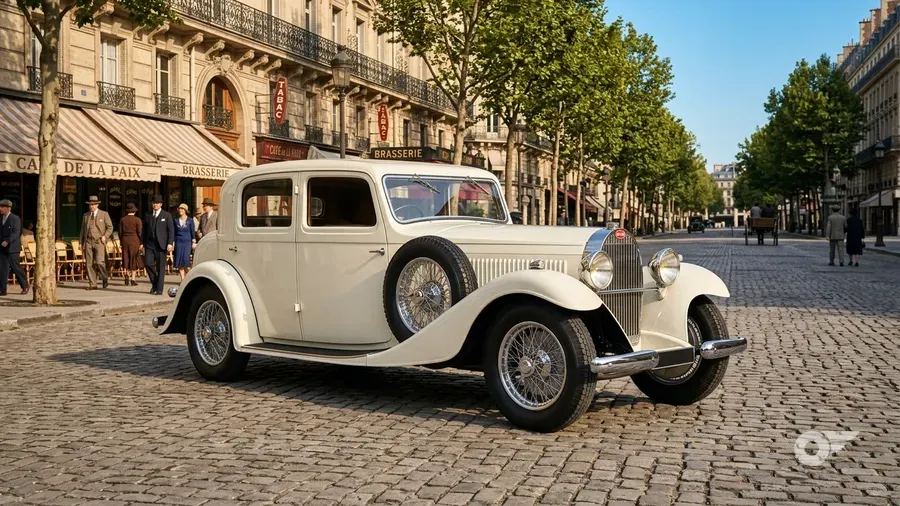

What owning one is like

Owning a Royale isn't really a maintenance question in the normal sense, since none of the six live anything like a normal collector car's life; most sit in museums or long-term private collections rather than getting driven. But the honest mechanical picture, drawn from the cars' own histories, is that this was never an easy machine even when new. Valve adjustment requires pulling the entire monobloc engine apart, since the cylinder head is cast in one piece with the block, an involved job even for a specialist. The cable-operated brakes need real strength and real planning; they work, but they are not power brakes by any modern standard. Fuel consumption is on another scale entirely, with one 1950s owner logging dramatically higher figures in stop-start traffic than on the open road. Tyres have occasionally been an actual crisis rather than an inconvenience: one 1940s owner could only find replacements sized for artillery pieces, and had to modify the fenders to fit them. None of this deters the handful of people ever likely to own one. It just means the Royale asks a level of mechanical sympathy and patience that matches its scale in every other respect.

Upkeep & parts

There is no parts network for a Royale, because there was never a production run large enough to support one; every component beyond basic hardware is either an original 1930s part or something made specifically to fit that one chassis. What exists instead is a small group of specialist restoration houses that have built their expertise entirely around these six cars and their replicas. Ashton Keynes Vintage Restorations and its sister firm South Cerney Engineering built exacting replica Royales for museum display, work precise enough that when the Kellner car's Japanese owners needed a replacement piston, they commissioned South Cerney to make one rather than trust a general machine shop. That is the real maintenance model here: bespoke fabrication by people who have handled the actual cars, not a catalogue and a phone number. The Bugatti Trust in the UK and enthusiast chassis registries built around the marque hold much of the documented history, which matters enormously given how often these cars have been rebodied and re-engined over ninety years. Budget for this kind of work the way you'd budget for restoring a piece of fine art, because functionally that is what it is.

Country of origin
France
Class
Luxury
Production years
1927–1933
Units built
6
Model
Type 41
Nickname
La Royale
Body
Sedan, Coupe, Convertible, Roadster
Layout
Front-engine, RWD
Engine
12.8L (12,763cc) SOHC straight-eight, three valves per cylinder, single carburettor, around 300hp at 1,800rpm (period sources range as low as 260-275hp)
Transmission
3-speed manual, rear-mounted transaxle, multi-plate dry clutch
Designer
Ettore Bugatti (chassis and engine); Jean Bugatti (Coupe Napoleon and Esders Roadster coachwork)