Overview
Klaas Zwart made his money in the oil industry, raced whatever he could get his hands on, and put both to work on a British car company named after Alberto Ascari. Ascari Cars built the Ecosse from 1998 and then the KZ1, carrying Zwart's own initials, and ran its own circuit in the Spanish hills at Ronda. The A10 was meant to be the third act, its name marking the company's tenth anniversary.
Underneath it is the KZ1-R race car made road legal rather than a road car made faster. The 4,941cc BMW S62 V8 was pushed to 625bhp, the gearbox was a six-speed sequential with a conventional manual as an option, and the whole thing weighed 1,280kg. The price was GBP 350,000 and fifty were planned.
One was built. On 9 December 2007 that car lapped the Top Gear test track in 1 minute 17.3 seconds, three tenths inside the Koenigsegg CCX and quicker than anything that had been round it before. Ascari Cars filed for bankruptcy in 2010 without ever building the other forty-nine.
Distinctions
The defining attributes and collector status that make this car garage-worthy.
Collectibility scorecard
Rated 1 to 10 on the traits that matter for owning, driving, and holding on to a car like this.
The BMW S62 arrives with BMW's own engine management and electronic throttle, so the engine end of the car is as electronic as a period M5. Everything after it is deliberately not. The gearbox is a mechanical six-speed sequential shifted by the driver, with a conventional H-pattern manual offered as an alternative; the suspension is passive and race-derived; and there is no stability control or torque vectoring of the kind that arrived on supercars within a couple of years of it. The result sits mid-scale: a modern engine in a car otherwise built to racing rather than road-car conventions.
Market data
Demand tier, price trend, and typical values by condition. Our own assessment, not a quoted valuation.
A dependable market. Well-kept cars hold their value and find ready buyers.
Values are holding steady. What you pay today is what it's worth tomorrow.
There is no price band because there is no market. One A10 exists, it has never been offered publicly, and by every account it remains in Klaas Zwart's own collection. The only published figure attached to it is the GBP 350,000 asked when fifty cars were planned in 2006, and no car was ever sold at that price. The nearest usable reference points are the KZ1, launched at GBP 235,000 in 2005 and built in genuine numbers, and the KZ1-R competition cars, which appear for sale occasionally. Ascari Cars filed for bankruptcy in 2010, so there is no manufacturer support behind any valuation. Treat this as a one-off with a famous lap time rather than as an asset class: any figure attached to it would be set by a single negotiation, not by comparables, and the desirability tier here reflects the car's significance rather than a tested market.
Buyer's guide
What anyone seriously considering this car should know first.
The Story
Driving character
625bhp in 1,280kg is a power to weight ratio that most road cars of 2006 could not approach, and the A10 delivered it through a sequential gearbox and a chassis lifted straight from a GT racer. The Top Gear lap is the best evidence of what that combination felt like: 1 minute 17.3 seconds around a small, technical, low-grip airfield circuit, where mechanical grip and immediacy count for far more than top speed. The engine is the familiar part. BMW's S62 is a 4,941cc V8 with individual throttle bodies, an engine that revs cleanly and sounds hard-edged rather than exotic, and in this application it is unburdened by weight or insulation. The rest is unapologetically racing equipment. A sequential shift, race-derived suspension, and a cabin built around the driver rather than around comfort. Claims of 2.8 seconds to 60mph were made at the time and should be read as claims from a company with one car and a lot to prove. The lap time is the number that survived scrutiny.
Design
Paul Brown, who had designed for the Zakspeed Formula 1 team, drew the KZ1 and then reworked it into the A10, and the family resemblance is total: 4,300mm long, 1,852mm wide and 1,138mm tall, dimensions the two cars share exactly. What changed is what a race car needs. The A10 is the more aggressive object, with the aerodynamic hardware and cooling arrangements of the KZ1-R rather than the smoother surfacing of the road car, and it looks like what it is: a GT racer with numberplates, wearing its downforce on the outside. The badge is worth a moment. Ascari Cars named itself after Alberto Ascari, the Italian who took the 1952 and 1953 Formula 1 titles, and Zwart named the KZ1 after himself, so the marque carries a double dedication that is either charming or awkward depending on your view of Dutch oil money in British motorsport. The A10 name is the most modest thing on the car, marking ten years of a company that would be bankrupt within four more.
Motorsport pedigree
The A10 never raced, and that is the wrong way round for this car: it is a race car that was made to stop racing. It was developed directly from the Ascari KZ1-R, which competed in the Spanish GT Championship and the FIA GT3 European Championship, and the road car exists because Ascari wanted to sell fifty copies of that machine with lights and numberplates. The company behind it was built on competition. Klaas Zwart finished third in the British GT Championship in 1995, won the EuroBOSS series in 2003, 2006 and 2007, and built Circuito Ascari near Ronda in Spain, a 5.4km private circuit with 26 corners drawn from Spa, Silverstone and the Nurburgring, completed in 2003. Ascari customers were offered access to it, which is a rare thing for a firm of this size to be able to promise. So the A10's competition record is entirely inherited, and its only recorded competitive performance is a timed lap for a television programme. Given that lap beat every supercar that had been round that circuit, the inheritance was clearly worth something.
In culture
The A10's entire public life is one lap. On the 9 December 2007 episode of Top Gear it went round the show's test track in 1:17.3, three tenths quicker than the modified Koenigsegg CCX that held the record, and became the fastest car the programme had timed. For a company most viewers had never heard of, that was as much publicity as a small British manufacturer has ever bought for the price of a track day. The lap has aged the way all lap records do. Wikipedia notes the A10 still sat 21st on the all-time Power Lap board as of 2023, which is a respectable afterlife for a car built once, in 2006. Everything else about the marque's public profile belongs to the circuit rather than the cars. Circuito Ascari at Ronda outlived Ascari Cars by more than a decade and remains a fixture on the private-track circuit, sold by Zwart in 2022. The car company is a footnote; the racetrack is the monument.
Related cars
Cars from the same manufacturer family, like platform siblings or shared-era relatives.


Ascari Ecosse

Ascari KZ1
Rivals
Cars from other manufacturers that competed for the same buyers when new.
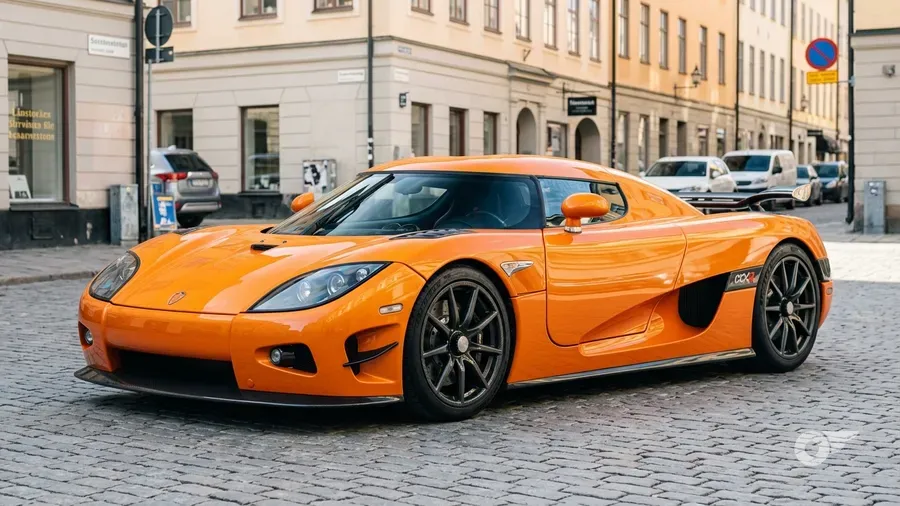
Koenigsegg CCX

Porsche Carrera GT

Mercedes-Benz SLR McLaren

Ferrari Enzo

Pagani Zonda
Owning One
Why collectors want it
The A10 is collectible in the way a prototype is collectible: it is the whole production run, the last car its company ever made, and the holder of a lap time that mattered enormously at the time it was set. Nobody has a second one, and there is no hierarchy to climb.
The significance is real even if the availability is not. In December 2007 the fastest lap of the Top Gear track was a genuine currency in the supercar business, contested by Koenigsegg, Pagani and Ferrari, and it was won by a firm in Banbury that had built fewer cars in its life than Ferrari built in a morning. That single fact is why anyone remembers Ascari at all.
For a collector the practical route into this story runs through the KZ1 and the KZ1-R, which do come to market and which share the car's architecture and its BMW V8. The A10 itself is a museum piece in private hands, and its value is a matter of what someone would pay for a unique object rather than of any market that exists today.
Which one to look for
There are no variants, because there is only one car. What surrounds it is a short family tree worth knowing, since it is where a buyer's attention will end up. The Ecosse came first in 1998, the car that established the company. The KZ1 followed, launched at Autosport International in 2005 at GBP 235,000, using a 4.9-litre BMW S62 V8 with around 500bhp and built at Banbury, and it is the Ascari that exists in real numbers. The KZ1-R is the competition version, tuned to around 520bhp and campaigned in the Spanish GT Championship and the FIA GT3 European Championship, and it is the direct parent of the A10. The A10 sits at the top of that tree as the KZ1-R made road legal and pushed to 625bhp. Wikipedia records its production simply as 2006, prototype, and the fifty-car run never happened. So the ranking is unusual: the grail is not a variant of the car, it is the car, and everything below it wears a different name.
What owning one is like
Nobody owns an A10 except its builder, so the honest version of this section is what the car would ask of anyone who did. The BMW S62 is the friendliest part: it is the M5 engine, it has a large specialist following, and its service intervals and weak points are well understood by people who have never seen an Ascari. Everything else is competition equipment on a road-registered car. A sequential gearbox wears to a schedule and is rebuilt rather than repaired. Race-derived suspension, brakes and aerodynamic components were specified for track use, and their consumable life is measured in sessions. The company has been gone since 2010, so there is no factory to call, no parts department and no build records to request. What survives is the small group of people who worked on the KZ1 and KZ1-R programmes in Banbury, and the owners of those cars, who face the same problems. For a single prototype in a private collection, the real risk is not wear, it is disuse. Race hardware left standing deteriorates faster than it does being used.
Upkeep & parts
Parts fall into two piles. BMW parts, which are easy: the S62 V8 is shared with the E39 M5 and the Z8, so internals, sensors, injection hardware and management components are available from BMW specialists worldwide, and the engine's documented weaknesses have solutions that predate the A10 itself.
Ascari parts, which are not. Body panels, glass, interior components, the aerodynamic package and the sequential transmission were made in tiny numbers for a company that went bankrupt in 2010. Any of it now means fabrication or a compatible race component sourced from the motorsport trade.
There is no owners club and no registry for a marque with three models and a total output measured in dozens. The useful continuity is Circuito Ascari at Ronda, which still operates as a private members' circuit under new ownership after Zwart sold it in 2022, and the Banbury motorsport industry that built the cars in the first place. A serious owner would end up commissioning work from race preparers rather than restorers, which is the correct way to approach a car that was a GT racer before it was anything else.