Octane Files
Explore CarsAlfa Romeo Disco Volante

Alfa Romeo Disco Volante

Overview

The factory called it the 1900 C52. Nobody else ever has. Alfa Romeo and Carrozzeria Touring built five of these between 1952 and 1953 as a rolling aerodynamic experiment, and the shape that came out of the wind tunnel was so unlike anything else on a road that the press named it after a flying saucer and the type number never recovered. Underneath is a new tubular space frame carrying lightened Alfa Romeo 1900 running gear: the 1900's twin-cam four rebored to 1,997cc in an aluminium block, 158 PS, a four-speed box, double wishbones at the front and a live rear axle on a triangle and two trailing arms. Over it Touring wrapped a body that is lenticular in section both from the front and from the side, with the underbody faired in and doors that swing up rather than out. Three were built with the four. Two more got the 3,495cc six from the 6C 3000 CM racing car. Only one of the five ever raced. The programme never got past the experimental stage, and it did not need to.

Distinctions

The defining attributes and collector status that make this car garage-worthy.

Octane Files Select
Renowned for its history, engineering, or cultural weight.

Collectibility scorecard

Rated 1 to 10 on the traits that matter for owning, driving, and holding on to a car like this.

Desirability
9/10
Rarity
10/10
Driving thrill
7/10
Investment trajectory
5/10
Usability
2/10
Ease of restoration
1/10
Cultural impact
7/10
Electronic dependence
Fully analogHeavily electronic

Two twin-choke sidedraught carburettors on the four-cylinder cars, coil and distributor ignition, a mechanical throttle linkage and hydraulic drum brakes on all four corners with no assistance of any kind. The only thing on the car doing anything clever is the bodywork, and that is shaped metal rather than a system. Even the aerodynamic work was done by putting a model in a wind tunnel and looking at it, which is why the fianchi stretti exists at all: the original body generated lift at speed, so Touring cut the hips off and tried again. There is nothing to plug a diagnostic tool into, and nothing that would understand it if there were.

Market data

Demand tier, price trend, and typical values by condition. Our own assessment, not a quoted valuation.

Demand tier
EntrySolidHighBlue-chip

The proven elite. Values are established, liquid, and defended at every auction.

Value trajectory
AppreciatingStableCooling

Values are holding steady. What you pay today is what it's worth tomorrow.

Price by condition
Driver
Excellent
Concours

No price band is given because there is nothing honest to build one from. Not one original Disco Volante has ever been offered at public auction. Four cars survive and three of them belong to museums, so the pool of tradeable examples is at most one, and it has not moved. The only Disco Volante results on the record are recreations: RM Sotheby's offered both a Spider recreation and a Fianchi Stretti recreation by OHA Automobili at the same 2022 sale, and those are the numbers a search will surface. Wikipedia carries an estimate of one to two million euros per car, but it is sourced to a Russian magazine article from 2008 and is eighteen years stale even as an estimate. The tier is set at blue-chip on the obvious grounds that a four-survivor Touring-bodied Alfa prototype would be, and the trajectory at stable because with no transactions there is nothing to trend.

Buyer's guide

What anyone seriously considering this car should know first.

Why it's worth it
The wind-tunnel shape that named itself, and that historians keep tracing forward into the Jaguar D-Type and E-Type
Callout
Five cars, four survivors, three of them museum property, and no original has ever been offered publicly
What to watch for
There is no meaningful buyer's guide for a car with four survivors and no market, so the useful advice is about what you are actually being offered. Anything described as a Disco Volante for sale is one of three things. It may be a recreation on 1900 or later Alfa mechanicals, of which RM Sotheby's has sold both a spider and a fianchi stretti version in a single sale, and a good one is a serious piece of coachbuilding sold honestly. It may be the 2012 Touring Superleggera Disco Volante, which is a different modern car built on an Alfa Romeo 8C Competizione rolling chassis and shown at Geneva that year, and it has its own separate value and its own small production run. Or it may be a 1900 C-series chassis that has been rebodied at some point and given the name. The tells are structural: the original cars ride on a purpose-built tubular space frame on a 2,220mm wheelbase, not a modified 1900 platform, and the Registro Internazionale Touring Superleggera holds the record of what Touring actually built.

The Story

Driving character

Almost nobody has driven one and the ones who have were mostly employed to. What can be said is what the specification implies. This is a 735kg car with 158 PS, which in 1952 is close to a two-litre Grand Prix power-to-weight ratio, and it is carrying that on 1900 saloon suspension geometry, drum brakes and 16-inch wire wheels with duralumin rims. The engine is the Alfa twin cam in its purest form, all-alloy with inserted sleeves, on twin sidedraught Webers and a raised 8.73:1 compression, which means it wants to be revved to 6,500rpm to give anything and rewards being kept there. The six-cylinder cars are a different proposition again: 230 PS and 240km/h in a 760kg body with the same brakes. The reason the programme stopped is instructive about how it must have felt. The full-width body generated lift at speed, enough that Touring rebodied one car to get rid of it, and a fast, light, aerodynamically unsettled car with drums is not a comfortable thing at 220km/h.

Design

This is Carrozzeria Touring's masterpiece and one of the very few cars where aerodynamics produced a shape nobody was expecting. Touring took the section of an aerofoil and applied it twice, so the body is lens-shaped seen from the front and lens-shaped seen from the side, and the two curves meet in a rim that runs right around the car and gives the flying-saucer profile its name. The underbody is faired in, which almost nothing else in 1952 bothered with. The wheels sit inside bulging wings rather than under cut-outs, so there is no visible break between body and arch. The doors swing upward. There is no grille to speak of, just the Alfa shield sunk into a shallow oval mouth. It is the least decorated Italian car of its decade and one of the most extreme, and its influence is out of all proportion to five cars: writers including Stephen Bayley have traced both the Jaguar D-Type and the E-Type back to the Disco Volante spider and coupé, which is a lineage worth more than most production runs.

Motorsport pedigree

Almost none, and the reason is the interesting part. The Disco Volante was built to explore a body shape rather than to win a race, and the shape turned out to be the problem: the full-width bodywork developed lift at speed, which is exactly the sort of thing a 1952 wind tunnel was not equipped to find. So of the five cars, only the rebodied fianchi stretti spider ever appeared on a start line, in a handful of events during 1953, and it never produced a result the marque cared to repeat. Alfa Romeo's competition effort of those years went instead into the 6C 3000 CM, whose 3,495cc straight six was lifted into two of the Disco Volantes, and the company withdrew from front-line sports car racing altogether soon afterwards. What the programme did do was hand Alfa a body of aerodynamic knowledge that went nowhere at the time and reappeared a decade later, when the Giulia TZ arrived with a Kamm tail and a purpose-built tubular frame, built by a different coachbuilder to the same principle.

In culture

The Disco Volante's cultural life is almost entirely visual, and it has outlasted everything the car did or failed to do. Two of the five sit at the Museo Alfa Romeo in Arese and are among the most photographed exhibits there, and Alfa runs them in historic events rather than leaving them under lights. The fianchi stretti went into the Schlumpf collection at Mulhouse by 1963 and is still on public display in France, which means two different national museums each hold a version of the same experiment. The name has proved more durable than the car: Touring Superleggera revived it in 2012 for a limited coachbuilt coupé on an Alfa Romeo 8C Competizione chassis, shown at Geneva, and it is not the same car despite sharing a badge and a coachbuilder. Alfa Romeo also cast a bronze sculpture of the shape for its centenary at the Fiera Milano in 2010, which is an unusual honour for a car that never won anything.

Rivals

Cars from other manufacturers that competed for the same buyers when new.
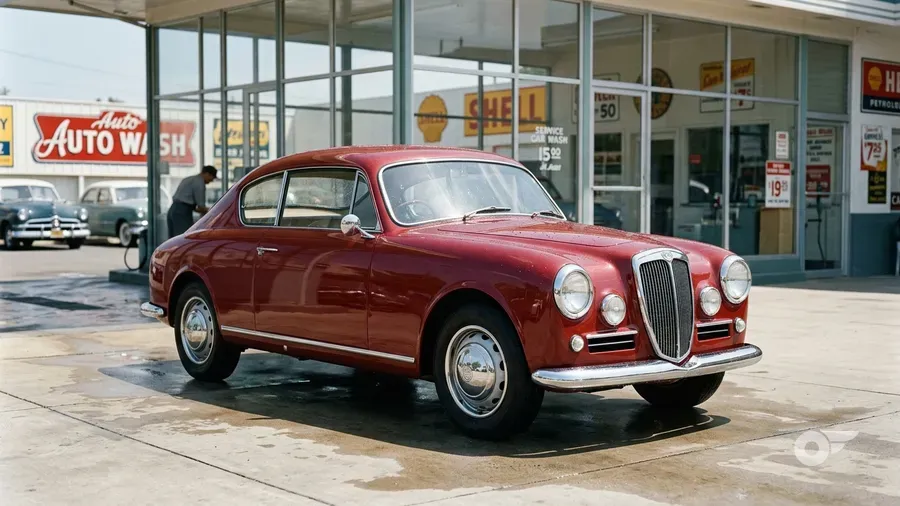
Lancia Aurelia B20

Lancia Aurelia B20

Italy·Grand Tourer·1951–1958

Owning One

Why collectors want it

Nothing about the Disco Volante is collectible in the ordinary sense, because it cannot be collected. Five were built, four survive, and three of those four are in public institutions: the 2.0-litre spider and the coupé at the Museo Alfa Romeo in Arese, the fianchi stretti in the Schlumpf collection at Mulhouse, and the surviving 3.5-litre six-cylinder spider at the Museo Nazionale dell'Automobile in Turin. What it does instead is set a value for everything downstream of it. The shape is the reason the name has been leased forward twice, to Touring Superleggera's 2012 coupé on an 8C Competizione chassis and to a whole recreation trade, and recreations of both the standard spider and the fianchi stretti have sold at major auctions. That is the practical market: if you want a Disco Volante you are buying somebody's interpretation, and the honest ones say so in the catalogue. The originals are a reference point, not an asset class, and Alfa Romeo has shown no sign of ever letting one go.

Which one to look for

There are only five cars and they divide into three distinct forms, which is worth knowing because the photographs get mixed up constantly. The original 1952 spider is the flying saucer proper: full lenticular section, bulging wings that wrap the wheels, a 1,997cc four and 220km/h. Three were built. In 1953 two of those three were rebodied for further aerodynamic testing. One gained a fixed roof and became the coupé, which is the version usually credited with pointing the way to the Jaguar D-Type. The other lost the bulging hips in favour of conventional wings and became the fianchi stretti, narrow hips, and that is the only Disco Volante that ever competed, running in a handful of 1953 events. Separately, two more cars were built in the original spider body with the 3,495cc straight six out of the 6C 3000 CM racing car, worth 230 PS and 240km/h, and one of those two was dismantled shortly after it was finished. So the connoisseur's car is the fianchi stretti, because it is the one with a competition history and the one that shows what the wind tunnel got wrong.

1900 C52 Coupé · 1953

One of the three 2.0-litre spiders given a fixed roof by Touring in 1953 for further aerodynamic testing. Mechanically unchanged. This is the version most often credited with pointing the way to the Jaguar D-Type, a lineage argued by writers including Stephen Bayley.

1900 C52 Fianchi Stretti · 1953

Narrow hips. The second 1953 rebody, this time deleting the characteristic bulging wings in favour of conventional ones to cure the lift the full-width body generated at speed. The only Disco Volante ever raced, contesting a handful of events during 1953, and the connoisseur's car of the five for exactly that reason.

1900 C52 Spider · 1952

The original flying saucer. Tubular space frame on a 2,220mm wheelbase, lightened Alfa Romeo 1900 running gear, a 1,997cc all-alloy twin cam on two twin-choke sidedraught carburettors at 8.73:1 giving 158 PS at 6,500rpm, 735kg and 220km/h. Full lenticular body by Carrozzeria Touring, bulging wings, faired-in underbody, swan doors.

C52 3000 Spider · 1953

Two further cars built in the original spider body with the 3,495cc cast-iron-block twin-cam straight six from the 6C 3000 CM racing car in place of the alloy four. 230 PS at 6,000rpm, 760kg, 240km/h, on the same drum brakes.

What owning one is like

There is no owner experience to report on for the four survivors, so what follows applies to anyone running an original or a faithful recreation on the same mechanicals. The engine is the Alfa twin cam four in an early and unusually highly strung state, alloy block with inserted sleeves, high compression and twin sidedraught Webers, so it wants correct fuel, careful carburettor balance and someone who understands where the 1900's tolerances end. Body repair is the real commitment. Touring's superleggera principle hangs hand-formed aluminium panels on a frame of small-diameter tubes, and once a panel of that curvature is damaged it is a fabrication job, not a repair. The aerodynamic behaviour that stopped the programme has not gone away either: the full-width body lifts at speed, which is why one car was rebodied in period, and it is a real consideration for anyone running a recreation hard. Drum brakes on all four corners on a 735kg car with this much power are adequate rather than reassuring.

Upkeep & parts

Nothing about keeping a Disco Volante is a parts-catalogue exercise. The good news is the mechanical half: the running gear is lightened Alfa Romeo 1900, which is a well-supported car with an active specialist trade in Italy and Britain, so the engine, gearbox, axle and brakes are all serviceable through the ordinary 1900 network rather than through one-off fabrication. Everything above the chassis rails is bespoke. Budget for a coachbuilder rather than a body shop, and for the sort of shop that already works in Touring's method of aluminium over small-tube framing, because the compound curvature of the body does not forgive filler or a quick panel beat. Documentation is the other cost worth planning for. The Registro Internazionale Touring Superleggera exists to catalogue every surviving Touring body and is the first call for anyone establishing what a car actually is, and Alfa Romeo Classiche at Arese can work back through the factory records for anything wearing a 1900 C-series chassis number.

Country of origin
Italy
Class
Sports
Production years
1952–1953
Units built
5
Model
Disco Volante
Nickname
Disco Volante (flying saucer)
Body
Spider, Coupe
Layout
Front-engine, RWD
Engine
1,997cc DOHC I4 (85 x 88mm, twin twin-choke sidedraught carburettors, 158 PS at 6,500rpm), 3,495cc DOHC I6 from the 6C 3000 CM (230 PS at 6,000rpm)
Transmission
4-speed manual
Designer
Carrozzeria Touring