Octane Files
Browse CarsOldsmobile Cutlass 3rd Gen

Oldsmobile Cutlass 3rd Gen

Overview

Oldsmobile's 1968 intermediate is where the Cutlass stopped being a model and became a franchise. GM redrew the whole A-body that year, and Oldsmobile's version, styled by Stan Wilen's studio, split its wheelbase by body style for the first time: 112 inches for two-doors, 116 for four-doors, which cured the freeway hop the old 115-inch chassis was criticised for. What sat on top of it was a range rather than a car. The base F-85, the fastback Cutlass S, the formal Cutlass Supreme, two station wagons and a 4-4-2 promoted to its own model line covered everything from a six-cylinder commuter sedan to a 455-powered Cutlass Supreme SX. Oldsmobile sold on taste rather than on price, and the Cutlass is where that argument worked hardest. A Chevelle buyer got value; a Cutlass buyer got a quieter car, a different V8 family and a nicer place to sit. By 1972 the F-85 name had died mid-year for want of buyers, the 4-4-2 had shrunk back to an option code, and the Cutlass Supreme Holiday hardtop on its own found 105,087 buyers. The nameplate would build 632,742 cars in 1977. This is the generation that made that possible.

Distinctions

The defining attributes and collector status that make this car garage-worthy.

Octane Files Select
Renowned for its history, engineering, or cultural weight.

Collectibility scorecard

Rated 1 to 10 on the traits that matter for owning, driving, and holding on to a car like this.

Desirability
6/10
Rarity
3/10
Driving thrill
6/10
Investment trajectory
6/10
Usability
7/10
Ease of restoration
7/10
Cultural impact
6/10
Electronic dependence
Fully analogHeavily electronic

Nothing on a 1968-1972 Cutlass makes a decision on your behalf. Ignition is breaker points and a coil, fuelling is a Rochester two-barrel or a Quadrajet fed by a mechanical pump, and the automatics shift on hydraulic pressure and a vacuum modulator. Electrical content stops at the charging system, lighting, wipers and whichever comfort options were ticked. The emissions equipment of the period is plumbing rather than electronics, and even the hardened valve seats fitted from 1971 were a metallurgy answer to unleaded fuel, not an electronic one.

Market data

Demand tier, price trend, and typical values by condition, based on recent sales data.

Demand tier
EntrySolidHighBlue-chip

A dependable market. Well-kept cars hold their value and find ready buyers.

Value trajectory
AppreciatingStableCooling

Values are holding steady. What you pay today is what it's worth tomorrow.

Price by condition
Driver
$11k
Excellent
$25k
Concours
$40k

The band describes the volume car, a Cutlass or Cutlass Supreme coupe with the 350, which is what most sellers actually have. These track a step below the equivalent Chevelle on the same platform in comparable condition, and that gap is why a lot of buyers end up here in the first place. The halo cars sit well above the band and trade on rarity rather than on the Cutlass market: a documented 1970 Rallye 350, a W-31 or an SX with its paperwork, and the 4-4-2 and Hurst/Olds cars, which are a separate market again. Published auction medians for this generation look higher than the band because the samples mix 442-badged cars in. Because the SX, the W-31 and the 1972 4-4-2 are option codes rather than series, documentation carries a disproportionate share of what any given car is worth.

Values as of August 2026.

Buyer's guide

What anyone seriously considering this car should know first.

Why it's worth it
The generation that turned Cutlass from a model name into Oldsmobile's whole business
Callout
The last Cutlass convertible was a 1972 Supreme; 11,571 were built before the Colonnade bodies dropped the roof entirely
What to watch for
Work out which car you are actually looking at before you look at anything else. From 1968 through 1971 the 4-4-2 was its own model with its own series numbers, so that paperwork is straightforward. For 1972 it went back to being option W-29 on a Cutlass, which means a 1972 442 needs a build sheet or a cowl tag to prove, and clones are common. The same caution applies to the Cutlass Supreme SX, the Rallye 350 and the W-31, all of them option codes on ordinary bodies. Then rust, which is the real subject. Start at the bottom of the rear window. The channel rots, the water runs into the trunk rather than onto the floor, and the trunk drop-offs behind the rear wheels go from the inside while the car still looks straight from three feet away. Lower quarters, wheel arches, floor pans, cowl seams, the trailing edges of the front fenders and the frame around the suspension mounting points all want a magnet and a good torch. Vinyl-top cars need the roof checked underneath. Mechanically these are undemanding. Look at the timing set and expect the Quadrajet to want attention.

The Story

Driving character

An Oldsmobile Rocket V8 does not feel like a Chevrolet one, and that is most of the reason to have a Cutlass rather than a Chevelle. The 350 and the 455 are torque engines, quiet at idle, unhurried in the way they build, pulling hard enough from low revs that you stop looking at the tachometer. A 350 two-barrel Supreme with the Turbo Hydra-Matic is a genuinely restful car: soft, well damped on the 112-inch two-door wheelbase, and better isolated from the road than the price difference over a Chevelle would lead you to expect. The W-31 is the opposite temperament. It idles rough, wants revs and rewards the four-speed, which is why drag racers took to it and why it feels nothing like the rest of the range. Order a 1970 Cutlass S with bucket seats and an automatic and you could have the Hurst Dual/Gate shifter, the one everybody calls the His and Hers, which let you leave the lever in Drive or take the gears yourself. That is a fair summary of the whole car: two temperaments in one body, and no obligation to choose.

Design

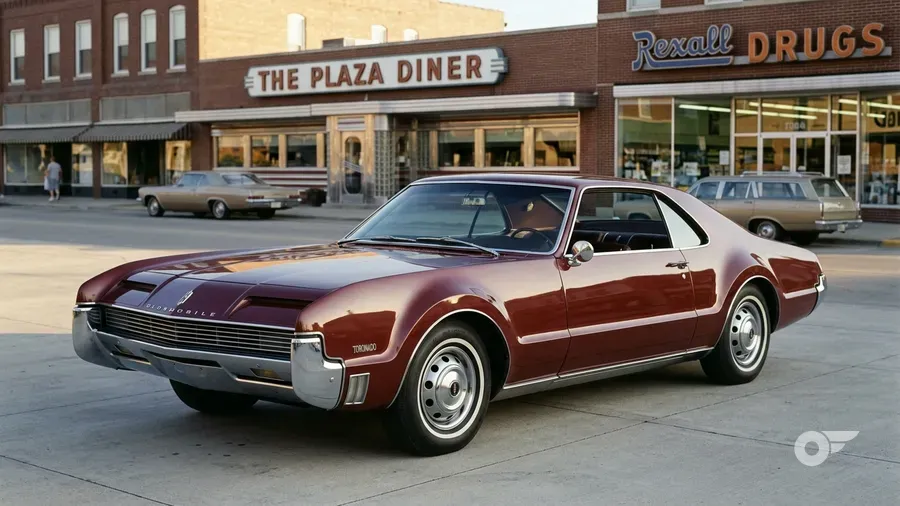
The 1968 car reads as a scaled-down full-size Oldsmobile, and that was deliberate. Stan Wilen's studio kept the division's formal vocabulary on an intermediate body: a split grille with vertical bars that became an Oldsmobile signature for the next decade, a long hood over the 112-inch two-door wheelbase, and a coke-bottle flank creased more softly than the Pontiac and Buick versions of the same shell. Two rooflines carried the range. The Cutlass S used a fastback Holiday Coupe, and from 1970 the Cutlass Supreme got a formal notchback with a squared-off rear quarter. That is the roof that sold. Vertical taillights arrived for 1969 and stayed. The 1970 Rallye 350 is the outlier and the most forward-looking thing here: Sebring Yellow over urethane-coated bumpers finished in the same colour, black and orange decals, a blacked-out grille and yellow-painted wheels. Body-coloured bumpers looked strange to 1970 dealers and looked normal by 1980. The Vista Cruiser kept its raised rear roof but swapped the split skylight of the previous car for a single piece of glass.

Motorsport pedigree

There is no factory road-racing record here, and the reason is corporate. GM's January 1963 ban on factory competition was still in force across this entire generation, so Oldsmobile's involvement had to be arranged at arm's length and aimed at the drag strip, where a dealer could carry the work. That is where the Cutlass actually ran. Oldsmobile backed a five-car W-31 effort through Smothers Brothers Racing in 1968 and 1969. Jim Waibel campaigned the King Oldsmobile-sponsored 1969 Cutlass S convertible in NHRA G/Stock, cut the ribbon at Gainesville Dragway and ran the inaugural Gatornationals in it. The heavier W-30 442s did the rest of the Stock and Super Stock work, and the whole programme reached buyers through the Dr. Oldsmobile print campaign rather than through results. The generation's most public race appearance was ceremonial. A 1972 Hurst/Olds convertible paced the Indianapolis 500 with Jim Rathmann driving, the first pace car to carry an automotive parts manufacturer's name rather than only a carmaker's. Oldsmobile sold 629 replicas of it, 130 of them convertibles.

In culture

The Cutlass never landed a film role anyone remembers, and it did not need one. Its cultural work was done in advertising first and in driveways afterwards. From 1969 to 1971 Oldsmobile ran Dr. Oldsmobile, a mad-scientist character in lab coat and monocle with a crew of assistants, selling the W-machines to buyers who could not afford the insurance on a big-block. The year before, the oldest surviving American car brand had tried to shed its own name with the Youngmobile campaign and slogans like 'Youngmobile thinking' and 'Young it up'. It was a strange thing to say about yourself, and it worked. What followed matters more than either. This body is where the Cutlass became the car most American families would picture if you said mid-size Oldsmobile, and the nameplate went on to build 632,742 cars in 1977 alone. The 1972 Supreme has had a long second life too, turning up regularly as a lowrider build, which for a lot of people is the only 1968-1972 Cutlass they have ever seen up close.

Owning One

Why collectors want it

The Cutlass is the grown-up choice among 1968-1972 GM intermediates, and the market spent decades punishing it for that. A Chevelle is louder, a GTO is more famous, and both cost more today than the equivalent Oldsmobile built on the same floorpan with a better-finished interior. That gap is the argument for buying one. It has been closing, but slowly enough that a sorted Cutlass Supreme hardtop is still the least expensive honest way into a period A-body that needs no excuses made for it.

Inside the generation the hierarchy is easy to read. The 1970 Rallye 350 sits at the top of the Cutlass-badged cars on rarity alone, 3,547 built and every one of them Sebring Yellow. The W-31 cars are the enthusiast's pick, the Cutlass Supreme SX the sleeper, and the 1972 Supreme convertible the last of its kind. Underneath all of that sit ordinary Cutlass S and Supreme coupes with the 350, and they are where the generation earns its keep. They are comfortable, genuinely usable, deeply supported by the aftermarket, and nobody has to be told why they matter.

Which one to look for

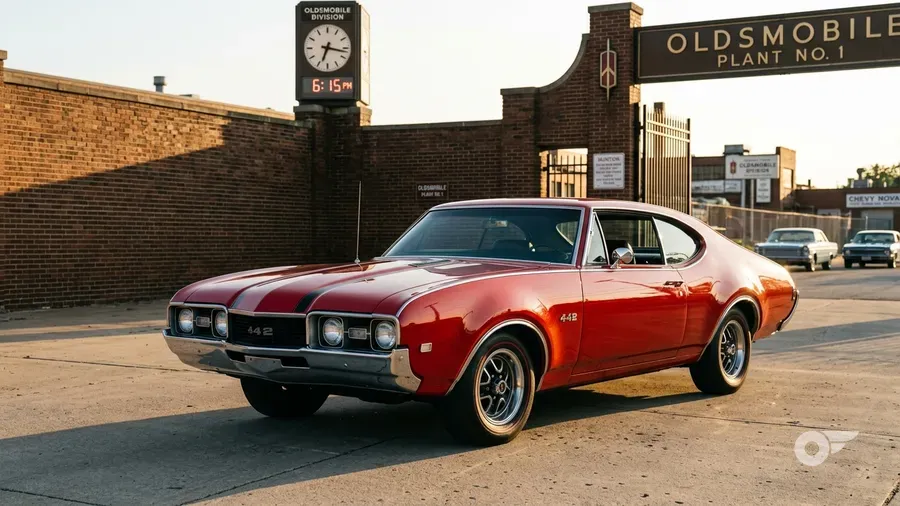
The 4-4-2 has its own page here, so this is the ladder underneath it, and the ladder is more interesting than the badge count suggests. The 1970 Rallye 350 is the one collectors chase: one model year, 3,547 cars, all of them Sebring Yellow including the urethane-coated bumpers and the Super Stock II wheels, with the 310hp four-barrel 350 and the Rallye Sport suspension. Dealers found them hard to sell, which is exactly why they are scarce now. The W-31 is the connoisseur's pick. Oldsmobile called the 1968 version the Ram Rod 350 and meant it: a hot cam, forced-air induction, a fibreglass hood on the 1970 cars, and 325hp claimed from a small-block in a light body. 742 were built for 1968, 913 for 1969 and 1,352 for 1970. The Cutlass Supreme SX of 1970 and 1971 is the underrated one, a 455 in a formal notchback with none of the shouting: 6,404 hardtops and 793 convertibles for 1970, then 1,820 and 357 for 1971, with the hotter W-32 engine in fewer than 900 of them. Everything else is the volume car, and a 350 Supreme hardtop is a genuinely good buy.

Cutlass · 1968–1972

The base Cutlass series sat one step above the F-85 with brighter trim and better seats, offered as a Sports Coupe, a Holiday hardtop coupe and a Town Sedan. Unremarkable by design, and the reason the nameplate outsold everything else Oldsmobile made.

Cutlass Cruiser · 1970–1972

The plainer wagon, introduced for 1970 with a flat roof on the shorter four-door chassis and sold below the Vista Cruiser. Less glass, less money, and the version most likely to have been used as a wagon rather than kept as one.

Cutlass S · 1968–1972

The sporting middle of the range and the body most performance options were ordered on. Used the fastback Holiday Coupe roofline, took bucket seats and a console, and from 1970 could be had with the 455 or the Hurst Dual/Gate shifter. This is the car the Rallye 350 and most W-31s were built from.

Cutlass Supreme · 1968–1972

The upmarket series, and from 1970 the only one with the formal notchback roof rather than the fastback. It became the volume car of the whole generation and the one that established the Supreme name for the next twenty years. The 1972 convertible was the last Cutlass drop-top; the 1973 Colonnade bodies had no convertible at all.

Cutlass Supreme SX · 1970–1971

A 455 in a Cutlass Supreme with none of the striping or the insurance surcharge, sold as a quiet alternative to the 4-4-2 and given no VIN of its own. Standard Turbo Hydra-Matic 400. The hotter W-32 version of the engine was the one to have.

F-85 · 1968–1972

The entry series, and the one nobody wanted by the end. Plain trim, rubber floor mats and the 250ci six as standard, though the Club Coupe body made it the lightest place to put a W-31 or a Rallye 350. Cut back to a single four-door Town Sedan for 1972 and dropped mid-year.

Hurst/Olds · 1968–1969, 1972

Built by Hurst Performance on Oldsmobile bodies, and in 1968 the way around GM's rule capping intermediates at 400 cubic inches: sell it as a specially trimmed Cutlass carrying a 455 rather than as a 4-4-2. Returned for 1972 on Cutlass Supreme notchback and convertible bodies, and paced that year's Indianapolis 500 with Jim Rathmann driving.

Rallye 350 · 1970

One model year only, and the strangest-looking thing Oldsmobile sold in the period. Every car was Sebring Yellow, including the urethane-coated bumpers and the Super Stock II wheels, with black and orange decals and a blacked-out grille. Underneath was the 310hp four-barrel 350, a Force-Air hood, dual exhaust and the Rallye Sport suspension. Aimed at young buyers priced out of big-block insurance, and hard for dealers to shift at the time.

Vista Cruiser · 1968–1972

The long wagon, on its own 121-inch wheelbase with the raised rear roof section that gives it its name. The second-generation car replaced the split skylight of the 1964-1967 model with a single piece of glass. Available with the 400 in 1968-1969 and the 455 from 1970, which makes it the most usable fast Oldsmobile of the period.

W-31 · 1968–1970

Oldsmobile's small-block answer to the big-block arms race, sold as the Ram Rod 350 in 1968 before the decals changed to plain W-31 badges for 1969. Hot cam, forced-air induction and 325hp claimed from 350 cubic inches in a light F-85 or Cutlass S body, with a fibreglass hood on the 1970 cars. The connoisseur's pick of the Cutlass-badged performance cars.
What owning one is like

Corrosion is the whole story and everything else is maintenance. The rear window channel is where it starts, and because the water goes into the trunk rather than onto the floor, a car can look sound while the drop-offs behind the rear wheels have already gone. Lower quarters, wheel arches, floor pans, cowl seams and the frame near the suspension mounts follow in that order. Northern cars are worse, and vinyl-top cars are worse again. The drivetrains are not the problem. Oldsmobile V8s are heavy, conservatively built and long-lived, and the Turbo Hydra-Matics behind them are among the toughest automatics GM ever made. What they do is leak, because nobody sealed an engine properly in 1970, and they run hot when a fifty-year-old radiator and a tired fan clutch are left alone. The nylon-toothed cam gear in the original timing set sheds teeth with age and is worth changing before it picks its own moment. Trim is the quiet frustration. Mechanical parts are everywhere. A correct Cutlass Supreme grille surround in good condition is not.

Upkeep & parts

This is one of the better-supported old cars in America, and the platform is the reason. Everything the Cutlass shares with the Chevelle, Skylark, GTO and Monte Carlo, which is most of the chassis, suspension, brakes and floor structure, is reproduced by several suppliers at several price points. Original Parts Group, RestoParts and the specialist panel makers cover floor pans, trunk sections, rockers and the rear window channel repair pieces this body specifically needs, and Ron's Classic Cutlass keeps a warehouse of used and NOS Oldsmobile parts for the things nobody reproduces at all.

Budget with that split in mind. Sheet metal and mechanical work are affordable, while correct Oldsmobile-specific trim, emblems, interior soft parts in the right colour and W-machine hardware are where the money quietly goes. Serious structural rust still means patch panels and fabrication rather than a new shell.

The community is deep and easy to reach. The Oldsmobile Club of America has run for more than four decades with several thousand members and a monthly magazine, and ClassicOldsmobile.com carries an active forum with its own Cutlass, 442 and Hurst/Olds sections.

Country of origin
USA
Class
Muscle
Production years
1968–1972
Units built
~1.5 million
Model
Cutlass
Nickname
No nickname ("Ram Rod 350" names the 1968 W-31 option specifically, not the generation)
Body
Sedan, Coupe, Convertible, Wagon
Layout
Front-engine, RWD
Engine
250ci Rocket I6 (155hp, 1968-1971); 350ci Rocket V8 2-barrel (250hp); 350ci Rocket V8 4-barrel (310hp); 350ci W-31 V8 (325hp, 1968-1970); 400ci Rocket V8 (290hp L-65 Turnpike Cruising 2-barrel, 325hp automatic and 350hp manual 4-barrel, 1968-1969); 455ci Rocket V8 (320hp in the Cutlass Supreme SX and 365hp elsewhere, 1970; 340hp, 1971); 455ci Rocket V8 (250hp and 270hp SAE net, 300hp in W-30 form, 1972). Figures are gross through 1971 and SAE net for 1972.
Transmission
3-speed manual (column and floor shift); 4-speed manual; 2-speed Jetaway automatic (1968-1969); Turbo Hydra-Matic 350 3-speed automatic (from 1969); Turbo Hydra-Matic 400 3-speed automatic
Designer
Stanley "Stan" Wilen (chief designer, Oldsmobile studio, under GM design VP Bill Mitchell)