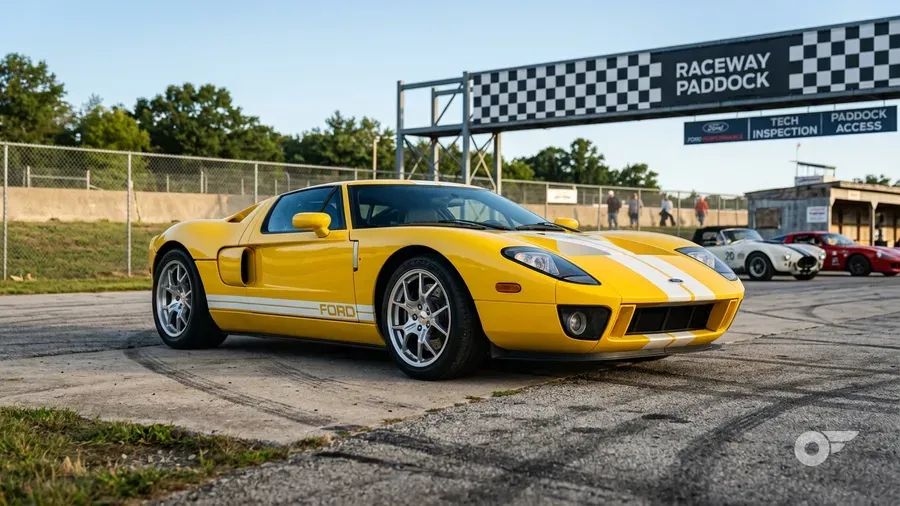
Ford GT 1st Gen
USA·Exotic·2005–2006

The defining attributes and collector status that make this car garage-worthy.


Rated 1 to 10 on the traits that matter for owning, driving, and holding on to a car like this.
Demand tier, price trend, and typical values by condition. Our own assessment, not a quoted valuation.
Values as of August 2026.
What anyone seriously considering this car should know first.
Cars from the same manufacturer family, like platform siblings or shared-era relatives.
Cars from other manufacturers that competed for the same buyers when new.
The development programme that produced the Mk IV. An aluminium honeycomb tub, radical for 1966, wrapped in bodywork that was still being resolved. Ken Miles was killed testing one at Riverside on 17 August 1966, and the reworked shape that followed became the Mk IV.
The original Slough-built car and the one that bookends the whole story. Sheet-steel monocoque, small-block Ford behind the driver, starting with the 4.2-litre alloy V8 and moving through the 289 to the 302. It failed to finish Le Mans in 1964 and 1965, then won it outright in 1968 and 1969 in John Wyer's hands once the rules banned the big engines and made a five-year-old design eligible again. Some were built or converted to road specification.
The 1966 car. Essentially the Mk I tub carrying the 7.0-litre 427 FE, with a Kar Kraft T-44 four-speed built specifically to survive behind it. Ford took eight Mk IIs and five Mk Is to Le Mans in June 1966; three finished, first, second and third. Chassis GT40P/1046 took the win with Bruce McLaren and Chris Amon and is the most expensive GT40 ever sold.
The road car, and the one nobody wanted at the time. Round headlights instead of the racer's oblong units, a 289 detuned to a rated 306hp, softened suspension, a more habitable cabin and a rear deck extended to make room for luggage. It looks awkward next to a Mk I and it is now valued precisely because so few were built.
The American answer, and a different car under the skin. Built on the J-car's aluminium honeycomb tub with a longer nose, a new roofline and a Can-Am style tail, drawn by Roy Lunn's Dearborn team and assembled by Kar Kraft at Brighton, Michigan. Dan Gurney and A.J. Foyt won Le Mans with one in 1967, covering 388 laps and 5,232.9km, the only Le Mans victory with an American chassis, engine, team, drivers and tyres.