Octane Files
Explore CarsFerrari 330 P4

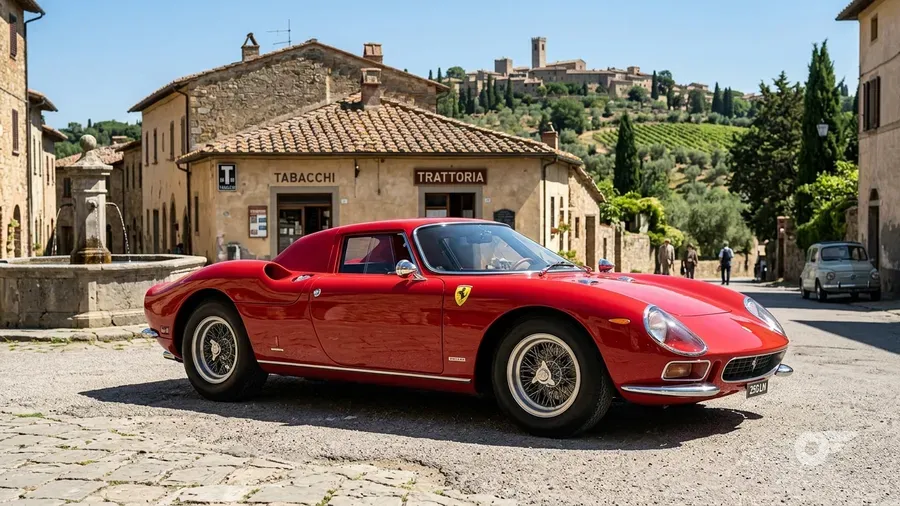
Ferrari 330 P4

Overview

Ford beat Ferrari at Le Mans in 1966 and staged the win as a three-abreast photograph that ran in every newspaper on earth. The 330 P4 is what came back the following February.

Mauro Forghieri had been given a free hand over the winter, and the car that appeared was the previous year's P3 rethought around a new cylinder head: three valves per cylinder, two inlet and one exhaust, taken from the engine Ferrari had just won the Italian Grand Prix with. Compression went to 11:1, Lucas injection stayed, and the 3,967cc V12 made 450hp at 8,000rpm. The tub, tubular steel with riveted alloy panels and a fibreglass centre section, came out at 792kg, 58kg lighter than the P3's.

Three were built new. A fourth car, chassis 0846, was the surviving P3 spyder converted to the same specification, which is why the total of four needs a footnote every time it is written.

The season then ran to plan for exactly one race. At Daytona the three leading Ferraris slowed and crossed the line side by side. Monza followed, then second and third at Le Mans, then the championship at Brands Hatch. Then the FIA capped prototypes at three litres and the P4 had nowhere left to go.

Distinctions

The defining attributes and collector status that make this car garage-worthy.

Legend
A car that transcended the hobby, known far beyond the people who drive them.
Poster Car
The car on the bedroom wall, the one people dreamed about before they could drive.
Octane Files Select
Renowned for its history, engineering, or cultural weight.

Collectibility scorecard

Rated 1 to 10 on the traits that matter for owning, driving, and holding on to a car like this.

Desirability
10/10
Rarity
10/10
Driving thrill
10/10
Investment trajectory
9/10
Usability
1/10
Ease of restoration
1/10
Cultural impact
8/10
Electronic dependence
Fully analogHeavily electronic

Nothing on this car computes anything. The Lucas system is mechanical fuel injection, a metering unit driven off the engine feeding slide throttles, and the ignition is twin Marelli distributors firing two plugs per cylinder. Throttle, clutch, gearchange and the Girling discs are direct linkages with no assistance anywhere in them. The only electricity that matters is the spark, the fuel pumps and, at Le Mans, the lights. Every input a driver makes arrives at the car exactly as he made it.

Market data

Demand tier, price trend, and typical values by condition. Our own assessment, not a quoted valuation.

Demand tier
EntrySolidHighBlue-chip

The proven elite. Values are established, liquid, and defended at every auction.

Value trajectory
AppreciatingStableCooling

Values are holding steady. What you pay today is what it's worth tomorrow.

Price by condition
Driver
Excellent
Concours

No 330 P4 has ever been sold in public. Chassis 0856 changed hands privately in 2020 with no published figure and the other two survivors have been settled for years, which is why this page carries no price band: a band built from nothing would be an invention. The nearest verified transaction is one tier down. A 1967 412 P, the carburetted customer car, sold for $30,250,000 at Bonhams' Quail Lodge sale on 18 August 2023, the fourth most valuable Ferrari ever sold at auction, and surviving 412 Ps are put at $35m to $45m. A P4 would sit above that. Nobody can say by how much until one is offered, and there is no sign that one will be.

Buyer's guide

What anyone seriously considering this car should know first.

Why it's worth it
Ferrari's answer to Ford, and the car that won the 1967 championship by two points
Callout
Three Ferraris crossed the Daytona line abreast in 1967, and Enzo kept the photograph
What to watch for
Nobody reading this is buying a 330 P4, so the useful version of this guide is about everything else sold as one. Start with the family tree, because the names blur. A 330 P is the 1964 car. A P3 is 1966. A 412 P is the customer P3, fitted with Weber carburettors instead of Lucas injection and deliberately left down on power so private teams could score points without beating the works cars. A P3/4 is 0846, the converted chassis. Only three of the four P4-specification cars still exist in any form. Two of those three spent years as 350 Can-Am cars and were re-bodied afterwards, which means a modern P4 can be a chassis that has worn three bodies. Ferrari Classiche certification and an independently assembled chassis history, built from period entry lists and photographs rather than from the seller's folder, is the only thing that settles what a car actually is. Then there are the replicas, and there are far more of them than originals. Noble alone built a series of them with various engines, sold honestly as what they are. The trouble starts three owners downstream.

The Story

Driving character

No magazine ever tested a P4 and nobody drives one to lunch, so what follows is what the hardware does rather than what a road tester felt. 792kg, 450hp, and a V12 doing its best work between 6,000 and 8,000rpm on three valves per cylinder and slide throttles that open in a straight line. There is no torque curve to hide behind. Lucas mechanical injection of this era wants heat and revs, so below about 4,000rpm the car is merely quick and slightly sullen, and above it the thing becomes something else entirely. The ZF five-speed sits behind the engine with a triple-plate Borg and Beck clutch that has one job and no interest in traffic. Ventilated Girling discs moved outboard at all four corners for 1967, so the pedal has more to work against than the P3's inboard rears gave. Firestones on 15-inch Campagnolo magnesium wheels, an inch and a half wider at the back. Geared for close to 200mph down the Mulsanne, it was still slower in a straight line than the seven-litre Fords and quicker than them everywhere else. Amon and Bandini made that trade work for a season.

Design

The bodies were built in Modena by Piero Drogo's Carrozzeria Sports Cars, and the P4 is the shape people mean when they call a racing car beautiful. It is longer, wider and lower than the P3 and yet presents less frontal area. The headlight cowls are faired into the nose instead of bolted onto it. The screen is lower. The tail is a single clamshell with the spoiler formed into its trailing edge rather than added afterwards, and a large rectangular vent in the back gets hot air out and the spare wheel in. What makes it work is the tension between the two ends: a nose that tapers to almost nothing, hindquarters swollen around the rear tyres. Both berlinetta and spyder bodies were used in 1967, sometimes on the same chassis a fortnight apart. The compliment it has been paid since is unusual. In 2006 James Glickenhaus had Pininfarina rebody an Enzo as a modern P-series car, the P4/5, with Jason Castriota leading the design. Ferrari was cool on the idea at first and ended up writing the result into its own history.

Motorsport pedigree

One season, seven months, and the whole reason the car exists. Daytona, 4 and 5 February 1967. Ford brought six factory cars and lost them all to seals and transaxles. With half an hour left the three leading Ferraris slowed to cross the line together: 0846 first with Bandini and Amon, the sister P4 of Parkes and Scarfiotti three laps behind, NART's 412 P another 26 laps back. It was the answer to Ford's staged finish at Le Mans the year before, and Enzo kept a copy of the photograph. Monza followed, Bandini and Amon again. At Spa a lone P4 finished fifth. At the Targa Florio, Vaccarella crashed 0846 out of the lead. Bandini died at Monaco in May, which is why Amon partnered Vaccarella at Le Mans. Le Mans belonged to Ford, Gurney and Foyt taking the Mk IV. Behind them Scarfiotti and Parkes brought a P4 home second and Mairesse and Jean Blaton a third; 0846 caught fire and did not survive. Amon and Stewart then finished second at the Brands Hatch BOAC 500 behind the Chaparral, and that was enough. Ferrari took the 1967 championship with 34 points, two clear of Porsche.

In culture

The Daytona photograph did more for this car than any of its results. Three Ferraris side by side, shot by the American wire services, hung in Enzo Ferrari's office for years and has been reproduced ever since as the moment Maranello answered Dearborn. Ferrari liked the race enough to name a car after it. The 365 GTB/4's project codename honoured that finish, the name leaked before launch, Enzo cancelled it in temper, and everybody has called the car the Daytona ever since. The P4 has also been copied more thoroughly than almost any other racing car. Noble built a series of replicas with various engines in them and was not the only firm to try. A shape built four times ended up on a great many driveways. In 2006 the tribute ran the other way. An Enzo was re-bodied by Pininfarina as the P4/5 for a collector who had spent years around P-cars, shown at Pebble Beach, and adopted by the factory afterwards. Forty years on, Ferrari was still borrowing from a car it had built four of.

Rivals

Cars from other manufacturers that competed for the same buyers when new.

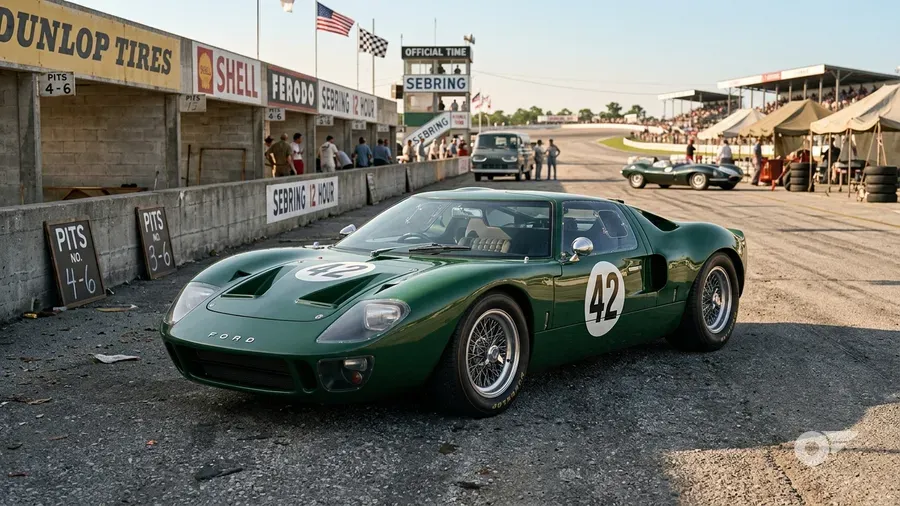
Ford GT40 Mk I–IV

Ford GT40 Mk I–IV

USA·Exotic·1964–1969

Owning One

Why collectors want it

Four cars, and you cannot have any of them. That is the beginning and the end of the P4's collectibility, so it is worth being precise about what survives.

Chassis 0846 burned at Le Mans and was scrapped; Ferrari's books record it as no longer existing. 0858 and 0860 were both cut about by the factory into 350 Can-Am cars and given P4 bodywork again later. Only 0856 has never been anything else, and it changed hands privately in 2020 with no published price.

So there is no P4 in the market and there never has been. What the market does have is the tier below. A 1967 412 P, the carburetted customer version built on a P3 chassis, sold for $30,250,000 at Bonhams' Quail Lodge auction on 18 August 2023, which made it the fourth most valuable Ferrari ever sold at auction. Surviving 412 Ps are put at $35m to $45m.

Underneath the arithmetic is the reason people care. This is the last four-litre Ferrari prototype, from the last season before the rulebook shrank, and it beat Ford in front of an American crowd.

Which one to look for

The hierarchy here is chassis by chassis rather than specification by specification, because there is only one specification. 0856 is the one. Built new as a berlinetta, cut down to a spyder by the factory for Brands Hatch in 1967 and never altered again: no Can-Am conversion, no later re-body. It sold to a new owner in 2020. 0858 and 0860 are the pair the factory turned into 350 Can-Am cars at the end of 1967 and sent to America. Both were given P4 bodywork again afterwards, 0858 as a berlinetta and now in German ownership, 0860 as a spyder in the early 1970s and still with the same French family. Genuine chassis, interrupted lives. 0846 is the ghost, and the most successful of the four. Built in 1966 as the only P3 spyder, upgraded for 1967, first at Daytona, then burnt at Le Mans and scrapped by the factory. Below the P4s sit the four 412 Ps, run by NART, Scuderia Filipinetti and Maranello Concessionaires. They are the cars that actually change hands, and the only realistic way into this family.

What owning one is like

Three people own one of these, and their problems are not ordinary ones. A 1967 prototype was built to last twenty-four hours and then be rebuilt. The V12 is a dry-sump racing engine on Lucas mechanical injection, which wants setting up by someone who has done it before and wants running properly rather than gently. The magnesium wheels are period castings and anyone using the car treats them as consumables. Inside the riveted aluminium and steel structure sits a fibreglass centre section, repairable but only by people who know what was original. Then there is the question that follows every P-car: what exactly is it. Two of the three surviving chassis spent time as 350 Can-Am cars and wear bodywork fitted later. That is documented and accepted, and it means the paperwork matters more than the panels do. The consolation is that these cars are not hidden. 0858 was on show at Rétromobile in 2020, and P-cars of this generation turn up at historic meetings rather than sitting in climate-controlled storage. For a four-car model, being seen at all counts as generous.

Upkeep & parts

There is no parts catalogue for a car built four times. Everything is made, and it is made by a short list of people.

Ferrari Classiche in Maranello holds the factory records and is the only body that can certify what a car is, which on a P-car is worth more than any rebuild. Outside the factory, the specialists who handle Ferrari competition machinery of this generation are a handful of firms in Britain and Italy; DK Engineering and GTO Engineering are the names that recur.

Budget is the wrong frame. The engine is a four-litre V12 with three-valve heads unique to these cars, so a rebuild is a fabrication exercise before it is a machining one, and Lucas mechanical injection is a specialism kept alive by the historic racing trade rather than by any supplier.

What actually protects the car is documentation. Period photographs, entry lists, a chassis history assembled properly and independently. On something this rare, provenance is the maintenance item that never stops needing attention.

Country of origin
Italy
Class
Sports
Production years
1967–1967
Units built
4
Model
330 P4
Nickname
No nickname
Body
Coupe, Spider
Layout
Mid-engine, RWD
Engine
3,967cc Colombo-derived V12, three valves per cylinder, Lucas fuel injection, 450hp at 8,000rpm
Transmission
ZF 5-speed manual
Designer
Piero Drogo (Carrozzeria Sports Cars, bodywork), Mauro Forghieri (engineering)