Overview
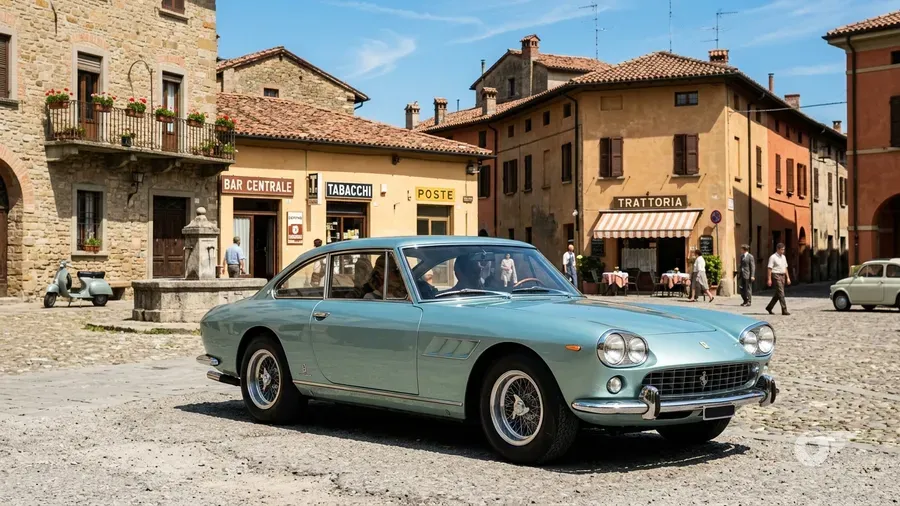
The 330 America existed to solve a problem Ferrari didn't want to wait out. By late 1963 the 330 GT 2+2, a properly redesigned four-seat grand tourer, was still being finished, but the outgoing 250 GT/E's three-litre V12 was starting to feel modest against newer rivals. Ferrari's answer was simple and quick: drop the new four-litre V12 destined for the 330 GT into the existing 250 GT/E Series 3 body and chassis, badge it 330 America, and sell it for a few months while the real replacement caught up. Pininfarina's steel body barely changed, a small script badge on the boot lid the only visible clue anything was different. Underneath, the new 4.0-litre engine gave 300hp against the outgoing car's 235hp, a genuine step up in torque and effortless high-speed cruising. Only 50 were built between late 1963 and spring 1964, making it one of the shortest production runs and rarest four-seat Ferraris of the entire decade, purely because it was never meant to last.
Distinctions
The defining attributes and collector status that make this car garage-worthy.
Collectibility scorecard
Rated 1 to 10 on the traits that matter for owning, driving, and holding on to a car like this.
Entirely mechanical, in keeping with every Colombo-descended Ferrari V12 of this era. Weber carburettors, coil-and-distributor ignition with mechanical advance, and a conventional four-speed manual gearbox make up the whole drivetrain. There is no power assistance for steering or brakes and nothing electronic anywhere in the car for a computer to manage, even in principle.
Market data
Demand tier, price trend, and typical values by condition. Our own assessment, not a quoted valuation.
A dependable market. Well-kept cars hold their value and find ready buyers.
Values are holding steady. What you pay today is what it's worth tomorrow.
The 330 America trades well below the marque's blue-chip cars, which fits a model whose whole identity is looking almost exactly like a cheaper car underneath. The Classic Valuer's own data puts an average-condition car at roughly 339,905 pounds, with the highest recorded sale at 361,444 pounds. That is a tight band for a 60-year-old Ferrari, reflecting steady but unspectacular demand rather than the kind of speculative swings seen on the marque's more famous nameplates. With only 50 built and as few as 30 believed to survive in original form, transaction volume is naturally thin, and the market has stayed broadly flat rather than moving sharply in either direction in recent seasons. That thinness cuts both ways for a buyer: it is hard to find one for sale at all, but a genuinely documented, original example rarely sits on the market for long once it does surface, and patient buyers tend to be rewarded more than aggressive ones at this end of the Ferrari market.
Values as of August 2026.
Buyer's guide
What anyone seriously considering this car should know first.
The Story
Driving character
The 330 America drives like a 250 GT/E with real extra shove. The four-litre V12 pulls with noticeably more torque than the three-litre unit it replaced, which shows up most on the open road: effortless high-speed cruising and easier overtaking, rather than a dramatic change in outright character. The four-speed manual and the car's general road manners carry over from the 250 GT/E almost unchanged, since the whole point of the exercise was a bigger engine in an unaltered car, not a reworked driving experience. Steering and brakes are entirely unassisted, as on every Ferrari of this era, so the car asks for real physical input at low speed even though it settles into an easy, unhurried rhythm once rolling. It rides and steers like a comfortable, well-mannered 1960s Ferrari grand tourer built to cover ground with four seats and real luggage space, not a sports car, and that comfort-focused character is exactly what its buyers wanted in period and what makes it a genuinely usable classic today.
Design
There is almost nothing to distinguish a 330 America from a Series 3 250 GT/E at a glance, and that is the whole design story. Pininfarina's steel body, aluminium only on the bonnet and boot lid, carried over unchanged from the outgoing car, and the only visible clue to what's actually under the hood is a small America script badge on the boot lid that not every source agrees was fitted consistently across all 50 cars. This wasn't an oversight. Ferrari needed a stronger engine in showrooms immediately and a genuinely redesigned body was already coming with the 330 GT 2+2, on a chassis stretched roughly 50mm longer, so spending design effort on a car built to sell for a single season would have made no sense. The 330 America is a rare case of a Ferrari whose design brief was explicitly to look like nothing had changed, which is exactly why so few casual observers today would recognise one on sight.
Motorsport pedigree
The 330 America has no motorsport history, and there isn't a mystery behind that absence the way there sometimes is on other Ferraris. It was conceived purely as a stopgap road car, built to bridge two four-seat grand tourers while a proper replacement was finished, and Ferrari's competition attention in this exact period was fully occupied by the 250 GTO and the earliest 250 LM development work. No works or privateer competition programme was ever built around the 330 America, and none would have made sense for a four-seat touring car built for comfort rather than a category with any competition class attached to it. The car's stablemate 250 GT/E, which it directly replaced, has the same clean sheet: a genuinely comfortable, well-equipped grand tourer built for owners who wanted a Ferrari badge and four real seats, not a lap time, and the 330 America inherited that identity along with the engine bay it borrowed.
In culture
The 330 America has essentially no independent cultural footprint, and that follows directly from what it is: a short-run stopgap model that looked almost identical to the car it replaced, sold for a single season to buyers who wanted more engine rather than a new identity. It never appeared as a signature screen car, never anchored an advertising campaign, and isn't the subject of the kind of enthusiast folklore that surrounds the GTO or the 250 LM. Its story belongs entirely to specialist Ferrari history and to the small community that tracks early-1960s four-litre V12 Ferraris specifically, for whom its very obscurity, and its real rarity, is the whole point of paying attention to it at all. That a car this scarce can still be found and researched today, chassis by chassis, is itself part of the appeal for the people who collect this specific corner of Ferrari history, and dedicated enthusiast research has done more to keep the model's story alive than any period publicity ever did.
Related cars
Cars from the same manufacturer family, like platform siblings or shared-era relatives.
Rivals
Cars from other manufacturers that competed for the same buyers when new.
Owning One
Why collectors want it
The 330 America's whole case rests on being genuinely, deliberately rare: only 50 built across a few months in late 1963 and early 1964, and specialist estimates suggest as few as 30 survive today in original form. That scarcity comes from the car's own reason for existing, a short-term fix rather than a planned model, which means there was never a large production run to draw from in the first place. For a buyer, it offers something specific: 250 GT/E elegance and usability with a genuinely stronger, torquier engine, in a package rare enough that most Ferrari enthusiasts will never see one in person. It sits below the marque's true blue-chip cars in price precisely because it looks so similar to the 250 GT/E it's based on, which is exactly the gap that makes it interesting to buyers who know what they're looking at and want real scarcity without GTO money attached.
Which one to look for
There is one specification, built for one short window, which makes this one of the simpler cars in the whole 250-adjacent Ferrari family to research: no trim levels, no factory competition variant, no notable one-off body. The only meaningful distinction among the 50 cars is condition and originality, since so few survive unmodified, and a handful were fitted with the small rear America badge while some references suggest not every car carried it consistently. Coachwork details that did carry over unchanged from the 250 GT/E, chrome wire wheels as a period option, the same steel body with aluminium bonnet and boot lid, are worth confirming against factory records rather than assumed present just because a car looks correct. Buyers shopping this model are really shopping for the best-documented, most original example they can find, not choosing between different factory configurations the way they would on a 275 or a 330 GT 2+2.
What owning one is like
Mechanically the 330 America is as forgiving as any early-1960s V12 Ferrari, sharing most of its running gear with cars built either side of it, so parts knowledge and specialist familiarity carry across easily. The Colombo-descended four-litre V12, its Weber carburettors and its four-speed manual are all well understood by specialists who work on this era of Ferrari generally, not just this specific model. The real issue is scarcity rather than mechanical fragility: with only 50 built and perhaps 30 surviving in original form, sourcing model-specific trim, badging or interior pieces can mean a longer search than on a more common Ferrari of the same period. Rust follows the same pattern as every steel-bodied Pininfarina Ferrari of the era: sills, floors, boot floor and lower rear wings are the places to check first, along with the usual attention a decades-old wiring harness and its connectors deserve on any car this age.
Upkeep & parts
Because the 330 America shares its chassis with the 250 GT/E and its engine with the early 330 GT 2+2, most mechanical parts and specialist knowledge come from that wider pool of early-1960s Ferrari V12 expertise rather than from any dedicated 330 America supply chain. A dedicated enthusiast site, ferrari-330-america.com, tracks known surviving cars and their history, which is genuinely useful given how few of the 50 built are believed to remain original. Ferrari Classiche certification is worth pursuing given how much of this car's appeal rests on rarity and originality rather than outright performance. Budget for patience over cost when sourcing model-specific trim pieces, since the mechanical side of ownership is no harder or more expensive than any comparable classic V12 Ferrari of the period, and a specialist who knows the 250 GT/E and early 330 GT well can service this car with total confidence, even without having worked on this exact badge before.