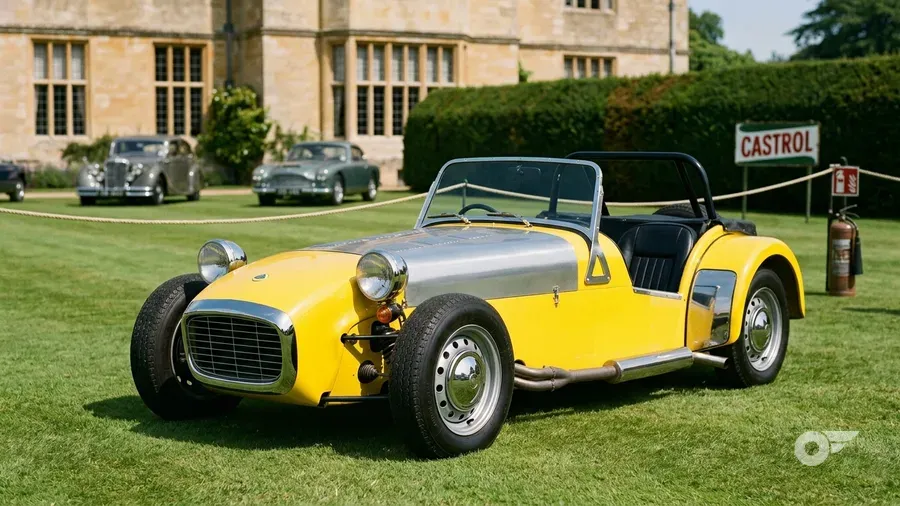
Lotus Seven
UK·Sports·1957–1972

The defining attributes and collector status that make this car garage-worthy.

Rated 1 to 10 on the traits that matter for owning, driving, and holding on to a car like this.
Demand tier, price trend, and typical values by condition. Our own assessment, not a quoted valuation.
Values as of August 2026.
What anyone seriously considering this car should know first.
Cars from the same manufacturer family, like platform siblings or shared-era relatives.
Cars from other manufacturers that competed for the same buyers when new.
The original. 190bhp from a naturally aspirated 1.8-litre Rover K-series in a car with no bodywork at all, launched for the new millennium and priced under GBP 17,000 at the start. The version that established every idea the model has kept since.
The switch to Honda power, and the version that made the Atom famous. A 2.0-litre Civic Type R engine gave 220bhp naturally aspirated, with supercharged cars running 275 to 300bhp; a 160bhp entry car weighed just 505kg. This is the specification Jeremy Clarkson drove on Top Gear in December 2004.
The long-running middle of the model and where most used buyers land. Honda K20 Type R power, 245bhp naturally aspirated or 300bhp supercharged, on a wider and stiffer chassis with roughly 100mm more shoulder room, a lower seating position and revised engine mounts to calm the vibration. GBP 29,750 when new.
A track-focused limited edition developed with Mugen, Honda's competition arm, at 270bhp and GBP 49,470 each. Sits between the ordinary Atom 3 and the specials, and is one of the harder versions to find.
The hard-edged development of the Atom 3.5, with 261kW from the supercharged 1,998cc Honda in a 550kg car, 0 to 100km/h in 2.6 seconds and 249km/h. Ariel presented one to Avon and Somerset Police in June 2014.
The American car. Announced by TMI AutoTech in October 2014 and hand-built at Virginia International Raceway, it swapped supercharging for a turbocharged 2.4-litre Honda K24Z7 making 365hp and over 300lb ft, with a manual, a sequential manual or a SADEV six-speed sequential with paddles. 0 to 60mph in 2.6 seconds.
Not a facelift but a new car, launched at the Goodwood Festival of Speed in July 2018 with deliveries from June 2019. New chassis, suspension, steering, brakes and aerodynamics, a thicker frame, separate seats and the turbocharged Honda Civic Type R engine at 321bhp. Autocar named it Britain's Best Driver's Car in 2020.
The current extreme version, launched on 13 July 2023. The same turbocharged 2.0-litre Honda tuned to 400bhp and 368lb ft with upgraded cooling, a six-speed paddle-shift gearbox with clutchless upshifts, carbon ceramic brakes, bespoke Ohlins suspension and a CFD-developed aero package. Around 700kg, under 2.7 seconds to 60mph and 170mph. GBP 64,950 plus taxes before options.
The V8, and the top of the model in every sense. A bespoke 3.0-litre flat-plane engine designed by John Hartley making 500hp in a 550kg car, with carbon fibre panels, chromoly wishbones, Alcon four-piston brakes, Dymag magnesium wheels and a SADEV six-speed sequential gearbox. It lapped the Top Gear test track in 1:15.1 on 23 January 2011, the fastest road-legal car the programme had recorded, and held that record until January 2013.